I have a rule for traveling: don’t discuss the host country’s politics. In Istanbul I kept it without effort, because I had nothing to offer a country living under a regime I’d never had to survive. In Portugal the rule held for a different reason — the fight there was over immigration, and Americans know the shape of that argument without knowing its Portuguese grain. Same in Greece. I was a tourist in someone else’s grievance. Tourists should keep their mouths shut.
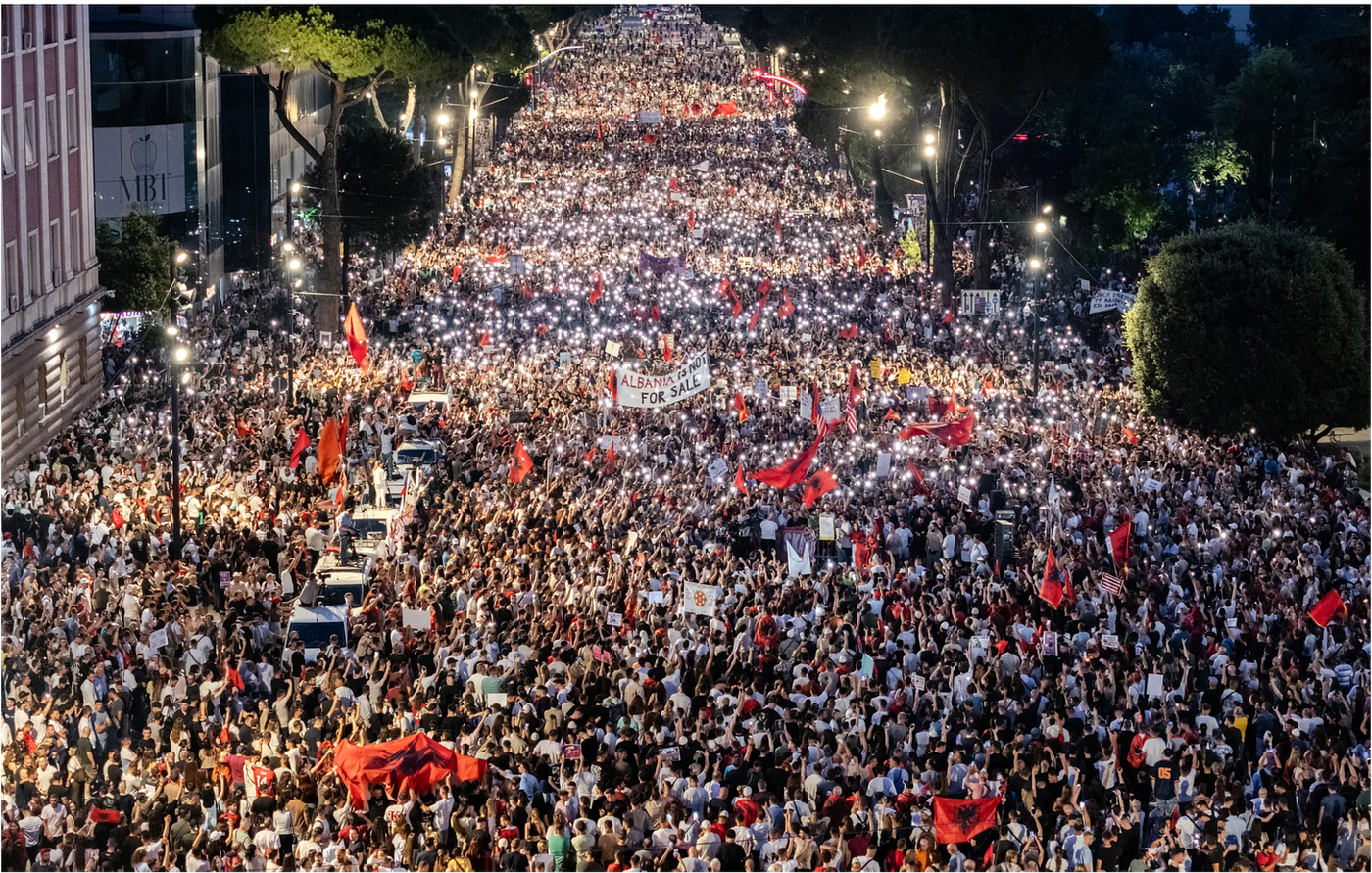
The Albanian situation is different. The protest filling Skanderbeg Square for three weeks now — nicknamed, with a lightness that undersells it, the Flamingo Revolution — was lit by a Trump-family business deal. Jared Kushner’s Affinity Partners, through a strategic-investor designation that lets the Albanian state override property law and environmental protection in one motion, has a path to a 10,000-bed resort on the stunning shores of the Vlorë/Narta Lagoon and Sazan Island. My country’s name is on the deed.
So I’m breaking the rule here, with that justification on the table. What I want to look at isn’t whether the protesters are right — they plainly are, on the merits, about the lagoon, the land seizures, the thirty years of rotating elites who never touched the mechanics underneath. What I want to look at is the question nobody marching in that square has answered yet: if this succeeds, then what?
Two different things are being called success
The protest movement itself doesn’t agree on what winning looks like, and that’s not a flaw so much as an honest description of where things stand. One version of success is narrow and achievable: the Kushner deal collapses, the resort projects get shelved, the “strategic investor” statute and the recent amendments to the Law on Protected Areas get repealed.
That’s a policy win. It requires no one to resign, no election to be called, no new party to form. It just requires the government to conclude that the deal costs more than it’s worth — in tourism cancellations, in EU accession leverage, in the simple exhaustion of governing through a continuous demonstration.
There’s early, unconfirmed signal that Affinity Partners is already weighing a partial withdrawal under that pressure, which tells you the narrow win is not fantasy.
The other version of success is the one the chants are actually asking for. Rama berg, Berisha berg. Berg means prison; Rama is the prime minister, Berisha the primary opposition leader. Many of the protestors want both of them gone, and that’s a different order of problem.
Edi Rama won re-election in May 2025 with roughly 800,000 votes, in a result nobody credible is calling stolen. There is no snap-election mechanism sitting on the shelf waiting to be triggered by crowd size.
Rama has shown no inclination to resign, and structurally he has very little reason to. The opposition he’d be ceding ground to is led by a man who was himself recently under house arrest for corruption, which is precisely why the protesters have refused to be absorbed into Berisha’s camp and have taken instead to chanting “the opposition is us.”
That’s a clean, admirable refusal to trade one set of hands in the till for another. It’s also a refusal that, by design, leaves no one positioned to actually receive power if Rama did step aside.
Those two versions of success don’t lead to the same country a year out. The narrow win leaves the current government in office, chastened, having lost a fight it can frame domestically as a concession to “the people” rather than a defeat — Rama is already rhetorically prepared for this, having spent weeks distinguishing the well-intentioned “flamingos” from the “crows and ravens” he claims are using them.
The wide win, the actual turnover, leaves a vacuum with no candidate, no platform, and no party structure ready to fill it — which in a country with this recent a relationship to single-party rule is not a neutral kind of emptiness.
Why joy isn’t the same as leverage
Every account from the ground, including from people I trust who are there, describes something genuinely remarkable: children coloring protest banners, families sharing supplies and water, vendors selling whistles off carts, drones overhead. The only violence to date was initiated by private security at the construction sites. It is, by every report, a joyful movement. That matters morally. It does not, on its own, function as leverage.
A government doesn’t change policy or cede power because a crowd is large and well-behaved. It changes because the cost of not changing exceeds the cost of changing — and right now, for Rama, that math hasn’t flipped. Tourism cancellations sting but don’t bankrupt a government. International scrutiny is uncomfortable but not disqualifying. EU accession warnings have been issued and ignored before, in Albania and elsewhere.
A movement that is leaderless by principle — that has correctly diagnosed both major parties as part of the same machine and refused to anoint a third option from within either — has protected itself from co-optation at the direct cost of having no one who can sit across a table and name the terms of a deal.
Open-ended moral pressure, sustained for three weeks or three months, asks a government to feel ashamed. Governments that have already weathered thirty years of rotating shame are not moved by more of it.
If the wider turnover is going to happen — not the narrow policy win, but an actual change in who governs — it will need something the square doesn’t currently have: a spearhead, and a message specific enough to act on. Not a single charismatic leader necessarily, but some structure capable of converting crowd size into a defined demand.
That means a platform that says, concretely: repeal the strategic investor law and the amended Protected Areas and Cultural Heritage statutes; force an independent audit of the Kushner-linked land transfers and the broader pattern of “strategic investor” grants; and — the harder ask — push for elections ahead of schedule through whatever constitutional mechanism exists for a no-confidence motion or coalition collapse, rather than waiting on Rama’s goodwill.
Without a named, specific ask like that, the protest has moral clarity and no theory of victory.
The thing the West can actually offer
Here’s where my own country’s involvement cuts both ways. The potential damage is at least nominally American in origin. The available remedy might be too — though not in the form people usually mean when they say it. This isn’t a foreign-aid question, nor should it be. But what does exist are two things money already knows how to find.
One is the unglamorous legal work of documenting the land seizures themselves — Albanian property-rights and rule-of-law organizations that build the case files families need to formally contest a strategic-investor designation. That work doesn’t require a winner to back; it raises the cost of the deal procedurally, seizure by seizure, regardless of who eventually leads anything.
The other is independent investigative reporting — the kind of outlet that traces the offshore ownership and the money-laundering math undergirding the construction. The kind of work that makes a government’s “trust us, it’s strategic” argument harder to make in public.
Neither of those bets rely on a spearhead emerging. Both make it more expensive for the deal to survive, and more possible for a spearhead to emerge with teeth when it does. Moral support is what you offer a movement you admire from a distance. This is how you support one you think might win.
I don’t know which version of success Albania gets, or whether it gets either. I’m going to Tirana next week to watch, not to participate, and I’d tell you I have a confident prediction if I had one. I don’t. What I’d put money on is narrower: a movement this large, this joyful, and this leaderless will not by itself produce the second kind of success.
Happy demonstrations, however large, don’t move an entrenched government off its position. Open-ended demands for “real change” don’t either — they’re easy to agree with and impossible to act on.
If the flamingos want more than a paused construction permit, somebody is going to have to step out of the crowd, say exactly what they want and from whom, and accept the exposure that comes with no longer being anonymous inside two hundred thousand people.
It is not clear to me whether western democratic traditions will ultimately hold in this beautiful, fragile country. How far might this regime go to hang onto power? I told my sons I might have to swim to Greece. I was joking. But I’m not laughing.