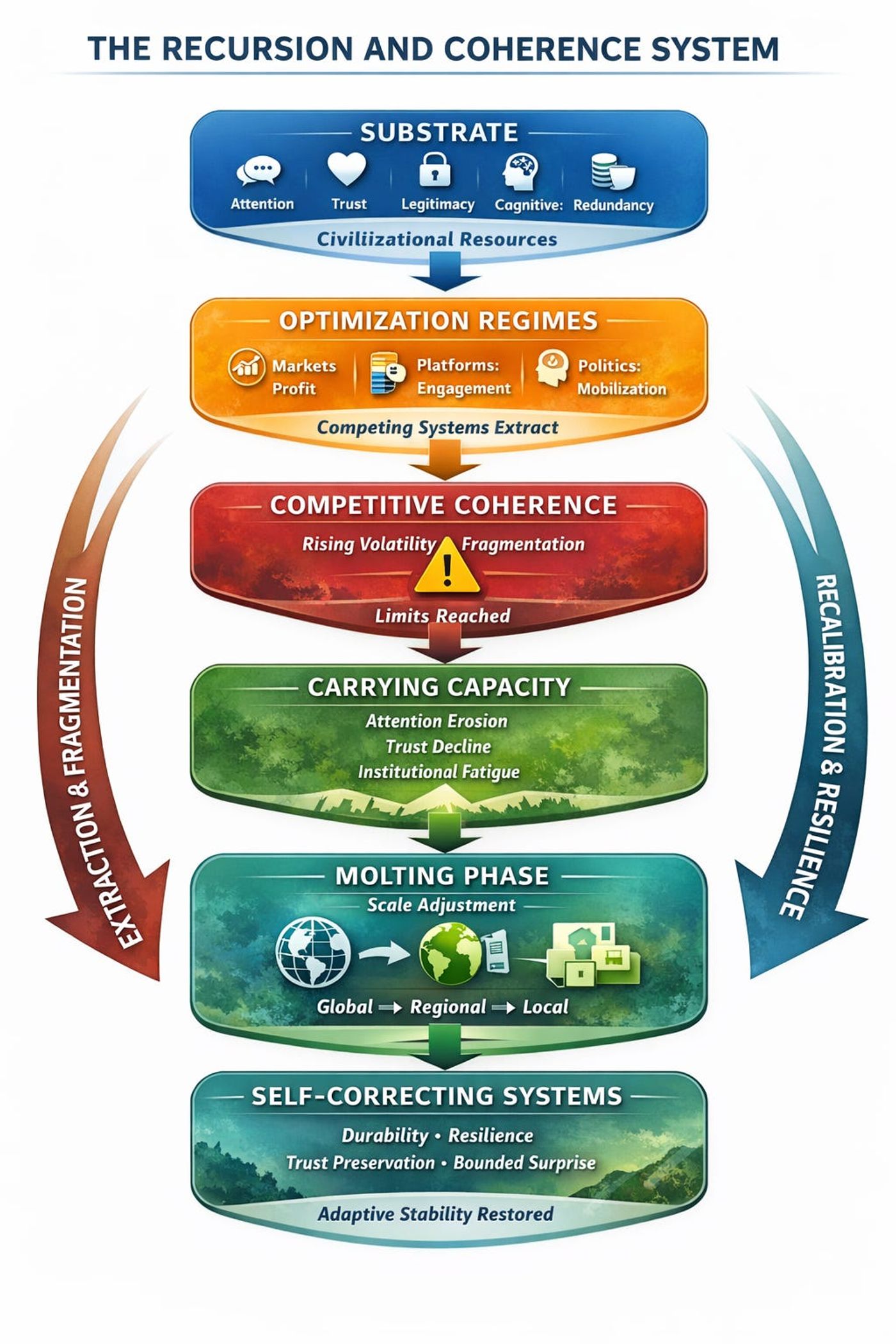
All systems ultimately depend on something quieter than the outputs they measure.
Markets depend on trust.
Platforms depend on attention.
Institutions depend on legitimacy.
Communication depends on shared interpretation.
These are not outputs of the system. They are its substrate—the finite human and institutional capacities that make coordination possible in the first place.
Attention.
Trust.
Cognitive bandwidth.
Legitimacy.
Redundancy.
They are the load-bearing elements of civilization. When they weaken, optimization continues for a time—but the gains become hollow. Eventually the system extracts from the foundation faster than the foundation can replenish itself.
Efficiency collapses not because the system stops working, but because the conditions that allowed it to work have been consumed.
The Volatility Economy
For several decades, volatility produced reliable rewards.
Fast signals generated engagement.
Outrage generated amplification.
Financial markets rewarded speed and leverage.
Political systems rewarded emotional intensity and rapid mobilization.
Whoever moved fastest extracted the most.
For a time this worked. Activity rose across every domain: media, markets, politics, social networks. Systems optimized themselves to generate stronger signals more frequently. But signals only function when they contrast with their surroundings. When everything accelerates, contrast disappears.
Outrage becomes routine.
Engagement fragments.
Attention shortens.
Trust thins.
The system continues producing activity, but the activity yields less. Each spike requires more intensity to achieve the same effect. The substrate begins to fray.
At first the erosion is invisible. Metrics still show growth. Platforms still generate traffic. Markets still trade at scale. But the underlying capacities—attention, trust, shared interpretation—slowly degrade. Coordination becomes more expensive. Communication produces less understanding.
Eventually volatility stops producing gains. It begins to drain the system that sustains it.
The New Instrumentation
Previous civilizations usually discovered these failures only after crisis. Wars, depressions, or political collapses exposed the irreversible weakness of the underlying coordination structures.
Modern societies possess something earlier civilizations lacked: instrumentation.
Large-scale behavioral data now exposes patterns of attention, trust, and coordination in real time. Data collected for commercial or administrative purposes has inadvertently become a diagnostic system for civilization itself.
Three forms of measurement are particularly revealing.
Behavioral Trace Data
Digital systems record how attention actually moves.
For instance, search queries reveal shifts in collective curiosity before institutions notice them. When millions of people begin searching for the same concern, the signal appears instantly in query patterns.
Social platforms reveal how discourse organizes itself. Analysts can observe whether attention distributes across many topics or collapses into cycles of emotionally intense amplification.
Streaming and reading platforms track completion rates and dwell time. These metrics reveal whether audiences sustain long-form attention or increasingly abandon extended material for short fragments.
Taken together, these traces measure something fundamental: the durability of attention. Because attention is a core component of the substrate, changes in these patterns provide early indicators of cognitive strain.
Institutional Trust Signals
Trust once appeared intangible. Today it is measurable across multiple systems.
Longitudinal surveys track public confidence in courts, governments, media, corporations, and scientific authorities. These datasets span decades, revealing slow shifts in legitimacy.
Financial markets measure trust indirectly through risk pricing. When investors demand higher premiums for uncertainty, they are expressing declining confidence in institutional stability.
Digital marketplaces generate similar signals. Ratings systems, dispute rates, and transaction reliability reveal how much verification effort participants must invest to maintain cooperation.
When trust declines, coordination does not stop—but it becomes more expensive.
Systemic Stress Indicators
Complex systems produce recognizable signals when they operate near their limits. Financial markets exhibit volatility clustering when uncertainty spreads. Supply chains develop delays and shortages when coordination buffers disappear. Information ecosystems fragment when shared interpretive frameworks weaken. Political systems display rising polarization and declining cross-party cooperation when legitimacy erodes.
Individually these signals are ambiguous. Together they reveal a consistent pattern: maintaining the same level of coordination requires increasing energy. That pattern is the signature of substrate strain.
The crucial difference from earlier eras is timing. These signals appear before collapse occurs. Whether societies respond to them is another question.
Regional Stabilization
When coordination becomes too fragile at one scale, systems naturally retract to scales where coherence can be maintained. This is not failure. It is a stabilizing mechanism.
Global coordination requires high trust, aligned expectations, and shared interpretive frameworks. When substrate capacity declines, maintaining those conditions becomes brittle and expensive.
Regional systems require fewer supports. Cultural familiarity lowers interpretive friction. Proximity reduces verification costs. Institutions respond faster to local conditions. A durable structure therefore emerges as a layered architecture:
Local capacity — communities and networks that maintain trust at human scale.
Regional coherence — coordination among populations that share cultural and logistical foundations.
Global cooperation — strategic collaboration across regions where substrate conditions allow it.
This structure does not end global exchange. It simply matches scale to carrying capacity. Disruptions in one layer do not automatically cascade through the entire system, and coherence can rebuild locally before expanding outward again.
The Phase Change
If these dynamics continue, the strategic orientation of modern systems may begin to shift. For decades, optimization emphasized extraction—maximum output from available capacity.
A different strategy is now emerging in scattered signals:
- movements toward slower growth and reduced volatility
- renewed interest in traditions that preserve social continuity
- disengagement from hyper-consumption and constant stimulation
- renewed investment in local institutions and networks
Individually these appear cultural or generational. Structurally, they represent something deeper: a shift from optimizing immediate yield to preserving the substrate that makes future yield possible.
Volatility does not disappear. But its role changes. It becomes something to deploy carefully rather than constantly. Systems begin favoring stability not because stability is morally superior, but because instability has become inefficient.
Designing Self-Correction
Optimization systems behave according to the metrics they are given. If metrics reward short-term output, the system will maximize short-term output even when doing so damages the environment it depends on.
A self-correcting civilisation, therefore, requires different measurements. Not the abandonment of optimization—but the expansion of what optimization considers valuable.
Three categories of measurement become central.
Durability
Most modern systems evaluate success on extremely short horizons.
Corporate performance is judged quarterly.
Media performance is judged hourly.
Political success fluctuates with polling cycles.
These time frames encourage behavior that produces rapid spikes in output while ignoring long-term degradation.
Durability metrics extend the evaluation window.
Infrastructure can be measured by expected lifespan rather than initial construction cost. Educational systems can track long-term comprehension rather than short-term test performance. Media organizations can measure sustained audience trust rather than immediate engagement spikes.
Durability metrics reveal a simple distinction: whether a system produces lasting function or merely temporary output.
Cognitive Capacity
Information systems currently reward attention capture rather than attention development.
The easiest way to maximize engagement time is through emotionally stimulating fragments that provoke reaction but rarely require deep thought.
A different measurement approach asks what participation does to the user’s ability to process complexity.
Do people maintain the ability to read long-form material?
Can they follow multi-step arguments?
Does interaction with an information system strengthen or weaken comprehension?
Educational research already measures similar variables through reading endurance and comprehension tracking. 1
Extending these ideas to media and digital platforms would redefine success: not capturing attention, but preserving the audience’s capacity to think.
Redundancy and Resilience
Optimization frequently eliminates slack.
Supply chains minimize inventory.
Organizations reduce staffing buffers.
Infrastructure systems operate close to maximum capacity.
In stable conditions, this improves efficiency. But it also reduces resilience. Without redundancy, small disruptions cascade into systemic failures. Resilience metrics track the ability to absorb shocks without collapse.
Energy grids maintain reserve capacity. Financial regulators require liquidity buffers. Logistics networks measure how quickly supply routes can reroute after disruption.
Systems that maintain redundancy may appear less efficient in the short term, but they remain functional under stress. Measurement makes that tradeoff visible.
Incentives and the Substrate
Measurement alone changes nothing unless incentives follow.
Participants respond to the rewards embedded in a system. If attention capture generates revenue while cognitive degradation carries no cost, the system will continue maximizing attention capture.
Aligning incentives with substrate health means making damage visible.
Financial regulation already does this by requiring banks to maintain capital reserves. Environmental policy does it by forcing polluters to internalize the costs of ecological damage.
The same principle applies to attention, trust, and legitimacy. Systems that erode them should incur visible costs, while systems that preserve them gain reputational, regulatory, or market advantages.
Only then does optimization reinforce the conditions that sustain it.
Disciplined Deviation
Innovation requires deviation from existing patterns.
Without experimentation, systems stagnate.
But deviation must remain bounded by the system’s ability to interpret and absorb it.
This is the principle of bounded surprise.
Creative breakthroughs typically come from individuals who understand a tradition deeply enough to depart from it deliberately. The frame remains visible even as it bends.
Technological and institutional systems require the same discipline.
Financial markets employ circuit breakers to pause extreme volatility. Aviation introduces new technologies through incremental certification. Engineering disciplines demand redundancy and stress testing before deploying new designs.
These constraints do not suppress innovation. They ensure that innovation strengthens the system rather than destabilizing it.
A civilization capable of disciplined deviation preserves both stability and discovery.
The Structural Insight
A self-correcting system does three things:
It measures the health of the substrate that supports it.
It aligns incentives with long-term viability.
It allows innovation while preserving coherence.
Such systems do not eliminate competition, growth, or technological change. They simply prevent optimization from consuming the conditions that make progress possible.
The question facing modern civilization is therefore not whether change will occur.
Change is constant.
The question is whether we can build feedback loops that detect strain early enough to adjust deliberately—or whether we will continue learning through collapse.
Self-correction is possible because humans can observe the systems they inhabit.
Whether we choose to act on what we observe remains the defining test.