I grew up around Atlanta when we had three sports and an attitude about it. Football, baseball, basketball — the holy trinity, non-negotiable. Soccer existed the way certain cousins exist: you were ok with them, so long as they never came to Thanksgiving.
I played intramural soccer in grad school. Was terrible. No skills, no idea what I was doing, which in soccer means you are both useless and dangerous. My strategy was simple: get the ball quickly to someone who knew what to do with it, then put my body in the way of things on defense. It worked well enough. But I recognized, even from that weird effort, that the game was something. The geometry of it. The way it refused to stop.
I filed that away and moved on.
28-3.
February 2017, Houston. The beloved Falcons build a late lead on their way to their first Super Bowl victory - no, wait! - in a slow-motion collapse that only Atlanta sports could produce, they go down in flames. Atlanta hosted the game in 2019 — Patriots again, Rams this time, 13-3. Joyless. Cold. Two years apart, two different kinds of misery.
Atlanta was ready to love something that didn’t humiliate it.
Atlanta United had arrived in 2017 — cheeky, fast, genuinely talented. Gerardo Martino, called Tata, a coach with the bearing of someone who had seen everything and was mildly amused by most of it. Josef Martínez, Venezuelan, electric, league MVP in the championship year. Miguel Almirón — Miggy — a Paraguayan winger so good that Newcastle paid $22 million for him in 2019, a league record, and he eventually came back because Atlanta has that pull.
Affectionately known as the Five Stripes, they drew 70,000 people to watch a sport that had supposedly wasn’t a thing in football country. The Stripes have led MLS in attendance every single season since entering the league. The largest crowd ever to fill Mercedes-Benz Stadium wasn’t a Super Bowl or a concert — it was the 2018 MLS Cup. 73,000 people, for a soccer match, in Atlanta. The games are loud and rowdy. The crowd responses are unique, occasionally clever. The A loves its Stripes.
But United didn’t create the culture from nothing. It revealed what was already there. On any given game day morning during the Premier League season, Brewhouse Cafe, Fadó, Hudson Grille — packed, early, loud. Nearly every Premier League club has an officially recognized fan club in Atlanta. Supporters of Spanish sides, German sides, Italian, French. The underground was extensive and had been running quietly for years before United gave it a public face.
Franklin Foer wrote a book in 2004 called How Soccer Explains the World. His argument, roughly, was that soccer is globalization’s most legible text — that you can read the new world order in the stands, in the transfers, in the ancient hatreds that the beautiful game refuses to dissolve. He traveled stadium to stadium: Glasgow, Milan, Tehran, São Paulo. The world was in the game; the game explained the world.
He didn’t come to Atlanta. Nobody did, then.
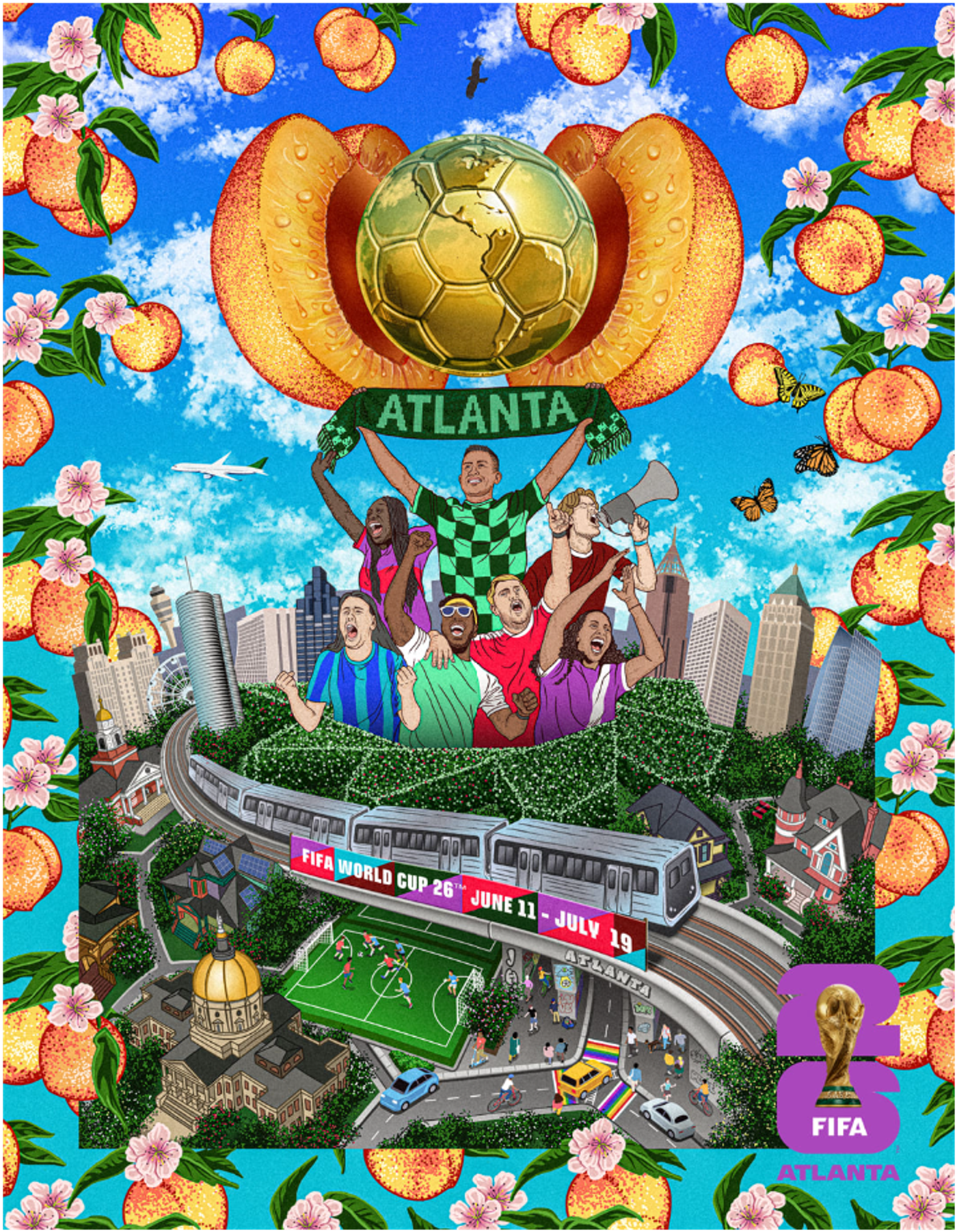
This month, the World Cup is being played in my city. Eight matches at Mercedes-Benz Stadium, which is by any honest accounting one of the finest sports venues on earth. Spain came. Morocco came. DR Congo came, and DR Congo did something there that they had never done before.
The story of soccer in Atlanta is longer and stranger than most people know. It starts not in a stadium but in a granite quarry, in nearby Lithonia, in 1892. Scottish stonecutters from Aberdeen arrived for the granite work and brought association football with them the way you bring a language. They challenged local Irishmen to a match at Piedmont Park. The Irishmen wanted to allow catching. The Scots, being Scots, had strong opinions about it. Said no.
But the Stonecutters played through the 1920s, fielding sides against Army teams from Fort McPherson and, in one of history’s better footnotes, against teams of prisoners from the Atlanta Federal Penitentiary.
1968: The Atlanta Chiefs won the inaugural North American Soccer League title — the city’s first professional sports championship in any sport — and most Atlantans have never heard of it.
Mexican national team matches drew full houses of some 68,000 to the Georgia Dome. The game was there. It just hadn’t announced itself.
United announced it.
What’s happening this month is not just the World Cup in Atlanta. It’s confirmation of a transformation that was already complete. The scale of people filling public spaces for soccer is the data point. Atlanta is now a place where the world comes to play.
Tiny Cabo Verde played cup favorite Spain here a couple weeks ago. Their first World Cup appearance, ever. A rout, one would expect. By the second half, something shifted in the stands — the Cabo Verdeans who had packed into that stadium moving through stages: relief that their team was holding, then disbelief, then the dawning recognition that a draw against Spain was not just possible but happening. They tied 0-0. Damn near won. First point in their World Cup history. They have moved on to the knockout round — the smallest nation ever to reach that stage. The celebration poured into the streets.
DR Congo beat Uzbekistan 3-1 here the other night. It was the best result in the history of Congolese football at a World Cup. They did it in Atlanta, the ostensible capital of black America.
And now they go back. Wednesday, July 1, Atlanta, England versus DR Congo, Round of 32. The English machine — professional, resourced, carrying the full apparatus of a soccer culture that has been perfecting itself for a century — against a team that just wrote a new page of their own story in this town. Sports mirrors life. Or maybe life mirrors sports.
This is a global story written in disappearing ink. It happens, it matters enormously to the people inside it, and then the tournament moves on and the stadium hosts something else and the city goes back to being Atlanta. But for that Wednesday in July, it matters.
Foer’s thesis was that soccer resists globalization’s promises — that ancient hatreds don’t dissolve, that tribalism persists, that the game is a mirror held up to everything we can’t iron out. He wasn’t wrong. But Atlanta offers a counter-reading.
Sometimes a city that had no history with the game becomes the place where other people’s history gets made. The Scots brought it in their boots in 1892. It went underground for a while. Then United brought it back, gave the city Tata and Miggy and Josef to love, and then the World Cup showed up, and the city that once defined itself by three sports became the place where Congo’s greatest moment happened — in the capital of Black America, against the backdrop of a tournament that nobody would have predicted landing here twenty years ago.
I got the ball to someone competent and got out of the way. The city did something similar. Cleared space. Let the game be what it is. It just runs. Whether you’re watching or not.
Real football starts in a couple months :)