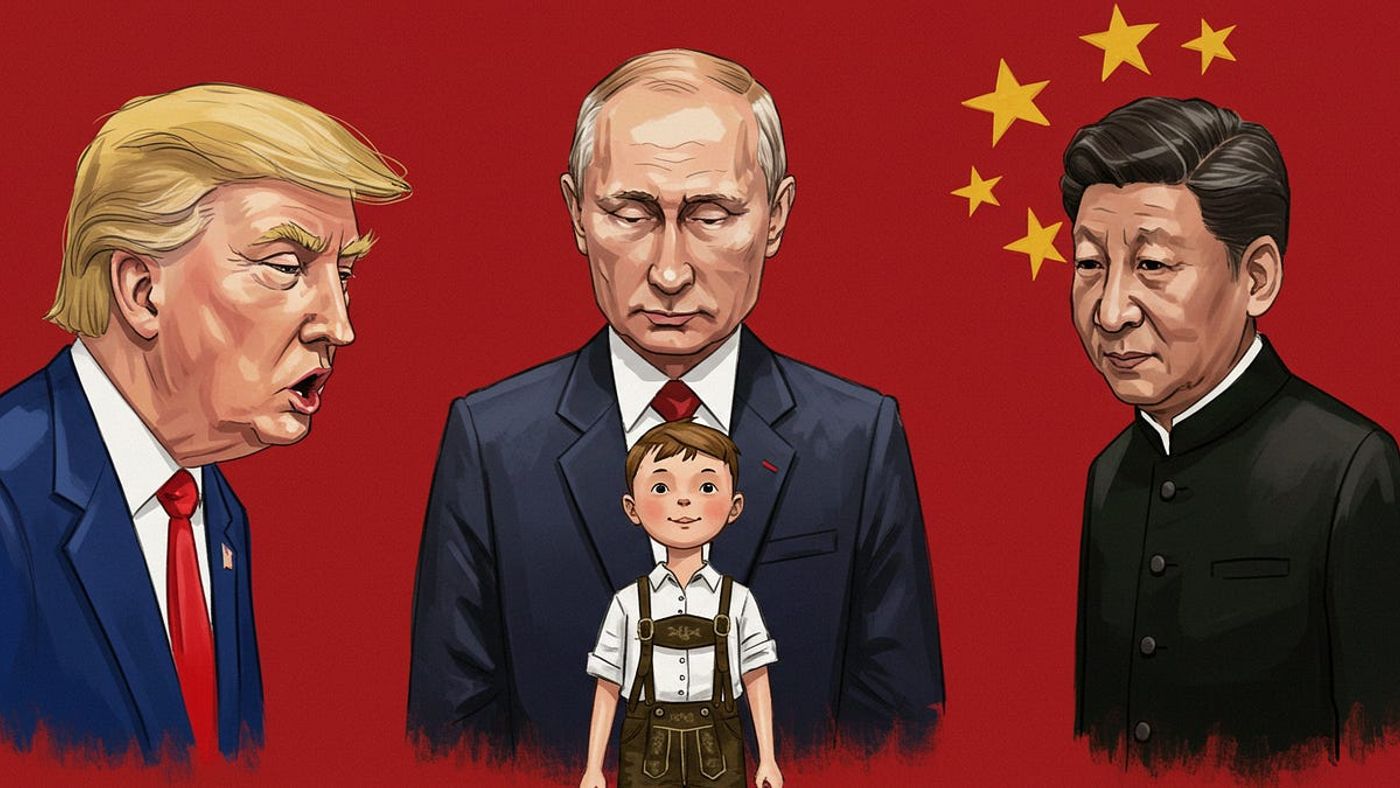
Europe is playing a discordant symphony these days—half funeral dirge, half punk rock opera—with bureaucrats clinging to their librettos while the band in the pit sets fire to the sheet music. Internal bickering, shifting alliances, and a long-distance relationship with America that now feels like a one-sided situationship have left the continent in the midst of a nervous breakdown. But if you listen closely, there’s a strange, underlying harmony—an opportunity, if Europe’s willing to improvise.
The EU: A House Still Standing, But With Smoke in the Rafters
The European Union, once a temple to postwar consensus, now looks more like a startup burning through its Series Z funding while its founders argue over the mission statement. Nationalist provocateurs like Alice Weidel of Germany’s AfD are no longer fringe—they’re stage center, mic in hand, tearing into Brussels with all the finesse of a wrecking ball.
Weidel isn’t here for polite critique. The EU, she says, has “completely degenerated” into a bloated “machine run by overpaid bureaucrats,” choking member states with green regulations, energy policy disasters, and a climate gospel that’s priced German industry out of global relevance. She blames Germany’s economic malaise on everything from the combustion engine ban to the nuclear phase-out, calling them gifts to China and Silicon Valley. Her prescription? Exit, stage right. “Everyone should leave the EU,” she declares—eyes on the door, middle class in tow.
And when it comes to Ursula von der Leyen, Weidel dials it up to eleven—branding her “openly corrupt” over the mysterious Pfizer text messages and hinting that Europe’s elite aren’t just incompetent, they’re self-dealing. It's a damning picture, and for a growing segment of the electorate, it rings uncomfortably true.
Orbán’s Eastern Gambit: Sovereignty With a Side of Sabotage
While Germany debates whether it has a pulse, Hungary is pounding its chest. Prime Minister Viktor Orbán isn’t just surviving—he’s strategizing. With the swagger of a man who’s memorized Brussels’ playbook just to set it on fire, Orbán is positioning Hungary as the nucleus of a revived Visegrád Group (V4) - a nationalist alliance of Hungary, Poland, Slovakia, and Czechia.
His current leverage? The EU’s 2028–2034 budget, which he dismisses as a “Ukraine budget”—a trojan ledger, he argues, funnelling cash to Kyiv while EU citizens are left holding the bag. With unanimous approval required, Orbán has veto power, and he knows it. Hungary’s funds remain frozen, allegedly over rule-of-law issues, but Orbán sees it as a political punishment for noncompliance with the Brussels liturgy.
He’s betting big on allies like Poland’s Mateusz Morawiecki and Slovakia’s Robert Fico to reinforce the V4 and act as a nationalist counterweight to Franco-German hegemony. If they pull it off, Brussels will have to do something it hasn’t done in decades—take Central Europe seriously.
And lest we forget, Weidel considers Orbán the “only one doing it right,” praising Hungary as a beacon of sovereignty, economic pragmatism, and old-school realism in a Europe she sees as self-hypnotized by carbon targets and migrant quotas.
American Empire: Time to Read the Fine Print
Meanwhile, across the Atlantic, the landlord is calling. Since 1945, Europe has lived under the security umbrella of the United States—not as an equal partner, but as a well-groomed province. NATO was always more of an insurance policy than a charity, with Washington setting the premiums.
Now, the terms are changing. Trump, with his signature bluntness, is demoting Europe in favor of a pivot toward East Asia and the long war with China. His message to the continent: no more free rides. Pay up, show loyalty, and don't expect roses in return. NATO spending demands, trade tariffs, and transactional diplomacy aren’t bugs—they’re features.
And here’s the irony: Europe could pay for its own defense at less than 5% of its collective GDP. But independence? That’s the stuff of sci-fi. Without America, the EU might fracture into competing interests—some eyeing Russia for gas and trade, others retreating behind old borders and older fears. Washington knows this, and so do the strategists in Brussels. Which is why the war in Ukraine, however tragic, remains a vital organizing myth.
Ukraine: The Crucible That Burns and Binds
Ukraine is the pressure point, the pretext, the performance. For European elites, it justifies cohesion. For America, it signals continued dominance. For Russia, it’s the open wound. And for Ukraine itself, it’s a crucible with no clean exit.
Trump calls it “Biden’s war”—a conflict he claims would’ve never ignited under his watch. In typical Trumpian theater, he says he responded to Russian nuclear rhetoric by moving submarines closer to Moscow. “My eyes light up” when someone mentions nukes, he said—equal parts deterrence, bravado, and stand-up routine.
But behind the theatrics, a quieter subplot unfolds: the potential replacement of Zelensky with General Zaluzhny, Ukraine’s former commander-in-chief turned ambassador. Russian intelligence alleges Western powers are preparing the swap to "reset" the optics, using anti-corruption as the pretext and a future ceasefire as the excuse. While Kremlin motives are clear—sow division, spread paranoia—the idea isn't implausible. Even respected Western journalists like Seymour Hersh have floated Zaluzhny as the postwar figurehead.
If the change comes, it likely won’t be during the shooting. Replacing Zelensky mid-conflict could signal weakness. But after a ceasefire? Zaluzhny could be the man to ink a peace deal while still keeping his medals shiny and his hands clean. Symbolism matters, and Ukraine—win or lose—will need a new story to tell.
The End of Consensus, Not of Europe
So where are we now? Europe is no longer the smug museum of liberal order it once aspired to be. The postwar scaffolding is creaking, nationalism is no longer a slur, and the empire across the sea is demanding payment, not partnership. Brussels is rattled. Berlin is tired. Paris is preoccupied. And Budapest? Budapest is wide awake.
The end of consensus doesn’t mean the end of Europe. It means the continent is entering its next act—messier, meaner, maybe, but also more honest. 80 years of relative peace have been a gift, even if they’ve spawned some ideological whack-a-moles like climatism and migrationism. Europe’s got the brains, the cash, and the grit to navigate this mess. It’s not the end of the world—it’s just the end of the free lunch.