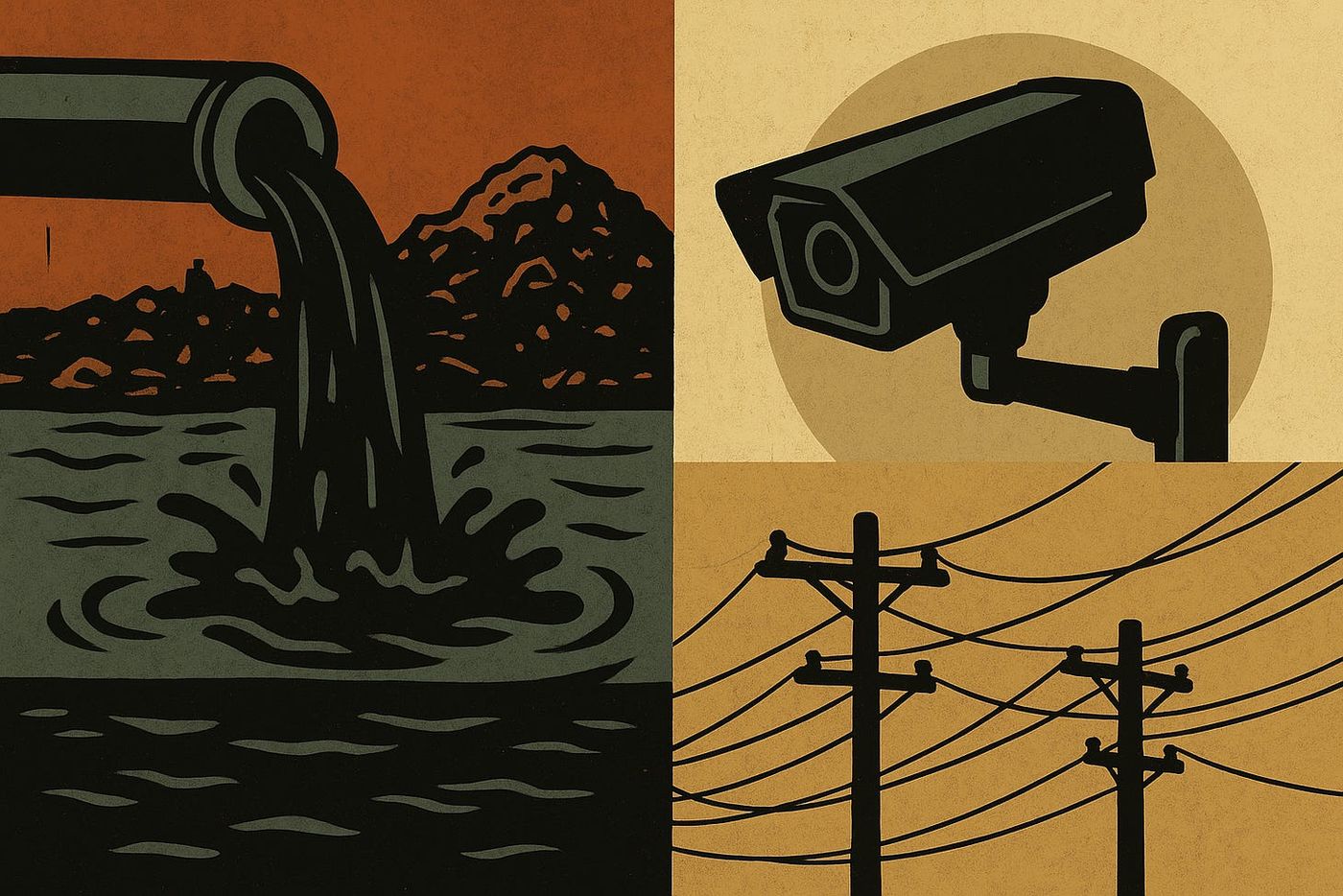
Imagine a world where the pipes under your street, the right to speak your mind, and the electrons powering your refrigerator are no longer public goods managed (however imperfectly) by elected governments.
Instead, each has quietly been converted into a private tollbooth, staffed by a revolving cast of politicians, financiers, and bureaucrats who charge you twice: once through taxes and bills, again through dividends, consulting fees, and political favors.
The toll never goes toward fixing the road. It just keeps the booth operators in business.
This is not a dystopian novel. It is happening right now, in three of the richest democracies on earth, through three apparently unrelated scandals that are actually the same scandal wearing different masks.
1. England: The country that sold its rivers and forgot to keep the receipt
In 1989 Margaret Thatcher’s government privatised water—the only OECD nation insane enough to sell a natural monopoly that literally falls from the sky. No competitive tenders, no minimum investment requirements, just ten regional monopolies gifted to whoever bid highest.
Thirty-six years later the owners are a who’s-who of global capital: Macquarie Bank (Australia), the Abu Dhabi Investment Authority, Chinese state conglomerates, BlackRock, Vanguard, and a dozen private-equity shops you’ve never heard of because they’re registered in Luxembourg and the Cayman Islands. Roughly three-quarters of English water is foreign-owned.
They borrowed £60 billion against the assets (none of which existed when the companies were sold), paid themselves £78 billion in dividends, and invested the absolute legal minimum. The regulator, Ofwat, functions like a polite debt collector for hedge funds.
Result: English rivers received raw sewage for 3.6 million hours in 2023 alone. The Thames now hosts a 180-ton floating island made entirely of wet wipes and cooking fat. A secret landfill the size of 130 football pitches near Oxford is quietly dissolving batteries, asbestos, and industrial solvents into the aquifer that supplies half the county. The companies call this “optimising shareholder value.” Everyone else calls it a slow-motion environmental crime wave protected by statute.
2. Brussels: The continent that decided free speech was a bug, not a feature
Across the Channel, the European Commission is rolling out something called the European Democracy Shield. The sales pitch is noble: protect elections from Russian trolls and deep-fake campaigns. The fine print is darker.
The Shield creates a permanent Monitoring Centre in Brussels empowered to define “disinformation,” force platforms to delete it within hours, and fine them billions if they hesitate. To decide what counts as truth, the Commission is spending hundreds of millions of euros on a sprawling network of “independent” fact-checkers, NGOs, and university departments.
Many of these organisations were already on the payroll; now they are formally integrated into the enforcement chain. Money flows from the Commission → grantee → “independent verification” → back to the Commission as proof its own narrative is correct. It’s a closed loop that would make a North Korean propagandist blush.
When national politicians need to disqualify a troublesome candidate or stop expats from voting by mail, they simply whisper “foreign interference” and watch Brussels provide the legal cover. The shield, in short, is pointed inward.
3. America: The republic where pipelines rise from the dead after one phone call
Meanwhile in the United States, solar panels are being installed faster than any energy source in history. In 2024 and 2025, renewables will account for more than 80 % of all new electricity generation added to the grid. The market has spoken.
Washington, however, still answers to a different master. In early 2025 the long-dead Northeast Supply Enhancement pipeline—a controversial gas project under New York harbor—was suddenly resurrected by the Federal Energy Regulatory Commission after a single conversation between the President and the Governor of New York.
Officially there was no quid pro quo, no “gas-for-wind” swap. Unofficially everyone in the energy business understands how these things work: you let my fossil project live, I’ll stop blocking your offshore wind leases. The market keeps building solar anyway, but the political system still finds a way to extract its traditional tribute from molecules that burn.
The single pattern hiding in plain sight
Three continents, three sectors, three decades apart—yet the same four-step playbook repeats with hypnotic precision:
- A vital public good (water, speech, energy) is declared “inefficient” when run by the state.
- It is transferred—via privatisation, supranational regulation, or back-room deal—to a narrow elite who face no competition and bear no downside risk.
- The new owners optimise for extraction: dividends, narrative control, or political rent. Maintenance, truth, and ecological limits are classified as externalities.
- When the system finally starts poisoning rivers, silencing citizens, or locking us into the wrong grid, the same elite blames “populism,” “foreign actors,” or “market failure” and demands even more centralised power to “fix” the disaster they engineered.
The tollbooth is now the governing economic model of the West. Democracy, environment, and trust are not being attacked by outsiders. They are being quietly metered, monetised, and degraded from within—by the same class of people who still fly in to Davos every January to lecture the rest of us about sustainability and shared values.
Until we start treating these stories as chapters of the same book instead of unrelated curiosities, the meter will just keep running.
Footnotes
[1] “England’s Water System: A Criminal Enterprise Protected by Law” – investigative series, The Bureau of Investigative Journalism / OpenDemocracy, October 2025
[2] “The European Democracy Shield: Brussels’ New Censorship Machine” – European Conservative / Compact Magazine, November 2025
[3] “Solar Crushes Gas in 2025 Additions as NESE Pipeline Mysteriously Revived” – Energy Wire / Politico Pro Energy, November 2025