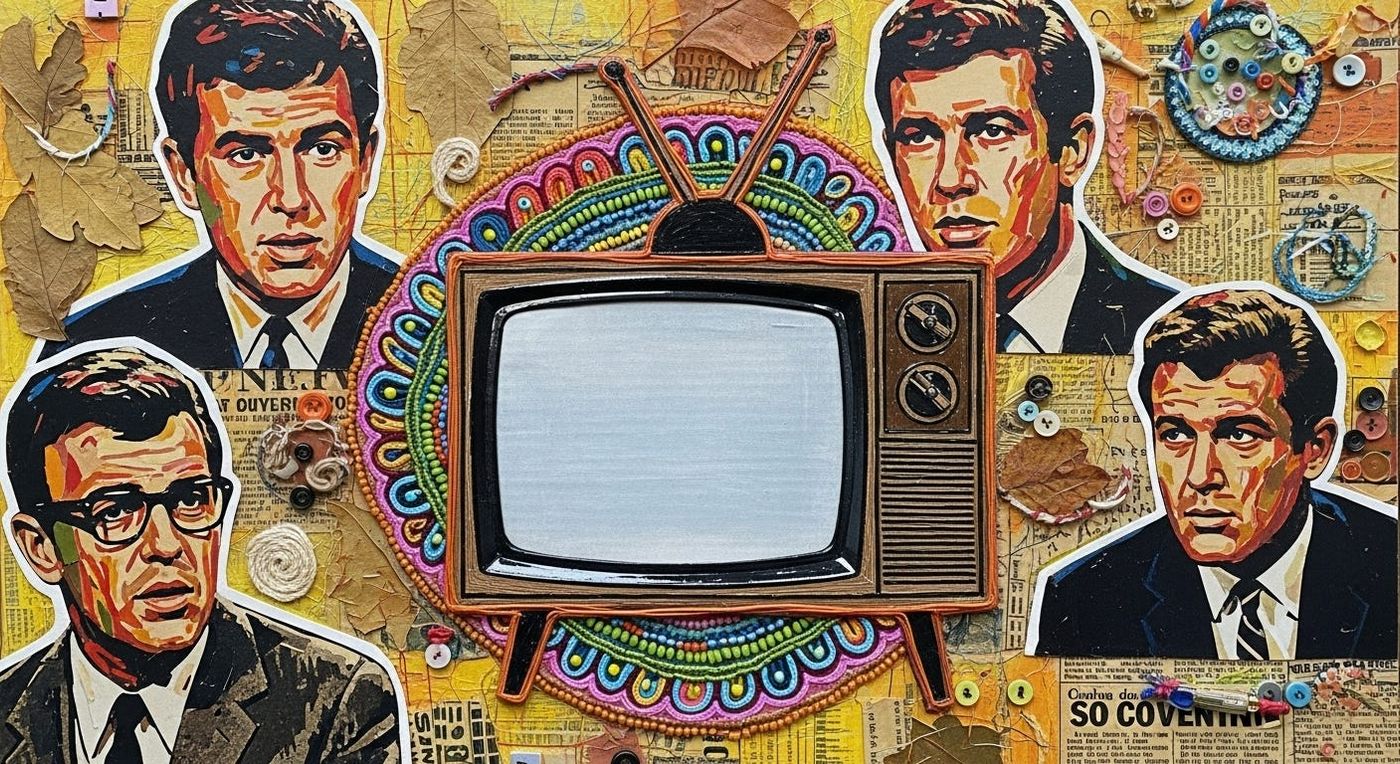
I watched Bonanza on a black-and-white set that buzzed like static electricity.
Men with straight spines moved through problems you didn’t even know were problems yet.
Over at the Stephens residence the witches rearranged the furniture, and the universe, with a nose wriggle. While poor harried Darrin scrambled.
Joe Friday brought the criminals in, Perry Mason twisted them in the wind. Colonel Hogan tricked the Germans (“I know nothing!”), and the Minnow would be lost.
Such were the men on sixties TV.
Ah, the golden age of cathode-ray catharsis. Those flickering tubes weren’t just entertainment, they were morality plays in monochrome, where every squabble ended with a handshake or a haymaker, and the good guys always rode off before the credits rolled.
Ben Cartwright and his boys didn’t just herd cattle; they herded values. A firm jaw and a faster draw settled land disputes, family feuds, and the occasional existential crisis. Problems? Solved by sundown, usually with a lesson wrapped in sagebrush wisdom.
Darrin’s perpetual fluster was every mortal man trying to keep cosmic chaos from spilling into the PTA meeting. The furniture moved itself, but the marriage stayed put. That was the real magic.
Those men—stoic, scheming, or simply stranded—weren’t just characters. They were archetypes in crew cuts and crew socks, teaching a nation how to stand tall, outsmart the system, or at least laugh when the boat never comes. The set buzzed, the picture rolled, and somehow, the world made sense in 22 minutes plus commercials.

The year was 1963, and the air in Studio 14 at NBC Burbank carried the faint ozone of vacuum tubes and the sharper bite of fresh hairspray. A junior writer named Hal, twenty-nine, still smelling of Iowa corn, leaned over the script table and watched the director block the final scene of Bonanza’s “The Legacy.” Ben Cartwright was about to ride down from the ridge, sunlight catching the silver in his sideburns, and tell his boys that a man’s word was the only fence that never needed mending.
Hal knew the line was cornball. He also knew the network had ordered it in boldface. The sponsor—Chevrolet—wanted the camera to linger on the new Impala parked beside the corral, chrome gleaming like a promise. Hal’s job was to make the promise feel ancestral.
Across the lot, in the Bewitched rehearsal hall, Elizabeth Montgomery practiced the nose twitch in a mirror while the head writer, Sol Saks, argued with Standards & Practices about how many times a week a mortal husband could be humiliated before the PTA wrote letters. Sol had a memo from Research: suburban men feared their wives’ book clubs more than Soviet missiles. The solution was simple—let the witch win the living-room skirmishes, but make sure Darrin kept the corner office. Chaos contained, hierarchy restored.
The memos never used the word containment, of course. They spoke of “family unity” and “traditional values.” But every Thursday at 3:15 p.m., a courier in a gray suit delivered a sealed envelope to each showrunner. Inside: a single sheet, Department of Defense letterhead, no signature. The message was always the same three bullet points.
- Reinforce male authority without alienating female viewers.
- Present problems solvable within one commercial break.
- Never acknowledge the existence of a draft card.
The writers called it the Ghost Sheet. They joked about it over martinis at the Smoke House, then went home and typed faster.
By 1966 the Ghost Sheet had grown teeth. The riots in Watts flickered on the news, but on soundstage 10, Joe Friday pinned a badge to his chest and recited crime statistics like rosary beads. The producer, Jack Webb, kept a red phone on his desk that rang only once a month. When it did, he listened, nodded, and told the writers to cut the episode where the suspect was a college kid with a protest sign. “We’re not in the nuance business,” he said.
The men on the screens never aged, never doubted, never asked why the Minnow never washed ashore. The Professor could build a nuclear reactor from coconuts but couldn’t patch a hull. The joke wrote itself, and the censors loved it: ingenuity without rebellion, competence without consequence.
In windowless rooms at the RAND Corporation, sociologists mapped the feedback loop. Every time Ben Cartwright solved a range war with a handshake, male viewers reported a 7% uptick in “belief in orderly resolution.” Every time Samantha’s mother threatened to turn Darrin into a toad, housewives laughed and renewed their magazine subscriptions. The data rolled in on punch cards, and the Ghost Sheet grew another page.
Then came 1968. The assassinations. The Tet footage. The smell of burning draft cards drifting over campus quads. The red phone rang twice in one week. Webb took the second call in the men’s room, receiver pressed to his ear while a grip pretended not to listen. When he came out, his face was the color of old ash. That night, Dragnet aired an episode in which a long-haired kid learned that marijuana led inevitably to heroin and heroin to a ditch outside Tijuana. The kid’s name was never spoken again.
The cathode tubes kept glowing. The laugh tracks kept cueing. But something had cracked inside the glass. Children who once begged to stay up for Hogan’s Heroes now asked why Colonel Klink never just shot the prisoners. Mothers who used to iron while Samantha twitched began to wonder what Endora did with her days when she wasn’t tormenting mortals. The Ghost Sheet’s third bullet point—Never acknowledge the existence of a draft card—started to feel like a dare.
By 1971 the soundstages were half empty. The writers who remained drank more, slept less. Hal, now thirty-seven and balding, stood on the Bonanza set after the final wrap and watched the prop wranglers dismantle the Ponderosa corral. A grip handed him a splintered fence post. “Souvenir?” the kid asked. Hal turned it over in his hands. The paint was still wet from the last touch-up—same shade of moral white they’d used since ’59.
He kept the post. Years later, when his own son came home from UCLA with a fistful of leaflets and a black eye from the sheriff’s deputies, Hal set the post on the kitchen table like a relic. “This,” he said, “is what they sold us.” The boy looked at the wood, then at his father, and asked the question the Ghost Sheet had never allowed: “Who bought it?”
Outside, the last of the vacuum tubes cooled in their cardboard graves. The picture no longer rolled; it streamed, infinite and borderless. But somewhere on YouTube, if you know where to look, Ben Cartwright still rides down from the ridge at sundown, silver sideburns catching a light that never quite set.