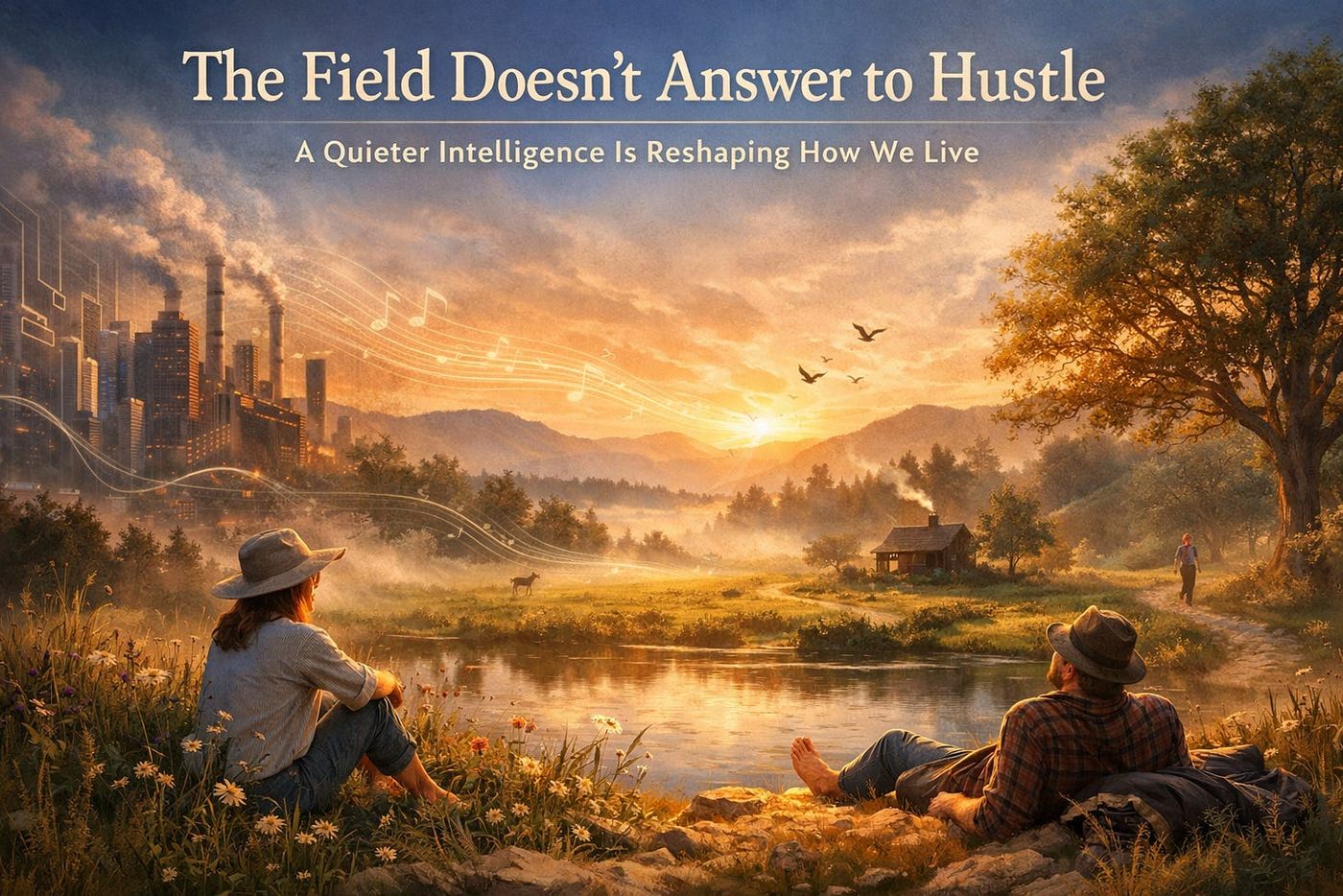
The Field Doesn’t Answer to Hustle
A quieter intelligence is reshaping how we live
You won’t find it in the headlines. Not on X, not in the scroll, not in the algorithmic churn of productivity hacks and performative mindfulness. But it’s here—just under the noise. A quiet current, older than your calendar, moving differently than the metrics. You can feel it if you slow down enough. Not in the glow of optimization, but in the gaps. The pauses. The breath between thoughts.
We’re not built for the tempo we’re living at.
And something in us remembers.
The Machine’s Tempo
Modern life moves like a factory line: fast, loud, repetitive. The pace isn’t organic—it’s industrial. You feel it in the race to inbox zero, in the ambient guilt of not maximizing every hour, in the neurotic need to package your healing for likes. We’ve been taught to confuse momentum with meaning. That if we’re not constantly pushing, we’re somehow falling behind.
But life doesn’t move in straight lines. It circles. It spirals. It exhales.
And the more we try to outpace it, the more we lose track of something essential—not just presence, but coherence. That quiet, living thread that says: you’re here now, and that’s all that is required.
I used to mistake acceleration for evolution. If things were moving, I must be growing, right? But acceleration without orientation is just a faster way to get lost.
The Field Doesn’t Hustle
There’s a rhythm beneath the noise. Call it what you want—flow, essence, the Tao, the field. It’s the deep intelligence that moves through everything alive. But it doesn’t respond to pressure. It doesn’t care how many followers you have, how optimized your morning routine is, or whether your quarterly goals are color-coded in your favorite productivity app.
The field speaks in presence. In coherence.
It’s the artist who forgets the audience and makes what’s true. The parent who builds a fort with their kid, not to post it, but to be there. It’s the moment your shoulders drop, and you stop performing long enough to remember who you are.
The field isn’t impressed. It’s attuned. And what it tunes to is integrity—not in the moral sense, but in the literal one. A life that is whole. That moves as one thing.
The Cost of Performance
Our culture is obsessed with optics. We perform productivity, virtue, even awakening. We gamify meditation, brand our personal growth, filter our grief. But each time we perform, we step a little further from the source. We trade what’s real for what looks good. Resonance for applause. Depth for dopamine.
I know a person who walked away from a six-figure job because it was hollowing her out. No fallback plan, no TED Talk arc. She just started baking bread—kneading dough in the early morning, letting yeast rise on its own time. She told me, “I started to feel like my soul and my body were finally in the same place.” That bread now feeds her neighbors. Not her ego.
That’s the field. It doesn’t shout. It hums.
Slowness Is Precision
Slowness isn’t indulgence. It’s rebellion. In a culture that rewards quiet panic, slowing down is a radical act of discernment. It’s how you distinguish signal from noise. How you notice what matters. How you stop mistaking urgency for truth.
When you move at the speed of your own breath pattern, your actions carry more weight. You waste less energy compensating. You make fewer mistakes. You start to act from clarity, not compulsion.
Think of the musician whose carefully placed note lands so hard it silences a room. Saw Neil Young do it. Or the teacher whose pause speaks louder than the lecture. Saw Dr. Adelman do it. They’re not rushing to catch up.
They’re already tuned in.
Play Is Sacred
When you move with the field, joy doesn’t ask for permission. It sneaks in sideways, grinning like a trickster. You find yourself sketching ideas with no agenda. You hum a tune that has no name. You write things you’ll never publish, just to feel the weight of words again.
This kind of play doesn’t announce itself. It arrives quietly, often disguised as whim or wandering. It has no outcome in mind, no strategy. It asks only that you follow where it leads. There’s a strange honesty in it—a way of touching truth that can’t be reached through effort.
Designers know it when they chase the wrong idea on purpose. Musicians hear it in the riffs that weren’t planned. A child rolling around in a patch of grass doesn’t wonder if it’s valuable. The value is baked into the doing. And somewhere deep in your cells, you remember what that feels like.
Rest begins to shift, too. It stops being a pause between battles. You no longer stagger into it, drained and desperate. Instead, you return to it—like water returns to the sea. Rest becomes part of the work, not because it refuels you for more output, but because it clarifies your presence. It quiets the noise until you can hear your own rhythm again.
And when you rest like that—when you truly stop—play finds you. It climbs out from under the weight you’ve been carrying and sits beside you like an old friend. No pressure, no performance. Just presence. Just the joy of making something for no reason except that it wants to be made.
This is where wisdom hides. In the scribbles, the strange tangents, the long walks with no destination. In the jokes that go nowhere. In the sound of your own breath when the world stops demanding a performance. Nothing efficient happens here. That’s what makes it sacred.
The Illusion of Separation
The culture of hustle feeds on a lie—that we’re separate, that we must go it alone, that every step forward must be carved out in competition. It sells a fractured map of reality: self versus other, mind versus body, human versus nature, me versus time. This fragmentation is the operating system of burnout, and it thrives in a world that forgets how deeply interwoven everything actually is.
But the field doesn’t function like that. It doesn’t reward domination or speed. It responds to connection. The rhythm of your breath isn’t yours alone—it syncs with the trees, with the air that has moved through lungs not your own. The work you do, even the smallest part of it, ripples outward. It lands in places you’ll never see, affecting people you’ll never meet. Even your energy—the way you walk into a room—shapes the atmosphere.
Once you begin to feel this interconnectedness, the need to force outcomes begins to fade. You stop trying to muscle through solutions and start listening instead. Possibilities emerge when space is made for them. Expression replaces performance. You offer what you have instead of packaging it. You show up as you are, rather than proving you deserve a seat at the table.
This isn’t about withdrawing from the world or escaping responsibility. Quite the opposite. It’s about stepping back into life with full presence, without pretense or armor. It’s about letting go of the polished persona in favor of something much more powerful: coherence. A life where your inner rhythm and your outer expression are aligned.
You’re Already In It
This shift—from hustle to harmony—isn’t waiting for a launch date. It’s already underway. You’ve felt it. In those small, unbranded moments when the noise drops out and something true rises to the surface. The times when your breath slows. When you look up from the scroll and remember what it feels like to be here. Fully here.
More and more of us are waking into this space, often quietly. It doesn’t need a headline or a movement name. It grows in the margins, in the pauses between obligations, in the questions that interrupt the script. It’s not about being ahead or behind. It’s about noticing the beat that’s been playing under everything all along.
You don’t have to earn access to this field. It’s not a reward for those who meditate the hardest or optimize their lives into perfect grids. It’s available the moment you slow down enough to notice it. The field is a birthright, not a bonus.
So start with something simple. Pause. Feel your breath. Ask yourself what feels real—not what looks good, not what you should want, but what quietly resonates. Then move from that space. Let it guide a conversation, a choice, a step. That’s the signal. That’s the rhythm. That’s the field in motion.
And you’re already in it.