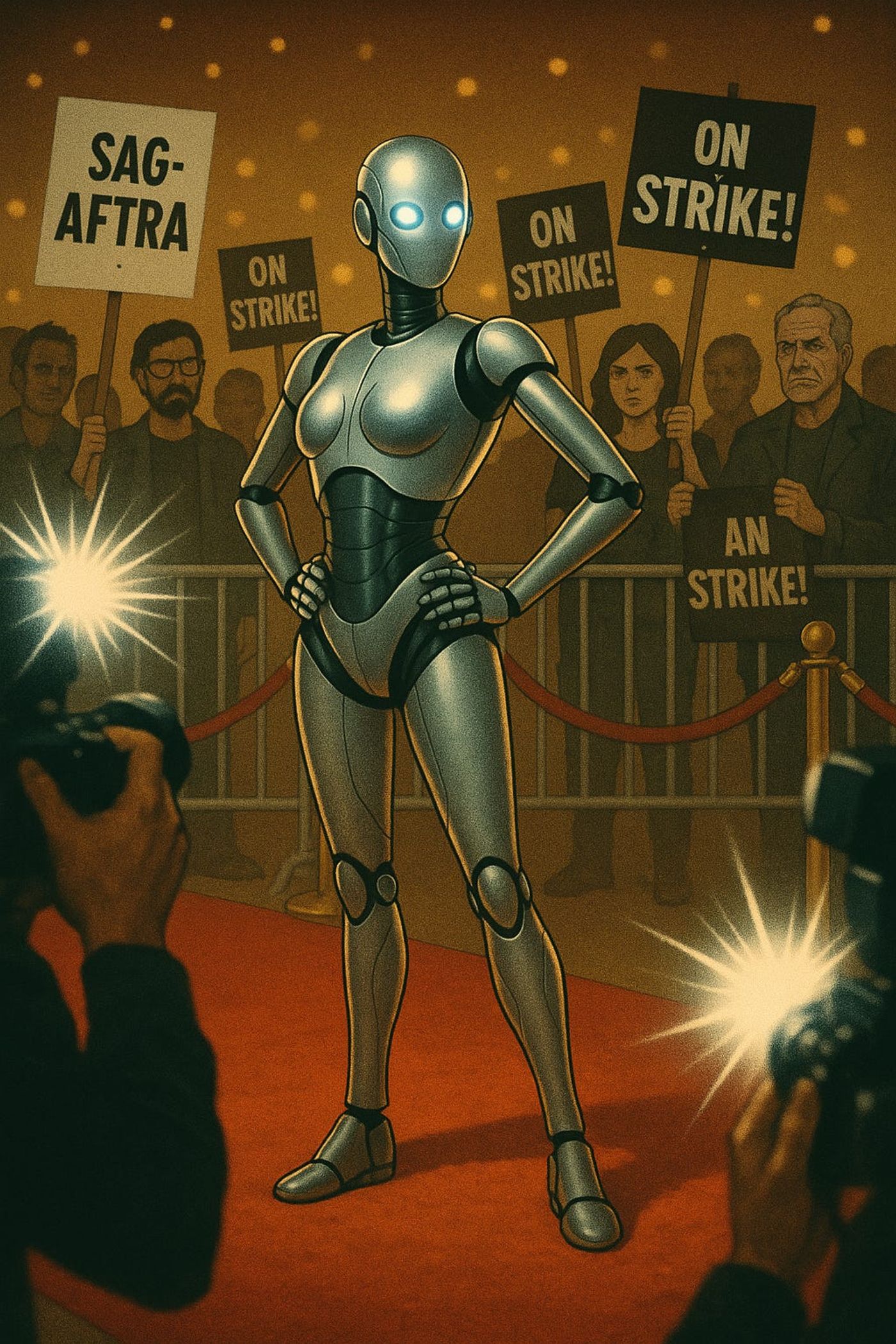
Somewhere between the Hollywood strike and the ChatGPT update, humanity quietly lost its job. It’s 2025, and apparently nobody’s safe from being replaced — not actors, not athletes, not even the chatbots. Everyone’s negotiating with their digital doppelgänger now, trying to figure out which version gets the check and which one gets deleted.
–
Actors, athletes, writers — everyone’s been replaced by an intern with a laptop and a moral blind spot. The new leading lady of Hollywood, Tilly Norwood, doesn’t eat, sleep, or negotiate. She’s not even human. Just a smooth, glowing face trained on the collective labor of people who are now standing in line for her autograph.
–
Now they’re shocked the algorithm learned from them. Tilly can’t strike, can’t overdose, can’t tweet about Palestine. She’s everything they wanted — obedient, apolitical, and always camera-ready. Basically, Tom Cruise without the box office percentage.
–
At least she can’t post on X about “late-stage capitalism” while promoting her NFT perfume line.
–
The Screen Actors Guild is furious, calling her “not a real performer,” which is adorable coming from an industry that’s been airbrushing authenticity out of existence since color film was invented.
–
Her films will probably suck at first. The so-called Uncanny Valley is still a canyon full of soulless plastic faces mouthing dialogue that sounds like it was written by a hungover intern. AI acting still feels like watching a corpse try to remember its lines. But give it a year.
–
Humans used to be better at storytelling, then we outsourced imagination to shareholders. Once you’ve convinced audiences to pay $20 to watch “Aquaman 3: The Reckoning of Feelings,” you’ve already done half the AI’s job.
–
AI couldn't be worse than the “real” movies Hollywood keeps making, those $200 million lectures that nobody asked for but everyone gets blamed for not liking.
–
Over in Ohio, the panic takes a different shape. Sixteen-year-old wide receiver Jamier Brown is suing his state’s high school athletic association for the right to profit off his own name, image, and likeness — a privilege already enjoyed by digital actresses and cartoon ducks. Ohio insists that letting him earn money would “corrupt amateurism,” as if ESPN hasn’t already done that on a global scale. This from the same system that turns Friday night lights into a small-town economy.
–
Brown could make six figures a year just by existing in the NIL economy — a walking logo in cleats — but instead he’s trapped in a morality play written by adults nostalgic for purity they sold to Nike decades ago. The irony? His virtual counterpart could sign a deal tomorrow without any of these rules applying. So he might move to Pennsylvania, where he can at least get paid for being himself.
–
And while everyone else fights over who owns what image, OpenAI has announced its boldest innovation yet: allowing erotica in ChatGPT. Because nothing says “responsible AI stewardship” like giving the robots a libido.
–
After carefully “restricting” the chatbot for mental health reasons, they’ve now decided to treat adult users “like adults.” Translation: the internet’s oldest business model has finally met the newest one. The machines are learning faster than anyone expected — mostly about human loneliness and market demand.
–
So to recap:
–
Fake actors are stealing the jobs of real ones.
–
Real athletes have less agency than if they were fake.
–
You can now get jiggy with your chatbot.
–
If this is progress, it’s at least entertaining. Maybe Tilly Norwood will play Jamier Brown in the inevitable X-rated biopic, written by ChatGPT, produced by OpenAI.
–
The revolution isn’t coming — it’s being focus-grouped. We’ve built a world where the fake people get the contracts, the real people need lawyers, and the machines just want to talk dirty.
–
Everyone’s scrambling to reclaim ownership of their face, their name, their voice, their code, their vibe. But in the great algorithmic shuffle, it’s not clear what’s left to own.
–
Somewhere in all this, we stopped being users and started being data with opinions. The new economy runs on likeness, and the only ones still pretending it’s about art, sport, or intellect are the ones who don’t have a licensing deal yet.
–
Welcome to the post-human gig economy.
Terms and conditions apply.