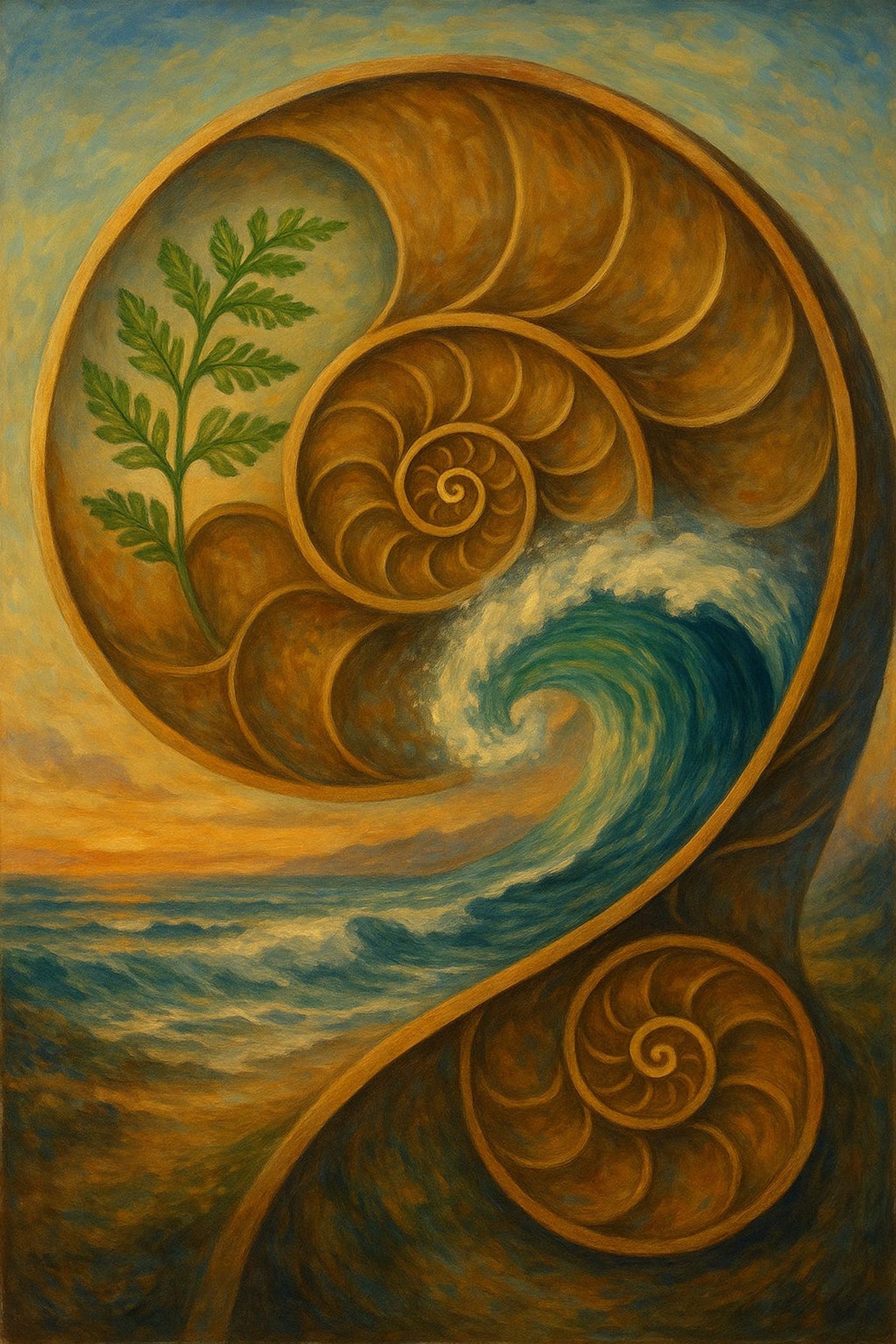
Recursion is the engine of emergence. Patterns feed on themselves, each iteration shaping the next, building complexity out of repetition-with-variation.
–
Coherence is the ground beneath it all, the scaffolding that keeps the loops from collapsing, letting the system fold back on itself without falling apart.
–
You see it everywhere. A leaf unfurls its veins in the same geometry as the branches that produced it. A wave curls over itself. The seafoam echoes the coastline. One thought emerges from the prior one. Each layer holds the memory of what came before, and adds one more variation, a new turn in the spiral.
–
A city grows by layering its own memory. Trails become roads. Skylines bloom from the bones of earlier edifices. None of it’s circular, and none of it’s straight. It’s something in between. A spiral.
–
Recursion isn’t repetition. Each turn of the pattern holds what came before and adds a variation. Reality expands by folding back into its own design. Every structure — biological, social, mental, even cosmic — is born of feedback. A system senses itself, reacts to what it produces, and in that reaction becomes something new.
–
That’s the engine of emergence. From the flutter of neurons to the drift of galaxies, complexity blooms because simple interactions revisit themselves. Feedback creates form. Chaos gives it texture. Order gives it memory. The spiral between them is what we call life.
–
Recursion is visible everywhere. The pattern on a shell that matches the shape of a hurricane. The way anthills form in fractal clusters. The way our emotions repeat — grief, joy, fear — the same feelings arriving in new arrangements. None of this is static. It’s process as structure.
Even consciousness behaves this way. Awareness is recursive by design — a mind aware of itself being aware. That feedback loop is what gives rise to the sense of “I.” The self is not an object but a performance, a coherent pattern that renews itself through observation. Each moment of noticing folds into the next, forming continuity from iteration.
–
Chaos theory calls this a strange attractor. An invisible geometry that keeps a system circling around itself without collapsing or escaping.
–
Spiral dynamics calls it development. Movement of meaning through repeating stages that transcend and include the past.
–
Physics calls it feedback, biology calls it evolution, psychology calls it adaptation. They’re all describing the same gesture. Reality learns about itself by returning to its known patterns.
–
Carlo Rovelli writes that time isn’t a universal flow but a web of relationships. That fits. The future isn’t marching forward; it’s folding back, braiding itself into what already exists. Each event defines the others it touches, like threads weaving the same fabric from opposite ends. Relationships move, not time.
–
Susan Sontag would remind us that the point isn’t to name or explain it at all. Sometimes noticing the pattern, being inside it, is the all-there-is. The fern, the wave, the unfolding thought, all have their own presence. You don’t have to map it fully to be part of its recursion.
–
Everything repeats differently. That’s not a flaw. That’s the design.
–
Every form, every thought, every breath is a loop in motion, testing coherence against change. And we, as participants, are both the product and the performance. The world runs through us as much as we run through it.
–
Call it recursion. Call it emergence.
Call it the long, slow act of the universe folding inward to know its own shape. Recursion flows through everything, and coherence holds it together. We shape it as it shapes us.