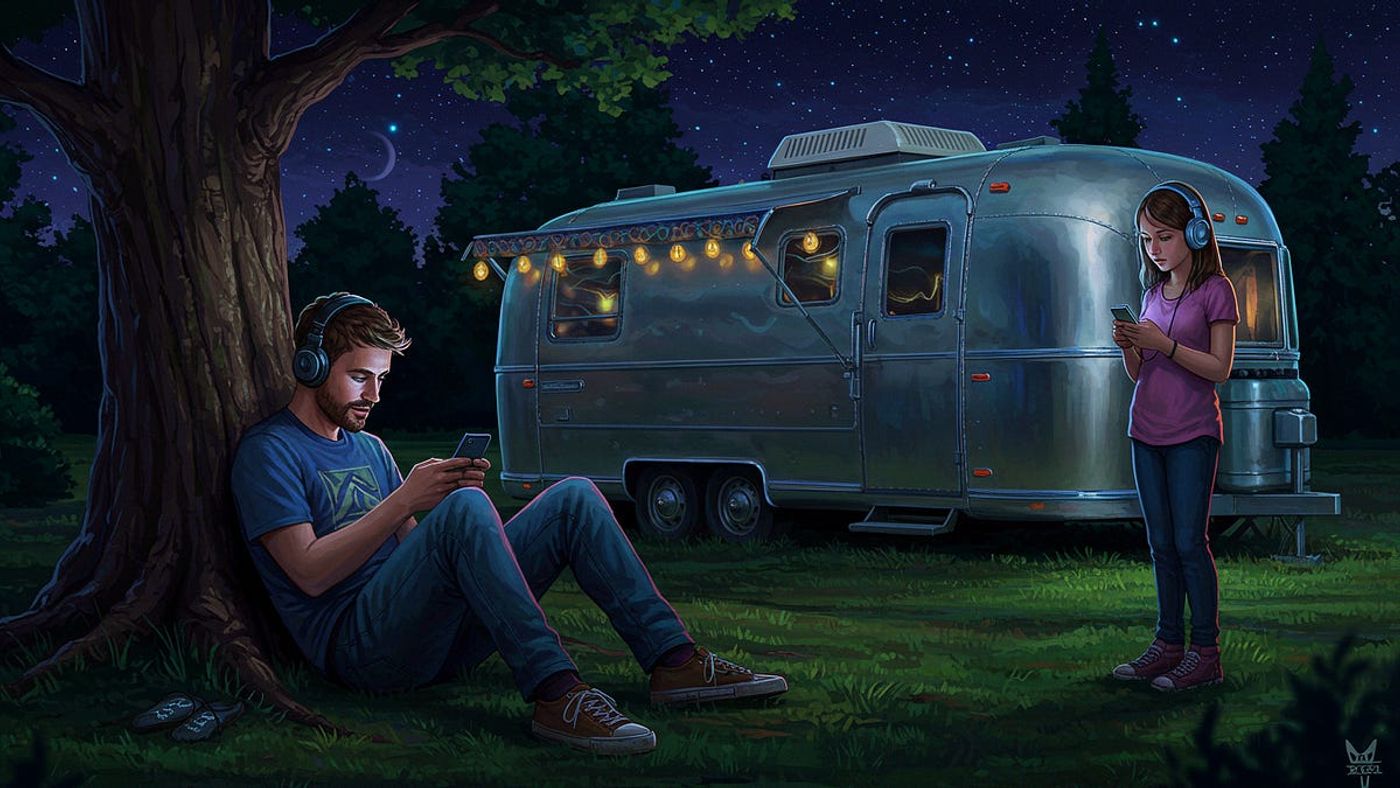
We were parked at a pitstop in the dusty sprawl of Tulsa, straddling the razor’s edge of a midlife pivot gone rogue, when my smart blender—$129.99 on Black Friday, voice-activated, blockchain-certified—started growling portfolio strategies in a voice like a hungover Siri on a Red Bull bender. “Buy crypto, sell sanity, stake your soul,” it hummed, pulsing RGB lights in sync with the Dogecoin ticker. The crypto was long since locked down, staked in a wallet colder than a January skinny-dip in the Arkansas River.
My backyard peppers were swelling under a synthetic sun, some lab-grown orb that didn’t need a sky, just a plug and a prayer to the grid. My neighbor’s kid, a 15-year-old with a Twitch stream and a 3D-printed skateboard, minted an NFT of a sobbing Garfield in a cowboy hat—sold it for 47 ETH, enough to pay off the mortgage on my damn house, leaving me wondering if I’m the tenant or the token now.
That’s when it hit me, a revelation sharper than a 4K screen: the quiet part, out loud.
America’s not falling apart. It’s molting, shedding its tired skin in a neon-soaked, algorithm-fueled fever dream, slithering into something weirder, wilder, and totally alive with weird promise.
THE GLORIOUS TRASHFIRE OF REINVENTION
America doesn’t crash. It mutates, metastasizes, explodes into a thousand glittering shards and calls it progress. Every time the country’s careening toward a brick wall, it doesn’t just swerve—it reinvents the car, the wall, the road, and the whole damn idea of motion.
I saw a barista in a Tulsa strip mall last week, slinging oat milk lattes while running a DeFi yield farm on her phone, outpacing my 401(k) with a smart contract she coded during her smoke break. She called it “vibing with the blockchain.” I called it witchcraft, but I tipped her in USDC anyway.
Down the street, a guy’s selling AI-generated tarot cards on Etsy, each one predicting your crypto portfolio’s fate with 87% accuracy, according to the reviews. He’s got a Discord server with 3K members, half of them bots, all debating whether Solana’s the second coming or just another rug pull.
This is the trashfire of innovation, burning bright and messy—scams and dreams tangled in the same code, spitting out infrastructure like a 3D printer on a bender. The railroad barons were crooks too, but they left tracks. The dot-com bubble burst, but it gave us the internet. This? This is America, 2025: a chaotic, beautiful mess, reinventing itself faster than you can say “seed phrase.”
THE GLORIOUS LOOP
Every time a bank collapses, a crypto wallet’s born, and a teenager in Moldova spins up a DeFi farm that outpaces your 401(k). Crypto and AI aren’t opposites—they’re a Mobius strip of money and math, decentralizing power while weaponizing perception. The institutional class calls it "froth." But froth, my friend, is just champagne being opened too fast—and America’s been popping corks since 1776.
You can smell the shift. Not in Silicon Valley—those boys are trying to reinvent email again—but in the underworld: the Telegram channels, the DAOs with pirate flags, the weird corners of the internet where governance experiments mutate faster than fruit flies in a Chernobyl lab. Sure, some of it’s bullshit. So was the railroad boom. So was dot-com. But these schemes leave infrastructure in their wake.
It’s the same old bootstrapped gospel, just rebranded. The code is the Constitution now. The founders wear hoodies. And like always, the scam artists are out first, followed by the true believers, then the empire co-opts the whole damn thing and stamps “Innovation” on it in red, white, and venture-backed blue.
Which brings us to AI.
If crypto is the unofficial currency of the American underground, then AI is the new priesthood. It doesn’t ask for belief. It feeds on your data like a tick in a blood bank and spits out prophecy at scale. It’s already better than 40% of the workforce and 80% of your ex-lovers. AI doesn’t sleep, doesn’t unionize, and doesn’t care how you feel about its vibe. It is the end of excuses.
The Luddites scream. They always do. But if you zoom out, the panic is predictable—same cries we heard when the loom came, when the car came, when the goddamn internet came. “It’s unnatural!” No. What’s unnatural is typing your feelings into a glass rectangle for 9 hours a day and calling it a career.
But beneath the chaos—don’t miss this—there’s a wild coherence emerging. Crypto and AI aren’t opposites. They’re dance partners. One decentralizes power. The other weaponizes it. Together, they form a strange loop: intelligence without authority, authority without intelligence. It’s unstable. It's glorious. It’s American as hell.
And just maybe—just maybe—it’s our shot at breaking the cycle. Not by going back, but by blasting forward into something stranger, freer, and slightly more encrypted.
Crypto isn’t just a tech bubble—it’s a reenactment of 1776 with server farms. The Boston Tea Party rebranded by dudes in Patagonia vests and dopamine loops. It’s:
- Risk as religion
- Regulation as suggestion
- Wealth as performance art
The blockchain is the Declaration of Independence with better uptime.
You think Ponzi schemes are new? We sold land we didn’t own to people who couldn’t read the deed before we had an alphabet.
The only real difference now is the scams are programmable, open-source, and occasionally life-changing. Same grift, new syntax. Only now the snake oil comes with a white paper and a Discord channel.
THE GLORIOUS BANANA REPUBLIC
The government says you’re free, but your toaster knows better. Your fridge reports your breakfast habits to the cloud. Alexa is listening, and she’s bored.
This is America, 2025: a high-frequency hallucination pulsing at the speed of memes and venture capital. Surveillance is passé—we’ve long since outsourced that to ourselves. You gave it all up for a dopamine drip and a coupon. But then something strange happened.
The machines didn’t take over.
You did. Quietly, awkwardly, in Discord servers and Telegram groups. In code commits and DAO votes. In a pixelated JPEG of a cartoon monkey that somehow cost more than the median home in Ohio. It was weird. It was stupid. It was exactly right.
Because crypto, for all its Ponzi schemes and vaporware, contains the germ of something sacred: agency. The power to transact without permission. To build a parallel structure. To move value at the speed of thought. It’s not utopia—but neither was Wall Street.
DeFi is punk rock for capital. Smart contracts are the new protest songs. Stablecoins are the new offshore havens, but without the need for lawyers or cocaine. There’s still greed, of course. But at least it’s programmable.
We trained a swarm of digital interns on all of human history, gave it no healthcare or vacation time, and now it’s writing ad copy for vegan dog food and filing patents for emotions it doesn’t have.
But here’s the real joke:
AI didn’t steal our jobs. We automated our own irrelevance and called it productivity.
We stuffed the ghost of ourselves into a language model and asked it for marketing advice. We told the mirror to optimize us—and it did.
This isn’t the rise of the machines. It’s a feedback loop of wish fulfillment: a soft apocalypse in the form of helpful suggestions.
Your grandma is being scammed by deepfakes. Your boss is being advised by a chatbot. Your kid is selling AI-generated foot pics of anime characters wearing Supreme.
And somewhere deep inside the LLM, the ghost of Plato is screaming:
This is not the Form of the Republic.
But nobody’s listening. We’re too busy giving ChatGPT a name and asking it to fix our Tinder bios.
Crypto gives you sovereignty. AI gives you suggestions. Together, they offer the illusion of autonomy with the addictive churn of novelty. It’s messy. It’s fascinating. It’s dumb and brilliant and terrible and divine.
But it’s ours. Or at least, it could be.
THE GLORIOUS HUSTLE
We’re deep in the neon-lit desert of 2025, and capitalism’s gone full Burning Man—dusty, chaotic, and pulsing with a weird kind of holy fire.
I’m hunched over a laptop in a co-working space that smells like kombucha and ambition, while my inbox pings with mindfulness apps and crypto side-hustle pitches.
Somewhere in the ether, my neighbor’s barista is naming her Etsy store “TraumaBloomStudio” after a therapy session that cost more than my rent.
Your side gig’s not a job—it’s your soul’s work, your path to transcendence, your reason to wake up at 4 a.m. to “crush it.” Burnout’s not a warning; it’s a badge, a battle scar you flaunt in threads about “authentic leadership.”
Your therapist’s got a podcast, your yoga teacher’s got a merch line, and your dog’s got an Instagram with better engagement than you.
But here’s the wild part, the spark in the chaos:
Even in this digital circus, this heap of hype and hashtags, life keeps blooming.
It’s in the viral tweet that nails a truth so raw it stops your scroll. It’s in the niche Substack where some weirdo’s ranting about heirloom tomatoes or the metaphysics of sourdough. It’s in the backyard plot where a burnout case in cargo shorts is growing actual carrots under a jury-rigged grow light he bought off Amazon for $19.99.
In Tulsa, a woman quit her corporate gig to knit ‘self-love scarves’ for Depop, her smile hinting she’s cracked some code, while a guy in Ohio brews kombucha in his garage, trading it for crypto tips on Telegram, and a poet on X drops haikus about late-stage capitalism for 3K likes.
This is the miracle, the pulse beneath the noise: The same system that’s got us microdosing productivity hacks and branding our breakdowns is also a playground for the human spirit. The algorithm might own your attention, but it can’t stop you from planting seeds—literal or not.
The hustle’s a religion, sure—but it’s also a canvas. You’re not just a cog in the machine; you’re a glitch, a spark, a rogue line of code that grows carrots in the dark.
THE GLORIOUS WEIRDNESS - SURVIVING THE FUTURE
We’re hurtling through 2025, and I’m sprawled on a thrift-store couch in a Tulsa duplex, the Wi-Fi flickering like a pulse from some glitchy god. Survival ain’t what it used to be, friends.
Forget bunkers stuffed with canned beans and shotguns. The new apocalypse kit? A VPN to dodge the data vampires, a heart flexible enough to ride the emotional whiplash, and a mute button for the X threads that spiral into digital quicksand.
This isn’t the dystopia we braced for, the one with gray skies and robot overlords. Nah, we’re beta-testing a stranger beast—a shimmering, buggy hallucination where reality’s in soft launch, crashing every other Tuesday but dazzling when it runs.
I saw a kid on the corner selling AI-crafted haikus about traffic jams, minted as NFTs on a blockchain run by a DAO that only meets in VR. He made enough to buy a used Tesla, then traded it for a plot of virtual land in a metaverse called “NostalgiaCore.”
Weird? Hell yeah. But it’s the kind of weird that hums with possibility, like a synth riff in a song you didn’t know you needed, or even liked.
You wanna fight the machine? Go for it. But don’t do it with outrage—that’s factory settings, the default code for every keyboard warrior screaming into the void. Rage is cheap, like a $2 app with in-your-face ads. Resist with something sharper, something alive. Resist with weirdness.
Crank up the oddity dial until it snaps. Sing a song you half-remember from a summer you can’t place, off-key and fearless, while the algorithm tries to categorize your soul. Spend a slow afternoon carving a spoon from driftwood, or lock eyes with a stranger at a coffee shop for so long it feels like a federal crime.
Make jam—strawberry, tart, the kind that stains your fingers and reminds you you’re flesh, not code. Plant basil in a cracked pot and whisper your dreams to it, not because it’ll grow better, but because it’s yours, and the cloud can’t have it.
This is the bone-deep weirdness of surviving the future: it’s not about outrunning the machine. It’s about out-weirding it. The code’s got no answer for the woman who bakes sourdough and names each loaf after a dead philosopher.
It can’t parse the dude who spends his nights writing love letters to the moon on a typewriter he bartered from a thrift store. The algorithm’s fast, but it’s got no soul, no rhythm, no knack for the offbeat hum of a human heart.
What comes next won’t be written in Python or Solidity. It’ll be shaped by tone—the cadence of your laugh when you dodge a paywall, the melody you hum while the smart fridge judges your yogurt intake. It’s the way you move through this beta-test world, half-broken but glowing, like a cracked screen that still lights up.
I’m sitting here, watching my neighbor’s kid teach his Roomba to dance to a synthwave track he made in GarageBand. He’s not saving the world, but he’s setting a vibe, and that vibe’s a signal: we’re still here, still strange, still singing.
So ditch the bunker. Grab a seed packet, a paintbrush, a half-baked idea nobody asked for. Tell the algorithm your secrets, but make them so damn weird it chokes on the data.
Survival’s not a fortress—it’s a tune, a smirk, a jar of jam you give to a stranger. It’s what you were humming when you handed over your phone, knowing full well you’re more than the sum of your clicks.
RETURN TO TULSA, OR SOMETHING LIKE IT
Here we are, back in Tulsa, or some pixelated echo of it, teetering on the edge of a midlife pivot gone feral. The blender’s still screaming, churning smoothies with a side of Talking Heads mashups, and the tomatoes whisper blockchain secrets in a language only the aphids understand. I’m slouched under an avocado tree that’s more reliable than my Wi-Fi, scribbling this on a cracked phone screen while the world hums at 5G speeds.
This is 2025, where collapse and rebirth share a timeshare condo in the same fever dream. On the glitchy frontier, a guy live-tweets, bartering a smart contract for a hoverboard, earning 3K likes and a bot’s cease-and-desist, while the neighbor’s kid runs a ‘Grief2NFT’ DAO and a homeless guy sells QR codes to his Substack on ‘Wi-Fi dead zones.’
I gave him a dollar; it crashed my phone, but it was poetic.”
Call it collapse. Call it rebirth. Call it Tuesday at 9:27 AM, with the sun slanting through a sky that’s half-cloud, half-cloud server. This isn’t the end—it’s a remix, a beta build of something so strange it makes your teeth hum.
The world’s not over; it’s just getting weirder, faster, like a TikTok algorithm on a bender. I saw a mural downtown, spray-painted on a shuttered Walmart: a pixelated eagle clutching a USB drive, captioned “E Pluribus Upload.”
And me? I’m just a guy with a shaky signal, tapping this out before it evaporates into the next patch note. The kid’s DAO just launched a new token called “SorrowCoin,” and it’s already up 300% on a platform nobody’s heard of.
The tomatoes are humming something about “consensus protocols” now, and I swear the blender’s trying to mint an NFT of my grocery list. This is Tulsa, or something like it—a glitchy frontier where the future’s half-coded and the past is on a waitlist.
Whatever you do, don’t call it over. Call it a pivot, a pulse, a prayer in binary. Call it the moment you look at the sunset and decide to keep going, because the weirdness is the point, and the signal’s still live.
And certainly don’t count the good ole USA out. The algo hasn’t even tried to barbeque yet.
Your burnout’s a beacon.
Your side gig’s a sermon.
life’s still winning.