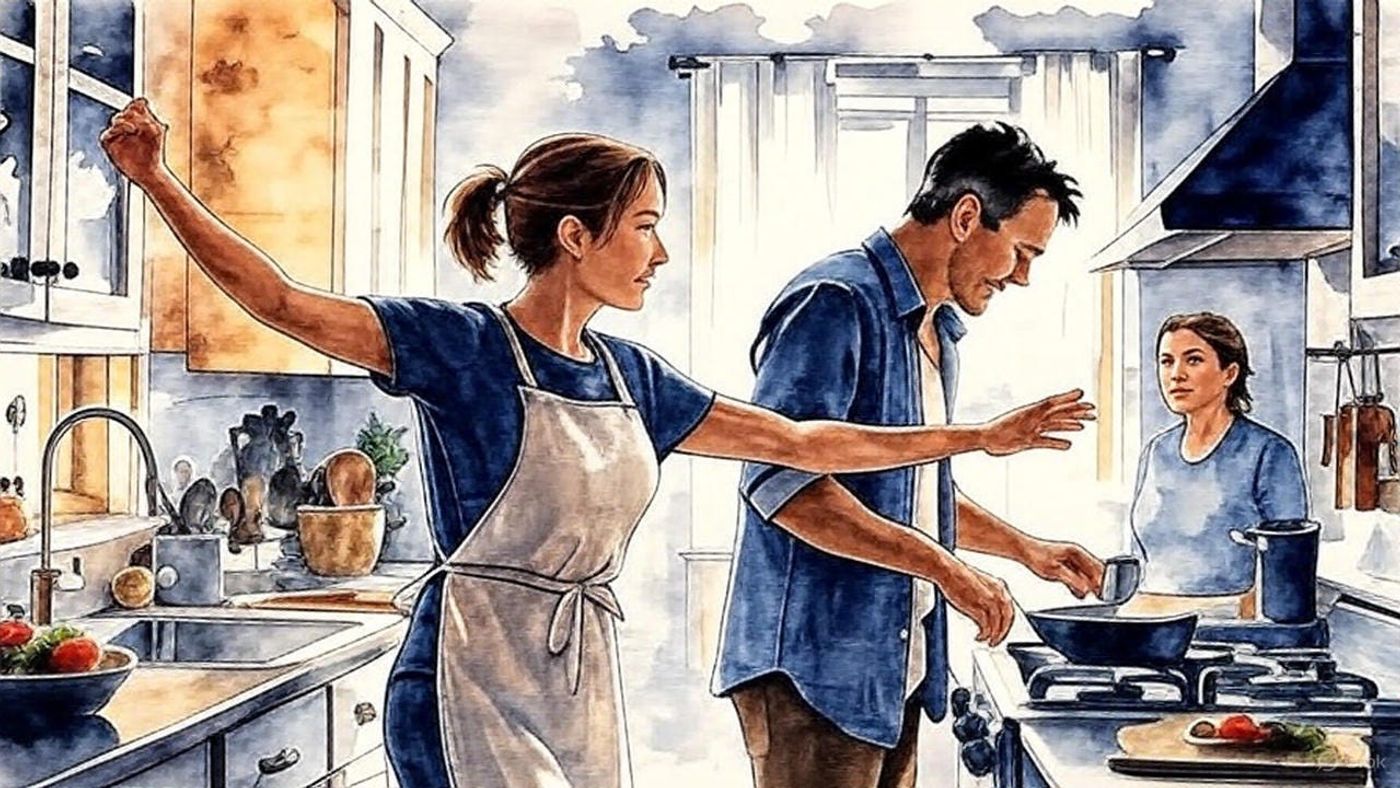
I’m standing in the kitchen of this dainty little thing from a town in Alabama so small the welcome sign was on the same pole as the now leaving sign. She’s sweet, bright-eyed, stocking feet on tile, and about as food aware as a golden retriever pawing a microwave. Her kitchen résumé revolves around Hot Pockets, popcorn, and an occasional canned minestrone.
So that is Victoria’s secret. She’s starving. How does one live without…?
She is a bit impressed that I know my way around a pantry, can sauté without setting off the smoke alarm. She tilts her head and gives me this look. Half awe, half “didn’t know they made men like that anymore.” She asks, “How’d you learn all this?”
And I don’t even have to think.
“My mama taught me.”
And just like that, the air shifts. The kitchen we’re standing in, the suburban cottage with the off-white cabinets and the shelf of knickknacks where ironware should be, fades out around the edges. Because when you say “my mama taught me” in the South, you’re not talking about a single moment. You’re cracking open a whole lineage of herb gardens and recipes handed down like military secrets, of rolling pins and wooden spoons, and generations of wisdom.
Suddenly I’m back in Mama’s kitchen, the aroma of rosemary and cinnamon. The splashboard with the tile of Jesus in the center. The cutting board Dad made from the fir tree that got hit by lightning. The counter always dusted with a fine layer of flour, no matter how often you wiped it down. And I can hear Mama now, clear as if she’s stirring a pot two feet away: “Baby, if you’re not tasting as you go, you’re not cooking. You’re hoping.”
Because of course she’d say that right here, right now, while Little Miss Hot Pocket watches me season cream like it’s a magic trick. I pick up her cutting board—plastic, barely used, still has that fresh-out-of-Target sheen—and I can feel Mama clucking in the ether.
“Okay,” Miss Alabama says, leaning in like we’re about to break open a safe. “What’s lesson one?”
And I grin, because Mama’s voice is right there behind me.
“Lesson one,” I say, “is we start with something fresh. Something alive. Something that smells like it’s got a story waiting to happen.”
She blinks. “That sounds complicated.”
And I’m back at the old house again, Mama showing me how to season a skillet like you’re courting it, how to taste a sauce with your soul. How food isn’t just food. It’s the rhythm of the day. It’s how you share love.
I had brought the ingredients to make a nice potato soup and flatbread, to ward off the January evening chill.
First out of the sack are red potatoes. Hot Pocket rinses them and presents them like rubies from the river. As she cuts them in half - “leave the skins on, they add nutrition” - and sets them to boil, I prepare the other vegetables, an onion and three garlic cloves, two carrots, some green and red pepper, a couple mushrooms, a few asparagus spears.
Winking, I tug her apron. “Gimme a little hug before the main event”. The apron is, of course, purely for show. Almost certainly the first time she ever used it.
She glides over, arms out. “My personal gourmet.” She slides across the room to pour two glasses of wine. That she knows how to do.
“Come watch”, I call out. “You have to do it next time.”
“Next time? Pretty sure of yourself, are you?”
I remember that Mama is watching. What she taught me about a good potato soup is to think of it as a bisque. Bisque is defined by its consistency. Silky, thick, delicious. Instead of shellfish, the common bisque base, we dice a slice of thick-cut uncured pork belly, and an ounce of premium southern sausage. I’m amazed and gratified to find quality cookware in a cabinet, a very serviceable iron skillet. We let the protein render, then add onion and garlic, then carefully add cream.
Mama always made it clear that high quality ingredients are essential. So I have gone all out. My girl would have been impressed with less. Honestly, though, I’m cooking for Mama. I always cook for Mama.
I start the flatbread by mixing four ingredients - flour, olive oil, water, salt - and rolling it into a dough ball. I then flatten the ball with a peanut butter jar (because she doesn’t have a rolling pin) into a very thin sheet. I sprinkle chopped rosemary and salt, cut the sheet into small triangles, and place it on a cooling rack in the oven. It only takes about 5 minutes, so we don’t turn the oven on yet.
Back to the bisque. We don’t want the cream to overcook, so we whisk it over low heat. We add salt and pepper, then the fresh herbs I had picked earlier from my garden (someday I’ll tell you how a strapping lad earned his entry into Mama’s kitchen, but when it comes to growing your own, I’m a Mama’s boy). First, rosemary, for the oil it releases in light heat. Then lemon thyme. We will add Italian parsley toward the end, because that shit just leaks flavor. It will overpower your dish if you use too much or use it too early.
Hot Pocket is enthralled, like I’m reading Akkadian scrolls. “So what now, flavor king?” over a sip of wine. She’s almost enough to let it burn. Almost. I turn the flatbread oven to 400 degrees.
“Drain the red potatoes, sous chef.” “Yes sir!” with a mock salute. Hot Pockets…
I add the trimmed vegetables to the pan, whisking constantly. She finds a French cafe music track, does a pirouette on the kitchen floor. I whisk.
“Flutter over this way,” watching her move, “and make yourself useful”. She gives the equivalent of a blank face emoji. “Add the potatoes to the pan, one by one”. Note: there is no particular reason to add the potatoes one by one, I was just messing with her. She completes the task heroically. As there was no masher to be found, I mashed the potatoes with a fork. Kinda more like a spork. A runcible spoon?
Hot Pocket is a quick study. She is quite adept at removing the flatbread sheet from the oven, which is trickier than it sounds. If not done deftly, the flatbread triangles will find the floor. She unearths a pretty teak cheese block, displays the triangles with distinct southern charm. Mama is no doubt impressed.
The potato bisque is a bit drier than I had hoped, so I add butter, a half ounce of water, and a tiny bit of new cream. Adding new cream is not a great idea, but given the small amount we are using, it’s fine. Hot Pocket, inspired, does a fine job of parsley shredding - just the leaves, no stems.
We let it simmer over low heat, and we did the same. After eight minutes, we removed it from the heat. “Eight minutes?”, she said. “That’s not a time, that’s a neurosis.”
We sat down to her bar table for two with a warm mug of potato bisque, a lovely tray of flatbread, and a glass of chardonnay. I had picked up a couple of blueberry scones for dessert. They, and the dirty dishes, will probably wait for daylight.