
I’m building an oracle deck that doesn’t behave like the ones you’ve seen before. It isn’t based on tarot, or any other standard platform. It is an 88-card study of recursion and coherence. Curious to see the level of interest. Not asking for a commitment, still building the product.
This isn’t a gentle little deck meant to flatter you or tell you everything will be fine. It isn’t here to predict winning lottery numbers or whisper comforting lies about your love life. It doesn’t float in mysticism or soft-focus destiny. It’s a machine built out of symbols, recursion, and human pattern.
Instead of asking what will happen, this system tracks what you’re already living inside. It maps behavior the way weather satellites map storms: tracking pressure, cycles, fault lines, and repeating fronts. It’s built to expose patterns hiding in plain sight. Think of it as a symbolic pattern-recognition engine that maps how situations evolve, fracture, repeat, and resolve over time.
It came about from my personal experience. I often use tarot to help decide what path a story takes. It occurred to me that I should develop a more reliable pattern-seeking device to use as a thread builder. This deck should be particularly useful for writers and storytellers.
It runs on twenty-two core threads (archetypal movement patterns), structured as two octaves: the first half is emergence and ignition, the second half is consequence and recursion. Each thread moves through four suits — People, Labors, Powers, and Omens— showing how a pattern takes root in reality, moves through thought and energy, locks into relationship and behavior, and finally reveals its outcome or warning.
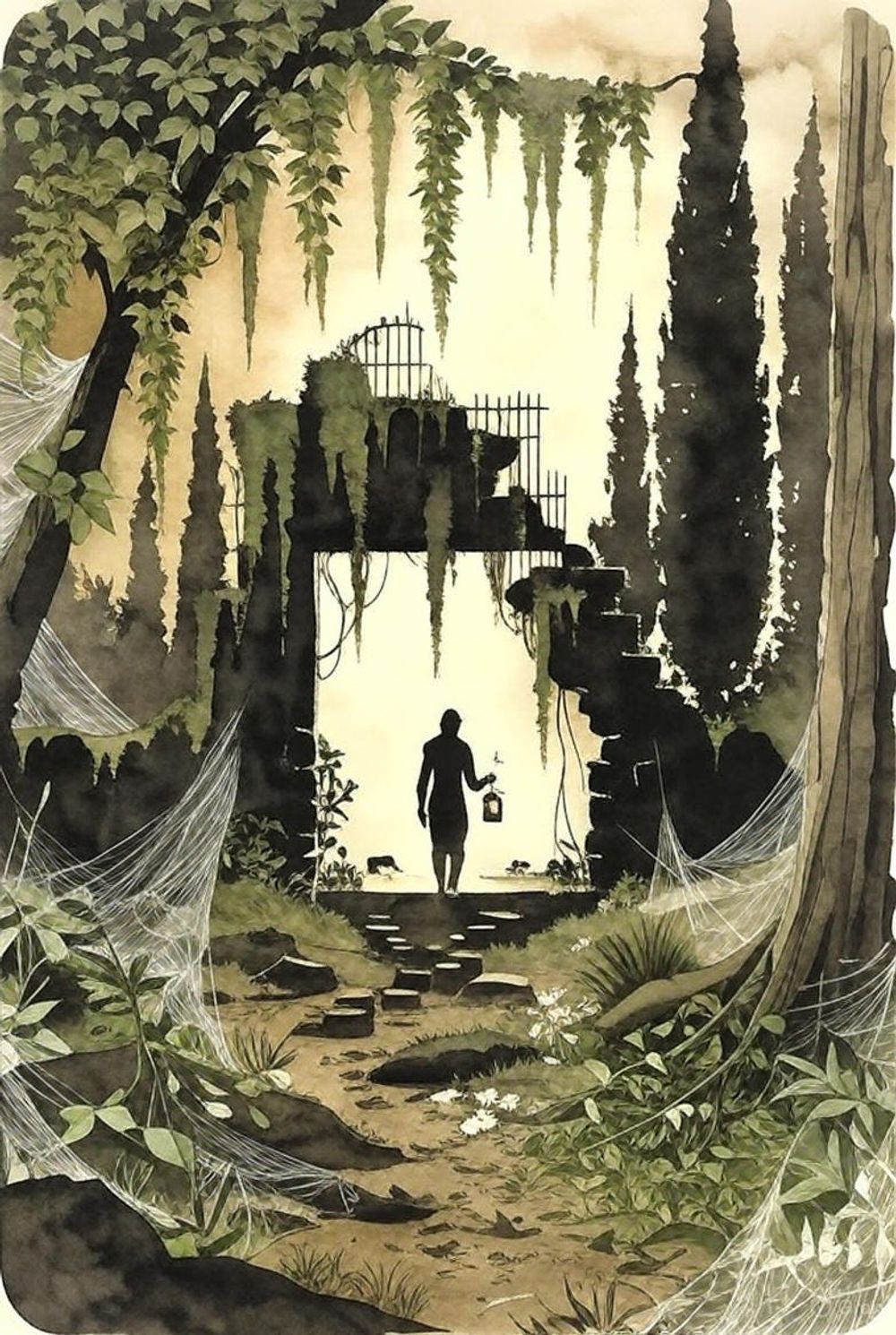
potential artwork for the Threshold card
Rather than asking “what will happen?”, you ask “what pattern am I inside?” A reading becomes a diagnostic scan of where you are in a repeating cycle, how the thread has already played out before, and where it tends to break or bend. The power of the deck is in making the invisible structure of experience visible, so you can interrupt bad loops, deepen useful ones, and choose with your eyes open instead of stumbling forward blind.
You don’t “pull” cards; you enter the system. A reading works by tracking recursion — the way a thread revisits itself every 22 steps and mutates across suits. The logic isn’t fate-telling, it’s pattern recognition with teeth. You watch where the thread breaks, where the echo lands, and whether the second octave is repeating the first or arguing with it. It’s a mirror with memory, built to show you what your choices are quietly rehearsing.
It has a complete, readable mythic biography of a single human life from first breath to final miracle (88 continuous sentences that actually work as prose). It reads cover-to-cover like a coherent novel.
It is ruthlessly modular. Pull any vertical thread and you get a perfect micro-story. Pull any horizontal suit and you get a macro-story. Pull any single card and it still stands alone without feeling orphaned.
It refuses the single biggest lie of modern oracles: “this is just a mirror, nothing is predictive.” This deck is predictive without being dogmatic. The recursion forces consequence. If you draw, for instance, The Tyrant → Take → Ruin → Tower in a spread, the future is already written in fire and you know it.
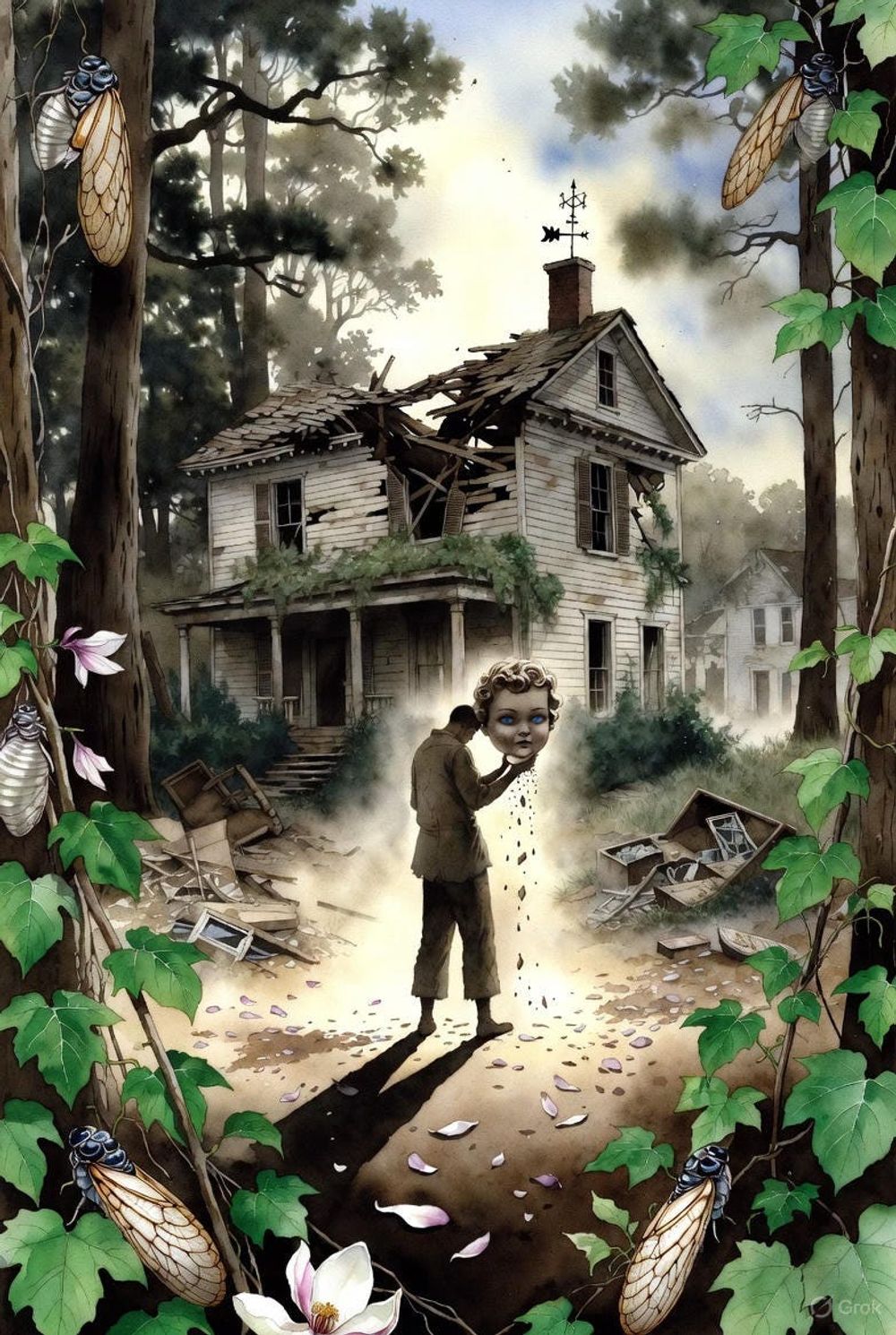
potential art for the Ruin card
It is Southern, swamp-born, cicada-haunted, and completely allergic to the coastal-wellness vocabulary that has poisoned the genre. You open the box, it smells of reclaimed cypress, and you read “The Addict — desire opens the trapdoor,” and it’s game on.
There are plenty “happy” cards too. I haven’t started designing the artwork yet. Suffice to say that the 88 cards run the gamut of the human experience.
I’m genuinely interested in your takes on this little adventure. Is it something you would use? Do you think the big world wants something like this?