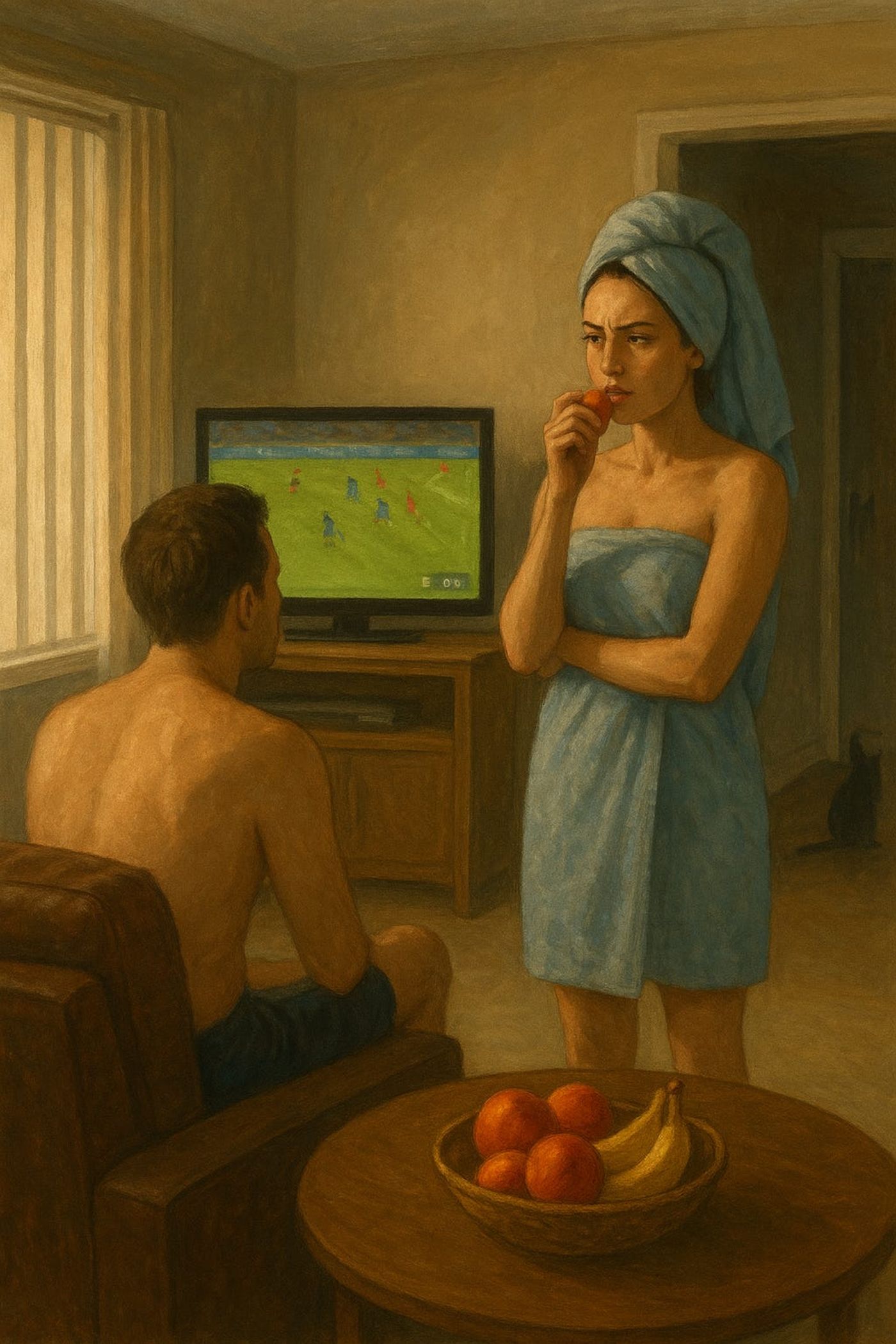
This is a rewrite of a draft from a few months ago. Would love to hear opinions on this story, or any others.
A Domestic Epic
It’s Tuesday. Or maybe Wednesday. Doesn’t matter. Time folds in this house like warm laundry. Creased. A bit damp. The dizzy spin captured into sharp corners.
Mark stands barefoot on the kitchen tile, the kind with hairline cracks that mimic his own quiet fractures. The fridge hums like it’s holding a secret. From the other room, the low murmur of a soccer match drifts in—some international friendly, no stakes, just men pretending to care about running in circles.
On the counter sits the fruit basket. His cubicle of doubt. One apple (bruised), two bananas (overconfident), and peaches. Too many peaches. Not a single nectarine. Because he ate the nectarine. Sloppy. Hungrily.
He stares at the waste basket like it owes him an explanation. “Nectarine apartheid,” he mutters. A Cold War phrase. A whispered heresy. The kind of thing you say to yourself when you realize someone in this house has made a choice, and it wasn’t you.
Thump of damp feet and a hallway sigh. She enters. Hair in a towel, skin still steaming. She moves like a woman who has read too many productivity blogs and is now on strike. Eyes a conspiracy of rebellion and boredom. Scanning the room like she’s grading it.
Mark doesn’t speak. He’s not sure he’s allowed.
She opens the fridge. Closes it. Opens a drawer. Closes that, too. Sighs. Restrained, but she might as well be shouting. The TV drones on—minute 73, nil-nil, an ad for Gatorade that Mark figures would taste like post-divorce sadness.
She looks at the fruit basket. Then at him. Then back to the basket.
The question—Where are the nectarines?—hangs unspoken in the humid air between them. He doesn’t answer. Can’t. Instead, he glances at the vertical blinds. A shape flutters in the slats—could be the ghost of his future self, or just the neighbor’s cat trying to startle the gods again. Doesn’t matter. It’s gone.
She lifts a peach, holds it like a relic. Bites. Grimaces. “Tastes like theft,” she says.
It’s going to be one of those evenings. Home sweet fukkin home.
Mark sits shirtless on the leather couch, the TV still murmuring things no one hears. His body slack, unposed. The stage directions of marriage no longer interesting. He’s listening—not to the game, but to the rhythm of her in the house. The way her lotion slaps her skin. The soft percussion of mascara tubes hitting porcelain.
She passes behind him like a comet. Wrapped in a towel. Royal. Fragile. She always passes without a word. She always does.
He looks. He always looks. But not directly. That’s part of the game. He lets his eyes track the condensation on her calves instead, the way the towel creases just slightly at her hip, a slight slackening of cotton that hints at everything and promises nothing.
She passes without a word. She always does.
In that moment, Mark felt himself dissolve, just a little. He shifted. Reached toward the basket on the table out of reflex. Mail. A dead candle. Her deodorant, the lavender kind.
The fruit basket haunts the moment. He knows the rules: don’t touch the nectarines. Like: don’t crowd me, and don’t wake me unless you’re bleeding, and I want to want you, I do.
He knows better.
She returns, sits beside him. Bites into a nectarine, one she apparently had sconced away. Juice runs down her chin. She doesn’t offer..
A striker flops onscreen, grabbing his ankle like he’s lost something vital. The game continues. Always running. Always falling.
He thinks about biting the fruit from her hand. Just leaning in. Letting the consequence fall where it may.
Instead, he stands. “Recycling,” he mutters. He turns to see her watching the screen now, one leg peeking from beneath the towel like a dare. He wants to say something. About fruit. About loyalty. About heat and permission. But the ball kept rolling, and he hasn’t decided yet what team he’s on.
She doesn’t respond. Just licks nectar from her knuckle like a spell.
From the bathroom, a hair dryer starts up and howls like some ghost of domestic ambition. He closes his eyes. The warmth of it takes him back, to a beach house on the Carolina coast, before they were married, before they were even real. She’d emerged from the shower back then, hair wild, skin glowing from some internal electricity. She stood by the window eating a nectarine, naked as myth.
He’d said something stupid like, “You look like a fruit commercial.”
She had laughed, “I’m a nectarine apartheid, baby. You don’t even know what that means.”
He didn’t. Still doesn’t. But he suspects it meant: “This moment isn’t for you.”
Even then, she lived just beyond the boundary line, just far enough to want. You could touch her, but not hold the whole thing.
The hair dryer falls silent. He wonders if she still wants out. Not from him, maybe, but from all of it: the mortgage, the threads of routine tightening into ropes, the way waking up can feel like a sentence.
He picks up the remote. Puts it down. Picks it up again. The team in blue misses an easy opportunity.
Then, footsteps. She’s pacing in the bedroom. Some rhythm only she hears is pulling her in small concentric circles.
She wants to smash the nectarine against the drywall. Wants to scream that there are people who have never even tasted sweetness, and here we are, rationing it.
Instead, she goes to the closet and pulls on his old shirt—maybe his. Maybe not. Clothes have no allegiance anymore. They just exist to soften the edges of bodies in retreat. She steps out into the hallway. The game murmurs. He looks up.
She doesn’t say anything. Neither does he. But the scent speaks the unspoken.
Says:
Do you remember me?
Says:
I’m still wild in here, somewhere, pacing.
Says:
I want you to follow.
Not like a husband. Like a thief.
He watches her. Hips doing that thing, like she’s apologizing and daring you at the same time. He waits one beat too long. That’s his habit. Second-guessing a lightning strike. But something shifts. Maybe the perfume. Maybe the way the shirt clings. Maybe the soccer ball on the screen, suspended midair.
She’s preening now. Perfume bottle in hand—the one she bought in Barcelona, back when light was Mediterranean and everything was about to happen.
Now everything has happened.
She used to write poems in the margins of receipts. Kiss in elevators to feel alive. Now she has a drawer full of potions and a man who knows how to load the dishwasher, mostly.
She sprays the perfume. Just a little. Just to see if it remembers her.
The bedroom door is ajar. Of course it is. He smells Spain. He walks the hallway like a man returning to his own home after a very long exile.
She stands at the mirror, hair wild, half-dry, half-siren. Their eyes meet in the glass. Neither flinches.
He places his hands on her waist. Fingers curl into the fabric of what might be his shirt.
“You smell like Spain,” he says.
“You smell like the couch,” she says. Flat, but smiling. She turns. Slowly.
He kisses her—not soft. Not polite. Like he dreamt this mouth into being and came back to claim it.
And for the first time in a long time, there is no waiting. No permission. Just bodies remembering they once spoke the same language.
They fall to the bed.
The crowd on TV erupts—goal, maybe. Maybe not.
Deep inside the drywall, mold and rot. Neither of them notices. Because in this room, the apartheid has ended. No rationed sweetness. No cubicle of doubt. He remembered to move. She never stopped daring him to.
The room smells of citrus and sex. The window’s cracked. The fan spins. Commercials about tires and IcyHot have replaced the soccer match.
Mark lies on his back, listening to her breath slow beside him. Her foot brushes his. No words. He reaches for her hand—just a thumb on a palm, no flourish—she doesn’t pull away.
“Don’t say anything dumb,” she whispers.
She lets it happen for three full seconds.
Then, with the patience of someone closing a book she has already memorized, she slides her fingers free.
“I’m going to shower again,” she says. Voice flat, almost kind.
The mattress shifts. Bare feet on hardwood. The bathroom door shuts with the soft finality of a border gate. Water starts. The lock clicks, delicate as a nectarine pit cracking in the insinkerator.
Mark stays on his back, thumb still curved around the shape of a hand that isn’t there anymore.
Tomorrow the bowl will be full of nectarines. Every single one of them hers. And the quiet, restored to factory settings, finally means exactly what it has always meant: minute 73, nil-nil,
and the game continues.