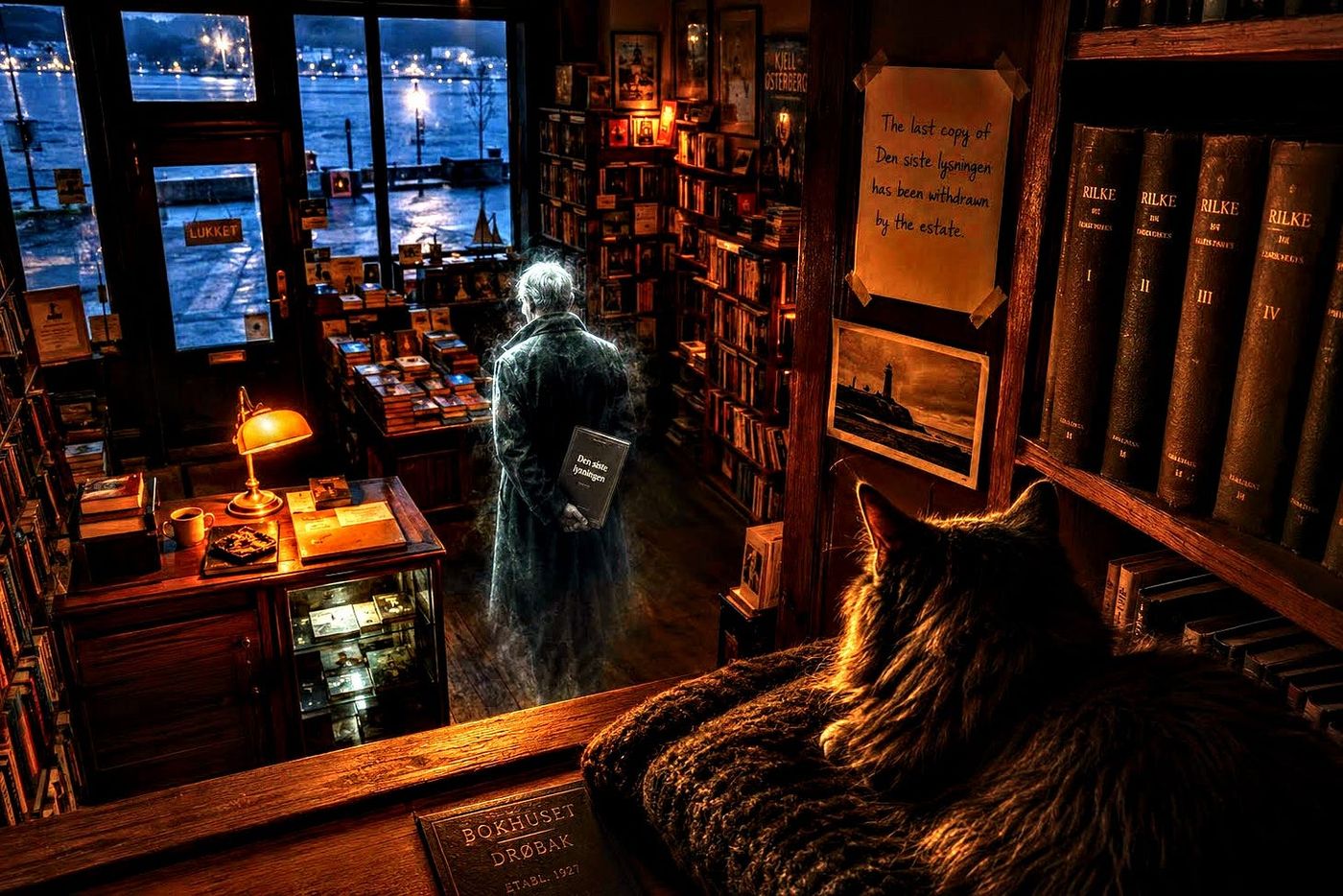
The frost is already silvering the windows of Bokhuset as the last customer leaves. Ingrid flips the sign to LUKKET, locks the door with that small decisive click she always makes, and climbs the narrow stairs to her flat above the shop. She leaves only the reading-lamp burning on the counter. A small amber island in the dark.
From the top shelf—where the Rilke volumes sit in their usual undisturbed row—I watch the room exhale into its night shape. The aisles soften. The books lean a little closer to one another.
At twenty-three minutes past one, the temperature simply slides sideways. Not a theatrical drop. Just the way frost makes everything feel thinner, more brittle. The lamp flickers once, then steadies itself like someone remembering to breathe.
He arrives the way old memories arrive, through the space where the idea of a door hangs. Magnus Vinter. Or what’s left of him. The coat carries the ghost of salt and pine tar. He floats in the middle of the center aisle for a long moment, looking at nothing. The way the living sometimes do when they are deciding.
The book is called Den siste lysningen. The Last Glimmer. Narrow hardcover. Charcoal-gray jacket. Title in small white sans-serif. No author photo on the front, no need. Everyone in Drøbak already knows the face of the author.
Kjell Østerberg wrote it. The Oslo poet who came here twelve winters ago looking for silence and found instead the opposite. Kjell has won every prize Norwegian letters can give; his early poems still sit in school anthologies beside names much older and much deader. When he chose Magnus as his subject—two years after the quiet death in the house by the fjord—most of us assumed elegy. A final gentle wreath for the town’s last real hero.
It is not elegy.
It is biography written by a man who has spent decades perfecting the art of saying the cruelest truths in the loveliest sentences. The book does not invent. It simply refuses to turn away. It sets Magnus in the unsparing light of his final months, and that light is not kind. No scandal-sheet headlines are necessary. The mere removal of the halo is enough. The town has always preferred its savior haloed. Kjell prefers clarity. And clarity, when it arrives in polished Norwegian stanzas, cuts cleaner than a paring knife.
The book has done precisely what Kjell meant it to do. It has brought attention. Journalists from Aftenposten and Dagbladet drive down from the city. A television crew sets up outside the shop and films Ingrid standing in front of the empty shelf. Literary tourists arrive—pilgrims asking to see “the book that dared.” Drøbak, which has spent decades perfecting the art of being charmingly overlooked, now tastes the sour metallic edge of being noticed. Some people are proud. Most are quietly, furiously ashamed.
That is why Magnus is here tonight.
He crosses the shelves without sound. The locked glass case behind the counter opens itself—polite, almost apologetic. The last copy slides into his wisp of a hand. He holds it the way someone holds an object that has disappointed both the giver and the receiver.
I watch from my perch as he turns the book over. He studies the back flap where Kjell’s author photo smiles with the calm, unshakable arrogance of someone who has never needed to ask forgiveness. Magnus does not open the pages. There is no need. He has already read them in the long silence after death.
He lifts his head. The hollows where eyes used to be find me.
No voice moves through the air, only certainty. I give him the slow, deliberate blink that means I see you and also I have no intention of interfering.
He tucks the book inside his hint of coat—into the place where breath used to rise and fall—and ambles toward the back door. The latch lifts itself. The alley breathes cold. The mist folds around him like a second, heavier coat.
The lamp steadies. The radiators resume their small domestic muttering.
Morning now. Ingrid comes downstairs, finds the shelf empty again. She stands there a long time with coffee cooling in her hand, then writes a short note and tapes it to the glass: The last copy of Den siste lysningen has been withdrawn by the estate. No one will press for details. Small towns understand when a subject has been closed.
Kjell Østerberg will hear of it by afternoon. He will smile that thin literary smile, light another cigarette, and begin writing something new—something even sharper, perhaps—because poets do not apologize for light.
And Magnus?
He carries the book down to the fjord, past the lighthouse he once kept burning, past the ice where he once pulled three children to safety and—much later—did the thing the town prefers never to name. He walks until the water is deep enough to be trusted, then lets the gray volume slip beneath the surface.
It sinks slowly. Pages open like tired wings. I stay on the shelf and watch the dark water through the window long after he has gone. Some stories end in print. Some end in water. Both are final.
I turn three times on the cushion behind the register, find the exact right angle of warmth, and sleep. The fjord keeps its secrets, as fjords always do.
And I keep mine.