Berlin, late summer 1927
Elise
Her name is Elise Moreau, French, born in 1899 in a village outside Arras where the soil grows sugar beets and silence. She learns early that silence is a crop you harvest with your teeth clamped shut.
1914: the Germans come like a harvest of iron. Father joins the colors, returns in a box labeled Inconnu. Mother takes in laundry from officers who pay in marks and contempt. Elise, fourteen, learns to iron collars while counting shell bursts like rosary beads.
1916: she’s a cantinière for the 112th Infantry, unofficial, unpaid, hauling coffee and bandages to the front in a cart pulled by a mule named Bismarck (irony being the only French luxury left). She learns that café ersatz tastes better when cut with gunpowder, that a kiss under fire is the only honest currency.
1917: the mutinies. She hides deserters in the laundry barn, teaches them to fold socks into birds that fly south. One night a lieutenant finds her. Instead of arrest, he gives her a Juno cigarette and a proposition: nurse the wounded in Lille’s underground hospitals. She accepts because refusal is a luxury for people with fathers.
October 1918: Lille falls, then falls again. Elise is in the cellar of a shelled estaminet on Rue de la Clef, turning the bar into an operating table. The surgeon is drunk on ether; she’s sober on adrenaline. Shrapnel peppers the air like confetti from hell’s parade.
That’s when Karl stumbles in—Gefreiter, helmet dented, blood on his cuff from a comrade he couldn’t carry. He’s nineteen too, from a Saxon village where the soil grows rye and obedience. His war is a ledger of losses. Brother at Verdun. Religion at the Somme. She stitches his arm with thread boiled in chicory. He watches her hands, steady, calloused, alive.
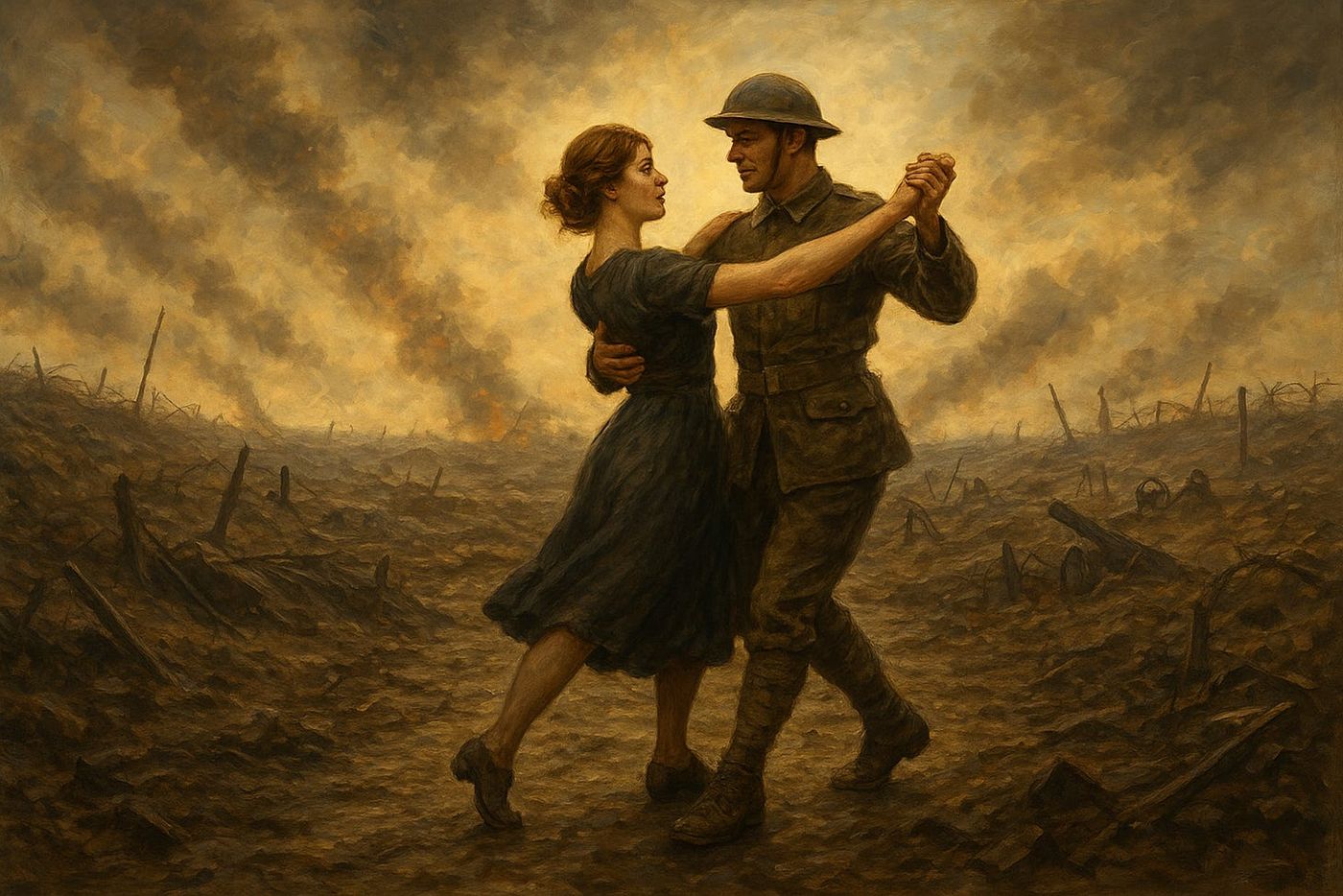
“La guerre finit quand on danse,” she says, pulling him up when the shells pause for breath. They waltz on broken glass, her hair tangled with shrapnel confetti, his boots leaving red commas on the floor.
The kiss happens mid-spin, café ersatz on her tongue, cordite on his, a transaction neither will invoice.
Armistice comes eleven days later. The cellar floods with cheers, wine, and Allied boots. Karl lands in a POW camp near Cologne. Elise stays to bury the unburied, to burn the laundry that smells of gangrene and goodbye.
1919: she follows the scent of peace to Paris, works as a seamstress in Montmartre, stitching flapper dresses for girls who’ve never heard a whistle. Her own dress is black. Mourning or camouflage, she’s never sure. She moves through Montmartre like she’s dodging artillery, like she expects the ground to argue. Her hips sway with each exhale, as if joy must be smuggled past the heart.
1920: a letter from Karl, forwarded through the Red Cross. Postmark: Berlin. He’s a riveter now, learning to build instead of breach. He writes in careful French: “The music won, but the dance is over. Come find a new floor.” She almost goes. Then Mother dies of the Spanish flu, and the village needs her to harvest the silence again.
1921–1923: she marries a schoolteacher who survived Verdun with all his limbs and none of his illusions. They open a café in Arras—Café de la Paix—where veterans drink pastis and pretend the war was a bad dream. The marriage is solvent but silent. He calls her chérie; she calls him monsieur. At night she dreams of a cellar waltz, wakes with shrapnel in her hair that isn’t there.
1924: the teacher dies in a tram accident, as irony is a thoughtful host. Elise sells the café, buys a ticket to Berlin with the proceeds and a Juno habit that costs more than rent.
1925: she finds Karl in a Siemens canteen, wooden leg hidden under the table, eyes older than the century. He doesn’t recognize her at first—war aged her into midlife well before she consented to it. Then she says “La guerre finit quand on danse.” He drops his spoon. The music wins, briefly.
They meet in doorways, never cafés. Too many ghosts. She teaches French to factory clerks. He teaches her patience and resilience. They practice the two-step of exhaustion and dawn. They don’t speak of Lille, but the shrapnel confetti falls in their silences.
1926: Greta is born. Not theirs. Karl’s wife claims the child, claims the bed, the name, the solvent ending. Elise becomes Tante Elise, the aunt who brings Juno cigarettes and stories where the music always wins.
1927: she wanders Berlin’s nights, a flapper ghost in a city that borrowed her cut and forgot to return the favor. She dances in cafés like Größenwahn, lets strangers buy her absinthe, searches every face for the boy who spun her until the shells stopped counting.
Tonight, on the Spree embankment, she lights a Juno and inhales the war’s aftertaste. A pack costs a week’s French lessons, but the blue paper is worth it. The same shade as a soldier’s eyes, the same nudge of permission. A tram rattles past with a man pressing his forehead to the glass. She doesn’t see him. But the smoke finds his window anyway, mixing with his, two ghosts sharing a lung. Elise keeps walking.
The devil’s mouth is the whole goddamn world tonight, and the music is whatever keeps her feet moving until the next white-hot instant decides to burn.
She whispers to the river, “La guerre finit quand on danse.” The water carries it downstream, past Karl’s tenement, past Greta’s dreams, past the matchbox waiting to strike. The white-hot is patient. It always strikes twice.
Lille, 17 October 1918
White-hot instant: 19:43, the cellar beneath the shelled estaminet on Rue de la Clef.
The air is a soup of carbolic, cordite, and chicory boiled three times too long. Candles gutter in green wine bottles; every flicker is a heartbeat rationed by wax.
Elise Moreau—nineteen, apron blood-stiff, hair braided tight as a tourniquet—leans over the bar-turned-operating-table. The surgeon, a captain with ether on his breath and morphine in his veins, mutters in Latin to a leg that will not be saved. She hands him the saw without looking; her eyes are on the doorway where the next stretcher waits. Shells walk the street above like drunk giants.
Thud. Pause. Thud. The rhythm is almost a waltz.
Karl stumbles in on the fourth thud, helmet askew, left sleeve dark and shining. He’s Saxon, speaks French like a prayer learned under fire. “Hilfe… bitte…” trails off into a cough that tastes of iron.
Elise catches him before he folds. He’s heavier than the poilu she dragged in an hour ago, lighter than the silence after. She eases him onto crates of bandages, rips his cuff with dressmaking shears. The wound is a red mouth screaming.
“Hold still, mon petit,” she says, voice steady as the mule that hauled her cart. She pours iodine; he hisses like a kettle. Thread, needle, boil-water, bite-down-on-this. The surgeon is busy sawing; Elise sews. Above, the shells pause. A courtesy, or reloading.
Karl’s eyes find hers: gray as North Sea fog, wide as a boy’s first leave. “Music,” he whispers. “Need… music.”
Elise laughs once, short as shrapnel. She fishes a mouth organ from a dead Tommy’s pocket. Miracle intact. Three notes, off-key, something between “La Madelon” and homesick rye. The cellar listens. Even the captain’s saw keeps time. She ties the last knot. The arm will live. The war will not.
“Up,” she says. He stands, sways. She takes his good hand. “La guerre finit quand on danse.”
They spin. Broken glass crunches under her clogs, his boots. Shrapnel confetti glitters in her braid—someone’s roof tile, someone’s life. His breath on her neck is warm, alive, solvent.
The kiss happens mid-turn: café ersatz on her tongue (three days old, still victory), cordite on his (gun oil and fear). Lips cracked, urgent, honest. No time for names. Just the transaction of pulse against pulse.
A shell whistles, closer. They drop, laughing into the straw. The explosion rocks the bottles. Wine bleeds like communion. Dust settles. Candles survive. So do they. The surgeon calls for the next. Elise straightens, wipes her mouth with the back of a bloody hand. Karl sits up, ties a rag tourniquet with his teeth.
“Name?” he asks.
“Elise.”
“Karl.”
They nod, seal it like a treaty.
Armistice is eleven days away. They don’t know. In this white-hot instant, the cellar is Versailles, the waltz is the treaty, the kiss is the signature.
Above, the shells resume counting. Below, the music—three notes on a dead man’s harmonica—wins for the length of one borrowed breath. Elise slides the mouth organ into his pocket. Karl pockets her laugh. In the pause between heartbeats, they dance on the devil’s tongue. The devil is too busy reloading to bite.
Lille, 17 October 1918
White-hot instant: 19:50, Elise’s mind mid-spin, glass crunching under clogs
His hand is furnace-warm, callus against callus—mine from cart reins, his from rifle stock. The cellar tilts like the mule’s cart on a rutted road, but I steady it with hips, with breath. Don’t fall. Don’t think. Just count: one-two-three, shell crater, one-two-three.
His lips—God, they taste of home I never had. Rye bread and gun oil, Saxon fields I’ll never see. Café ersatz on my tongue is suddenly champagne. This is what victory feels like. Borrowed. Fiery. Brief. Shrapnel in my braid—someone’s chimney, someone’s life—catches the candlelight, sparkles like the sequins I’ll never afford. Confetti for the end of the world. Appropriate. The saw behind us keeps time, scrape, pause, scrape, like a drunk metronome.
Keep dancing, Elise. If we stop, the leg comes off. If we stop, the shells remember where we are.
His eyes: gray fog over the Somme, but inside them a boy asking permission to live. I grant it. With this turn. With this kiss. La guerre finit quand on danse. I said it to tease, to distract from the needle. But the words land true as shrapnel. If we dance hard enough, maybe the devil forgets to bite. Glass grinds to dust under my clog. Good. Less evidence.
The whistle—incoming—slices the air like a scythe. Drop. We fold into straw, laughing because crying costs too much. His body over mine, shield and sinner. Warm. Alive. Dust rains. Candles flicker but hold. So do we. In the pause between heartbeats. His name is Karl. Mine is Elise. The war is a bad dancer but we’re better.
Eleven days. I don’t know. But tonight the music is three harmonica notes and the thud of two hearts refusing to count casualties. I’ll sew the next wound. He’ll carry the next secret. But this spin—this white-hot, glass-strewn waltz—is mine to keep. Folded in my apron pocket with the mouth organ, the iodine, the lie that peace is coming. Spin again, mon petit. Before the shells finish their rosary.
Lille, 19 October 1918
White-hot instant: 14:27, a beet field outside Radinghem, two days after the cellar kiss
The arm is a dull throb under Elise’s stitches. Clean, professional, kissed into memory.
Karl marches with the rearguard, pulling out of Lille like a bad tooth. The war is retreating, but it leaves teeth everywhere. The field looks innocent: sugar-beet stubble, mud churned to porridge by retreating boots. Sun breaks through for the first time in weeks, mocking, reliable light that makes the barbed wire sparkle like tinsel.
Karl’s platoon is ordered to sweep for stragglers, for souvenirs, for anything the French might use to chase. He steps off the path because the sergeant yells “Links!” and because the boy beside him—Fritz, seventeen, still believing in postcards—trips on a root.
One step. Left foot into the soft earth between beet rows. The mine is French, forgotten in the chaos of advance. A Sauterelle jumping jack, pressure plate primed for a careless boot.
Click. Time compresses to the length of a harmonica note. Karl knows. He shoves Fritz sideways, uses his good arm to hurl the boy clear.
The world lifts, flips, explodes in white-hot confetti of soil and shrapnel.
He lands ten meters away, leg a red ruin below the knee, the beet field suddenly a ballroom floor of blood and iron. Fritz crawls back, screaming for Sanitäter. Karl laughs once—short, delirious—because the pain is clean, honest, normal.
Elise said the war ends when we dance. I just danced with the devil and he took my leg for the privilege.
Medics find him clutching the mouth organ she’d slipped into his pocket. Three notes, off-key, still warm from her breath. He plays them while they saw—scrape, pause, scrape—the same drunk metronome from the cellar. The leg comes off neat, at the knee.
The war signs the treaty with a tourniquet.
Evacuation train to Cologne. Delirium of ether and rye-field dreams. He wakes in a camp hospital smelling of carbolic and cabbage, stump throbbing a new rhythm, alive, solvent.
The mouth organ is gone, pocketed by a nurse. But the three notes stay, folded in his chest like Elise’s laugh.
Two days after the kiss, the devil collected his due. Karl paid with a leg. The music won anyway, for the length of one white-hot explosion, one danse macabre of confetti and blood.
He’ll learn to waltz on wood. He’ll teach Greta the two-step of exhaustion and dawn. And every creak of the prosthetic will echo: La guerre finit quand on danse—even when the floor is a minefield and the partner is memory.
Lille, 19 October 1918
White-hot instant: 15:02, the cellar beneath Rue de la Clef
The cellar smells of fresh sawdust and yesterday’s blood. Elise hasn’t slept; the war runs on chicory and adrenaline. She’s wrapping a poilu’s head when the stretcher bearers burst in, four men, mud to the eyebrows, carrying a Saxon with a stump where a leg used to be. She knows before she sees the face.
Karl. Pale as candle wax, lips moving around the ghost of three harmonica notes. The medics shout in French and broken German.The kiss is still warm on her mouth; the mine has already cooled his blood. She drops the bandage roll. It unspools across the floor like a white surrender flag.
“Mon petit.” The words come out cracked, half-lullaby, half-curse. His eyes flutter open—gray fog over the Somme, but filmed now with morphine and fever. Recognition flickers.
“Elise…” A whisper thinner than the harmonica she slipped him. She kneels. Her hands, steady for a hundred strangers, tremble over the stump. The tourniquet is her own scarf, the one she wore the night they danced. Silk, once red, now rust.
The surgeon barks: “Move, girl. Next train to Cologne in twenty.” She ignores him. Presses her forehead to Karl’s good hand—the one that held her waist mid-spin.
You danced with the devil and he took the downbeat. She blames the Juno she didn’t smoke that morning.
A medic tugs her sleeve. “Il est vivant. Laissez-le.” Alive. The word lands like shrapnel—painful, permanent. They lift the stretcher. Karl’s lips shape her name again, soundless. His fingers brush her cheek, once, feather-light, then fall away. The doors swing. He’s gone. Train whistle outside, three blasts. Elise stands in the sawdust swirl. The poilu with the head wound tugs her apron: “Mademoiselle, s’il vous plaît…” She wraps him mechanically, eyes on the empty doorway.
Two days. The war keeps its own arithmetic. Later, in the ledger of the clearing station, she writes: Gefreiter K. — lower left amp. — stable — evac Cologne. Her hand doesn’t shake. The war has taught her that.
But in the pause between heartbeats, the cellar floor is still glass-strewn, the harmonica still plays three off-key notes, and the white-hot instant burns a new signature: La guerre finit quand on danse.
Berlin, Autumn, 1928
Greta
Bare feet silent as a trench raid.
She tugs his sleeve:
“Tell me the story where the music wins.”
He lifts her, wooden leg creaking like old floorboards.
They sway in the dim kitchen.
no band, no floor,
just the two-step of exhaustion and dawn.
“Her kiss tasted of café and cordite…”
he begins, voice low as a field telephone.
Greta’s head on his shoulder,
breath warm against the medal’s shame.
They spin until the shells stop counting,
until the kettle whistles a truce,
until the city outside pretends
the war is a bedtime story
with a happy ending.
But in the pause between heartbeats,
the cellar’s wet stone lingers,
and the next white-hot instant
waits in the matchbox,
the kettle’s whistle climbs,
shrill as a trench flare,
then settles into a low, domestic growl.
Karl hushes it with a rag-wrapped hand,
steam curling like surrender.
Greta’s weight is feather-light,
a rationed miracle in his arms.
She smells of sleep and carbolic soap,
the only clean war he’s won.
“More,” she whispers,
eyes half-mast but hungry
for the part where the shells hush.
He carries her to the window,
cracked open to the courtyard’s breath:
a neighbor’s radio leaking “Valencia”
through thin walls,
a cat arguing with a dustbin lid.
“Her kiss tasted of café and cordite…”
he continues,
painting Elise in softer strokes now,
no shrapnel, just confetti of laughter,
the cellar a ballroom with candle stubs.
Greta’s fingers find the medal,
trace its edges like braille for bravery.
“Is the music still winning, Papa?”
He looks out:
dawn bleeding pink over the tenements,
smokestacks yawning awake,
a woman on a bicycle
delivering fresh rolls
that cost yesterday’s wages.
“For now, Liebling.
For the length of one kettle.”
The city stirs,
pretending the treaty stuck,
that reparations are just a promise away.
Karl closes the window.
Sets Greta down.
The two-step ends
in the warm geometry of her cot.
He tucks the blanket under her chin,
a trench parapet against nightmares.
Outside, the radio fades to static,
then to the morning announcer:
“Berlin stock exchange opens strong...”
Greta’s eyes flutter shut.
In her dream,
the music wins forever.
No shells, no cellar,
just an endless kitchen waltz
with a father who never limps.
Karl stands in the doorway,
wooden leg silent now,
listening to the pause between heartbeats
where the war rehearses its comeback.
ready to burn.
Baltic Coast, August 1930
the pier at Binz, Rügen Island
The sea is a dull Baltic pewter, wind sharp enough to shave the foam off the waves. Karl, Elise, and Greta walk the pier’s warped planks—three silhouettes against a sky that pretends the crash never happened.
Karl’s wife, Anna, died in the ’29 flu wave, the one that swept Berlin like a bad debt collector. No drama: fever, cough, gone in four days. Greta, five now, asked once why Mama didn’t dance anymore. Karl answered with silence and a tighter hand on her shoulder. Elise arrived for the funeral in a black coat that smelled of Arras laundry soap. She stayed.
They rented a fisherman’s cottage for the week—American money from Elise’s tutoring, Karl’s overtime at Siemens. The radio stays off; headlines are poison even on holiday. Greta runs ahead, barefoot, collecting amber fragments that look like frozen shrapnel. “Papa! Tante Elise! This one’s got a fly inside—still flying!” She holds it to the sun; the insect’s wings blur eternal.
Karl’s wooden leg thuds steady on the boards. New model, lighter, carved from beech. He carries a wicker basket: rye bread, herring in oil, a bottle of real Mosel. Elise walks beside him, arm looped through his good one. Her hair is shorter now, flapper cut grown out to a practical bob. No sequins. Just a linen dress the color of trench mist. At the pier’s end, they sit.
The Juno habit is down to one a day, rationed like everything else. She lights it at sunset, cupping the match against the Baltic wind. Karl doesn’t complain. Greta calls the smoke “Tante’s cloud letters.” Elise exhales toward the darkening sea, watching the ribbon dissolve like the republic’s promises.
Greta perches on the railing, legs dangling over water that could swallow the republic. Karl uncorks the wine with his teeth—old trench habit. Pours three enamel cups. Greta gets half. “To unfinished business,” he toasts, voice low as a field telephone.
Elise clinks. “That ends when we dance.” She stands, pulls him up. The leg creaks like old floorboards, but holds. They sway—no band, no floor, just the two-step of sea wind and memory. Greta watches, amber in hand, then joins, her small hands on their hips, a triangle against the horizon.
The sun drops, bleeding pink over the water—same bruise as that 1928 dawn, but solvent for now. A steamer horn sounds three blasts: not a warning, just a schedule. Karl spins Elise once, careful. Her laugh cracks open like a fresh paycheck. Greta spins herself dizzy, falls giggling into their arms.
They dont mention the lists getting longer, the boys in brown shirts marching in Berlin, the radio voices sharpening like bayonets. They know.
The white-hot instant is patient.
But here, on this pier, with salt in their lungs and amber in a child’s fist, the music wins for the length of one borrowed coat of sunset. Greta whispers: “Tomorrow we build a castle that floats.” Karl nods. Elise smiles, eyes on the darkening sea.
The devil’s mouth is the whole goddamn continent.
Tonight, they dance on his tongue.
The tide hasn’t decided yet to swallow or to sing.