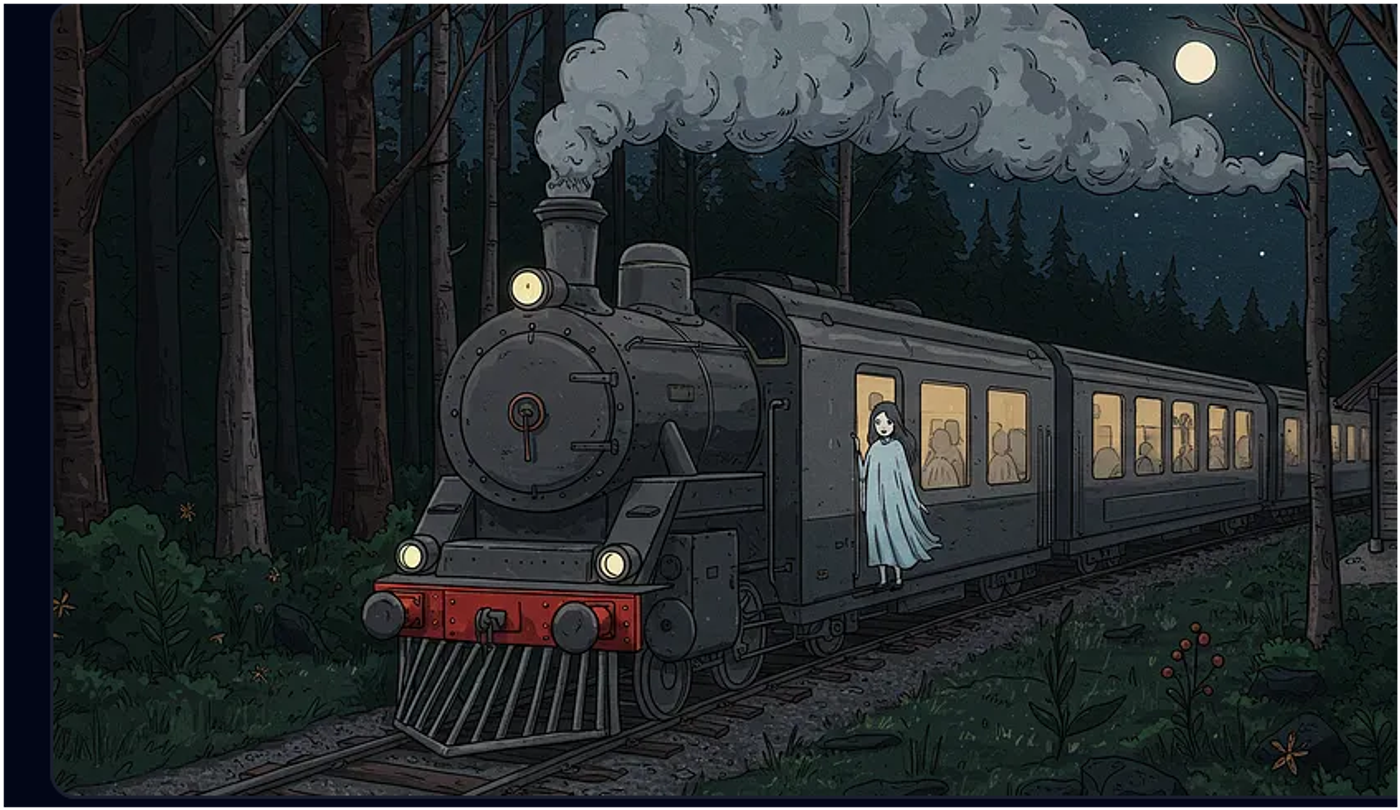
The path into Destiny runs crooked as a dog’s hind leg. Two iron stripes wind through a forest so thick you wonder how they fit tracks in at all. Pines crowd in like they’re listening. Walnuts crack like buckshot as they fall.
Follow the bend by the river and there’s the old train station, the one folks would rather forget about. Nobody goes there much, not the living anyhow. But every Wednesday, along about four-twelve in the morning, the train comes.
Don Carter didn’t care for Wednesdays. Never did. He kept to a rhythm, hoping time would settle. Mornings were for the chickens, afternoons for the shed, evenings for the church if his back would let him manage. He wore the same brown jacket most days, patched at the elbow, and people nodded when he came by Luke Denton’s store. Luke said he could smell the stench around old Don, gave him a wide berth.
Harriet McCall was an ordinary Sunday kind of child, hair a little wild from play, with a laugh that could make the owls stop and listen. It was July when she disappeared, the year the Calistat River nearly dried up, the summer the county fair let the midway lights burn out. Some said she wandered too close to the bluff. Some suspected widow Blythe’s sorcery. Others thought some city slicker had taken her away. Don knew otherwise.
Don Carter ran a place back in his day: a general store in the front, an auto repair garage in the back. Don had a logical mind, organized, a place for everything and everything in its place.
That day, Edna, the counter girl, was sick, so Don was minding the store. He could see the school playground across the street, where little Harriet was doing the hula hoop. It wasn’t the first time he had noticed her wispy frame gliding across the surface of the earth, like an angel calling out to him.
After a bit, she came down to the store, looking for a soda. What happened next is plain to anyone who looks past the polite facades. Don put some kind of magic in that drink. And while he did what he did, Harriet woke and screamed. Don snuffed her out.
Wrapped her little frame in a nylon tarp, stuffed her in the trunk of a junk Chevrolet for a couple days. He carried her to the back of his land in the middle of the night, and buried her deep, covering the earth with leaves and sticks. Nobody would ever see a trace.
Abner McCall was frantic when his little girl didn’t come home for dinner. She loved Grandma Ellen’s potluck stew, never missed it. He and Dorinda, Harriet’s mama, knocked on doors, asking if anyone had seen her. The last anyone knew, she had been at the schoolyard, playing with Tom Bigbee’s boy.
It was dusk when they got to Don Carter. He put on a performance worthy of the theater over in Morgantown, acting like he didn’t know a thing.
The sheriff organized a search party. Don was at the front of it, leading the men through the holler, down to the bridge, up along the thickets by the playground. They even searched the Bigbee yard. Needless to say, they never found Harriet. Never at all. Absence carves its own story into a place.
Rumors swirled, as they always do: the handprint in the garage, old lady Blythe screaming at the kids, Rudy Bigbee pretending ignorance. People muttered that Don shouldn’t lead the search if his boots were muddy. But Don kept his jaw set and went on with chores. He went to church, sat at the VFW, learned to let the town take its measure of him.
Yet the whistle at four-twelve cut clean through him when it rolled into the old station.
The 4:12 didn’t announce itself. Windows glowed like oil lamps low on fuel. No smoke. No conductor’s call. Doors eased open for passengers who had no business hitching a ride. Folks in Destiny pretended not to notice. But they did.
Harriet was always on it. She stepped off the train and took three steady steps toward the road, maybe a quarter-mile past the sagging fence where Don’s land met the woods. She didn’t run. No, she just walked the way folks do when they know where they’re goin. Sometimes she carried a rag doll with its seam split at the shoulder; sometimes a tin pail, the sort used for berry-picking. Sometimes she brought nothing at all. But she always wound up in front of Don Carter’s house, just standing there in the pale light, like a moon forgetting to shine.
The first thing she left on Don’s porch was a Dixie cup, a smear of lipstick on the rim, ice that didn’t melt. Next time she left a flashlight. It shined when he touched it. Then a scrap of ribbon tied around his fence post, the kind the school used for trophies. She never spoke. He watched from his window. One Wednesday, she shimmered at the foot of his bed, asking why, in a voice so silent it filled the house.
He thought he could leave, change his name, breathe new air. He sold a truckload of old junk, packed three suitcases, and caught a flight out of Charleston, through Chicago, over the water into a world that did not know him. Tokyo was loud; the lights made him small in a new way. For three days he slept. On Wednesday, at 4:12 a.m., he was back in his bed, Harriet staring at him like a wounded animal. He had no idea how he got there.
He tried again to leave the town for good. Each time the four-twelve found him. He’d wake in a cheap motel half a state away, the room tilting until he was on his feet and the road had him in its hand. The whistle would come, in his head or across the hills, and he’d be back in his bed, Harriet asking why he would do such a miserable thing.
Don began to drink more. Coffee by day, whiskey by night. He talked less, the space between his sentences widened. Folks said he looked pale as creekstone. He tried to stir, to be the man he used to be. He was one who could drive a straight nail with a straight back. But Don folded in on himself the way a man does when shame is daily bread. The yard went wild. The roof leaked. He stopped visiting the store.
Wednesday came as it always did. The train slid in like a hand over a Bible. Harriet paused at the bend by Don’s fence, then glided to his porch and laid a rope down on his step. She waited, watching for a face at the window, then turned back to the tracks as the train sighed and took its load away.
In the train window the next Wednesday, just past where the light bent against the glass, a face sat beside her. Don Carter, jaw slack, eyes like river rock. He didn’t turn away or beg forgiveness. He sat like a man who had been called and answered, like a thing that had finally learned how to keep the terms of its punishment.
The town took its bearings and kept its mouth shut. The sheriff didn’t open a folder. Down at the VFW, the boys finished their beers. Church bells kept their schedule. Every Wednesday, the train came through, carrying what the town could not. Don Carter was kept to the small, organized logic that had always been his measure. He would not slip the debt, the steady, unsparing metronome of the four-twelve.
When visitors ask now, years after Don’s porch light went out and his furniture gathered dust, they’re told the fib that keeps the place polite. “He lit out, I heard.”
But if you come up the road at the right hour and stand by the river bend, you’ll see a luminous train, stopping at the old station. If you stand still and let the night press in, you might see a little girl step off a train and lay something down.
You may see a man in the window beside her, eyes fixed on the hills, carrying his sentence like a coat.
In Destiny, doors don’t close all the way. A town needs to remember what it owes. The forest parts, the train pulls in. And certain as 4:12am, justice comes on Wednesday.