DISSONANCE IN THE GARDEN CITY
I have a room booked in Tirana in a couple weeks. Flying to Spain from Tirana, as it is the cheapest airport around. I booked an extra day in the capital city on both sides of the Spain trip, just to take the temperature. Well, it got hot.
There is a certain sense of psychological dissonance. My past visits to the Albanian capital were defined by tranquil, shaded strolls around Grand Park, the serene reflections of Lake Tirana, lush surrounding pine forests, and the unpretentious warmth of its people.
For over a decade, official state narratives and international coverage presented Tirana as a vibrant, reinvented Balkan metropolis—a triumph of urban aestheticism, public art, and European integration under the stewardship of a self-styled artist-politician.
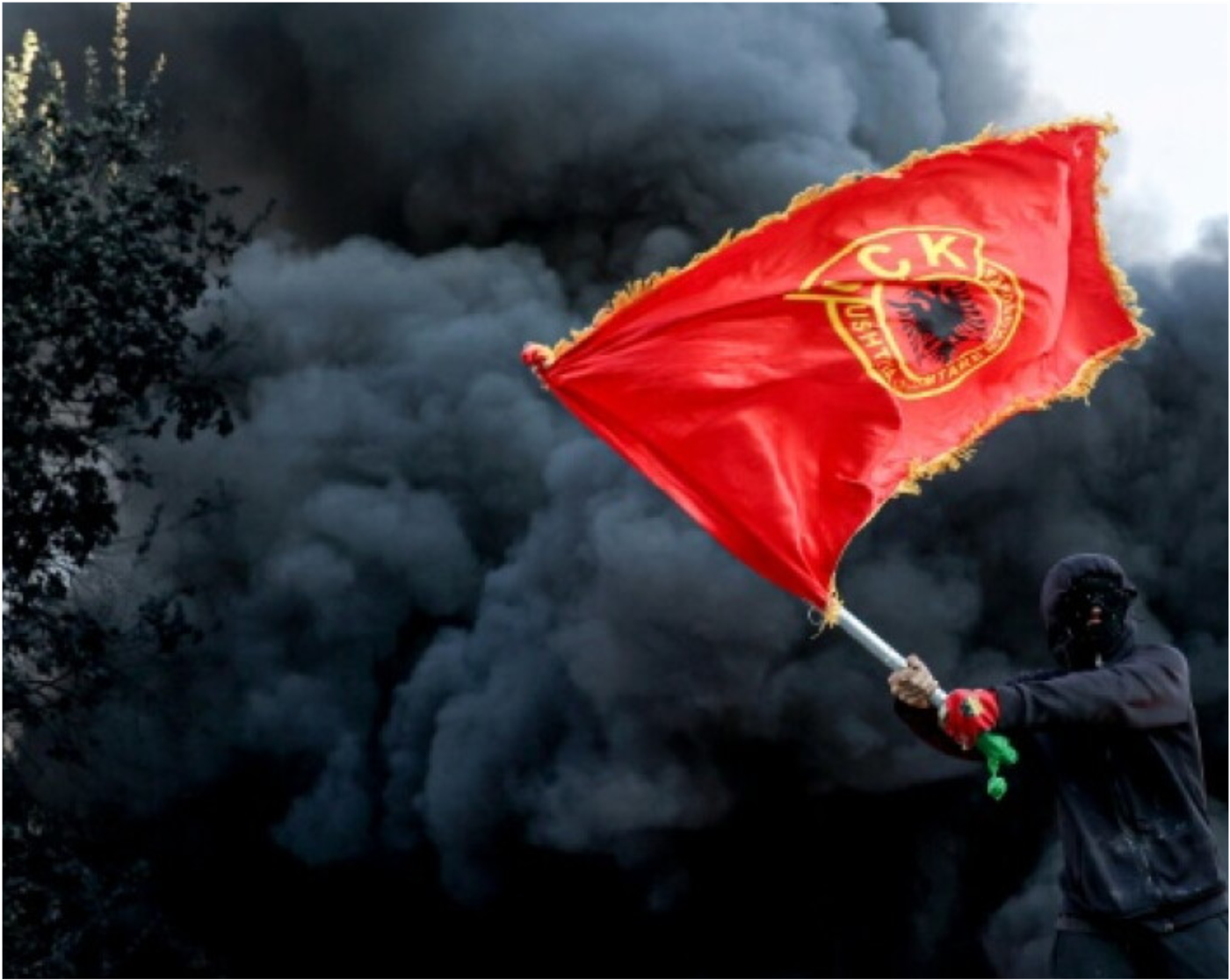
That soft-power veneer has shattered completely. The peaceful garden city has been transformed into an urban battlefield. Central Tirana is currently choked with acrid tear gas and heavy black smoke rising from burning makeshift barricades. Petrol bombs illuminate downtown intersections, boutique store facades sit smashed, traffic signals lie destroyed in heaps of twisted wire, and violent clashes erupt between heavily armored riot police and street crowds.
This violent rupture is the inevitable escalation of months of peaceful protest which the government has essentially ignored.
In my first report on the Flamingo Revolution back in June (link here), I said “Happy demonstrations, however large, don’t move an entrenched government off its position. Open-ended demands for “real change” don’t either — they’re easy to agree with and impossible to act on. If the flamingos want more than a paused construction permit, somebody is going to have to step out of the crowd, say exactly what they want and from whom, and accept the exposure that comes with no longer being anonymous inside two hundred thousand people.”
I was far more correct than I wanted to be. The happy revolution accomplished little. Now, the revolution is angry.
THE OCTOBER ESCALATION
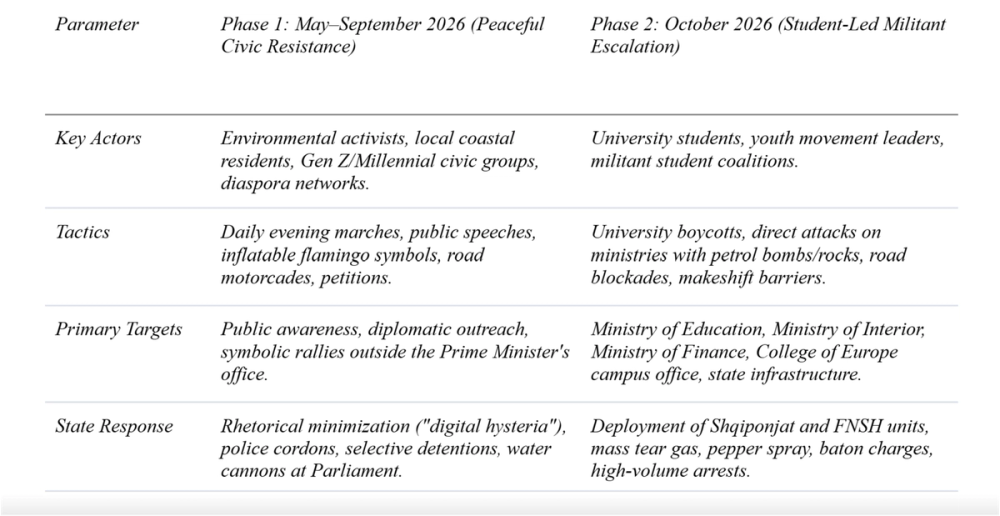
For more than 100 days, the “Flamingo Revolution” operated as a non-violent, broad-based civic movement. What began in May 2026 as localized resistance against luxury coastal development projects—mobilizing up to 250,000 peaceful marchers along Dëshmorët e Kombit Boulevard on June 20—was met with complete government indifference and executive arrogance.
Prime Minister Edi Rama repeatedly downplayed crowd sizes, attributed demonstrations to “digital hysteria” or foreign “hybrid war,” and insisted that state-backed luxury developments would proceed without interruption.
Rama argues that the “Flamingo Revolution” protests against his government, while partly driven by legitimate domestic grievances, have been deliberately amplified by foreign interests.
He has accused Greece and regional competitors of fomenting unrest out of jealousy over Albania’s booming tourism industry, particularly opposition to his coastal development plans.
Rama also contends that anti-Trump political forces are exploiting the protests because of a proposed €4 billion luxury resort investment backed by Jared Kushner, Donald Trump’s son-in-law. I covered this aspect of the protest extensively in a July post, found HERE.
Then, in a recent speech at the UN, Rama blamed external actors for using AI-driven disinformation campaigns to spread fabricated narratives, including rumors of a foreign takeover of Albania’s coastline, inflaming public fears and undermining his government.
On October 9, 2026, Kushner issued a public defense of his firm’s foreign direct investment vision in Albania. Representing Affinity Partners and Sazan Real Estate Development LLC, Kushner cited a €230 million private land acquisition and promoted a long-term vision projecting up to €4 billion in investment on Sazan Island and Zvërnec.
Kushner, and the executive stonewalling, transformed civic frustration into a militant, student-led uprising. Abandoning symbolic evening marches, youth and student groups held university boycotts, established strategic road blockades, and targeted symbols of state power directly between October 13 and October 15.
Demonstrators launched direct attacks on state infrastructure, throwing rocks and petrol bombs at the Ministry of Education on October 13, followed on October 14 and 15 by attacks on the Ministry of Interior, the Ministry of Finance, the Prime Minister’s office, and the campus office of the College of Europe.
EDI RAMA
The destruction at the College of Europe office is not random. The institution represents European Union (EU) integration, the mandate Rama claims as his primary goal.The news this morning (Oct 16) shows Rama speaking from the smoking ruins, stating that he will not step down, as the majority has given him a mandate to pursue the target of integrating Albania into the EU by 2030.
Rama is the long-time leader of the Socialist Party of Albania (PS), which is the country’s primary center-left political force and a member of the global Socialist International. He has been popularly elected four times, most recently on May 11, 2025
In the May 2025 general election, his Socialist Party won in a landslide, capturing 52.2% of the vote and securing an expanded 83 out of 140 seats in parliament.
Edi Rama remains a deeply polarizing figure. The country is split in half politically (sound familiar?). His supporters credit him for driving an international tourism boom and advancing Albania’s European Union integration.
His detractors say he is selling Albania to the highest bidder, that he and his administration are corrupt, and that the rising cost of living indicates his lack of concern for the people.
To maintain power and counter dissent, Rama utilizes sharp, high-handed rhetoric that dismisses critics and opposition leaders rather than engaging with their grievances. A masterful communicator, he frequently uses direct social media platforms to bypass traditional journalism, occasionally labeling critical media and domestic protesters as tools of foreign interference, artificial intelligence deception campaigns, or regional rivals trying to derail Albania’s progress.
International watchdogs, political analysts, and domestic critics say that Rama treats the political opposition harshly. His approach is generally defined by an intense combination of sharp public rhetoric, aggressive defensive strategies, and significant structural dominance over state systems.
THE STATE APPARATUS
The state response has been unyielding. Special police units—including the elite Shqiponjat (Eagles) and the FNSH (Rapid Intervention Forces)—deployed water cannons, tear gas, pepper spray, and batons against crowds in Skanderbeg Square and surrounding government precincts. In a single night (Oct 14) of running street battles, emergency facilities treated 89 injured individuals, including 61 police officers.
The desperation and rage driving this shift are captured on the frontlines. Kiara, a masked student protester, articulated in a street interview the systemic collapse of opportunity for young Albanians: “Our prime minister is the meaning of the word corruption. You can only find work in your field if you know a guy who knows a guy.”
Political analyst Afrim Krasniqi, Director of the Albanian Institute for Political Studies in Tirana, emphasized in an October 15 statement to The Guardian that executive intransigence pushed the civic movement past a point of no return:
“Young Albanians are tired of all the corruption, tired of all the arrogance. They want to live in a better country and they are not afraid to use violence... There is no prognosis. Nobody can say what will come next. I think this week we reached a turning point. The government had more than four months to talk to people, who every day have been out on the street. It chose to belittle and dismiss them instead. And now students have joined in, and they appear to have the upper hand.”
NARCO-LAND
Allow me to state unequivocally that I have no evidence for or against the charges being made. I can state with confidence only that deep-seated public rage is now directed at the alleged laundering of organized crime capital through state-sanctioned real estate projects.
Judicial documentation and paper trails uncovered by SPAK (Special Structure against Corruption and Organized Crime) have illuminated ways in which certain public institutions and legislative frameworks have been weaponized to accommodate illicit financial flows. SPAK, however, is itself contested ground. Some agents work to clean up corruption. Others, it seems, work to conceal it.
Michael Rubin, Senior Fellow at the conservative American Enterprise Institute, wrote in May 2026:
“(Albania) is no stranger to organized crime, but incumbent Prime Minister Edi Rama has taken the country’s criminality to a new level. His legalization of marijuana cultivation has provided cover to launder drug profits as Albania becomes Europe’s drug hub for not only marijuana, but also heroin, cocaine, and methamphetamines.
Rama consults frequently with Turkish Prime Minister Recep Tayyip Erdogan, whom he openly models himself after. Like Erdogan and his cronies, Rama and his allies make money confiscating land for development. Those who stand in his way — former Deputy Prime Minister Arben Ahmetaj and Tirana Mayor Erion Veliaj — find themselves fighting spurious charges from SPAK, an Orwellian anti-corruption force that acts increasingly as Rama’s private militia.”
THE MARGINALIZED KIDS
The explosive anger witnessed in Tirana reflects the grinding economic reality facing Albanian youth. The domestic labor market is severely distorted by credential inflation, systemic brain drain to Western Europe, and widespread patron-client networks where professional advancement depends entirely on political affiliation and nepotism rather than merit.
While public university infrastructure decays—characterized by neglected facilities, underfunded research, and escalating fees—young citizens are systematically excluded from viable economic futures in their own country.
Albania faces one of the world’s most severe brain drain crises, ranking among the top 10 nations globally—and the highest in Europe—for the emigration of highly skilled and educated individuals. The exodus involves Albania’s most educated, ambitious minds: doctors, engineers, researchers, and software developers.
In the past five years alone, over half a million Albanians, mostly educated youths, have filed for asylum, work permits, or residency in the EU. Roughly 44% of the Albanian population now lives outside the country. About 70% of those emigrants are under 34 years old, and at least 47% hold university degrees.
A recent poll indicated that some 80% of university and postgraduate students plan to leave Albania within a few years of graduation. Over 3,500 medical doctors have left for Germany alone over the past decade, severely straining local clinics and hospitals.
Studies estimate that the loss of human capital costs Albania up to €500 million in education investments annually, representing an overall economic impact of roughly 5% to 6% of its GDP.
In stark contrast to this youth marginalization, executive spending decisions consistently favor high-visibility state spectacles. The Rama government in July issued an “urgent” emergency reserve fund release of some €4.2 million to subsidize a private live concert for American artist Kanye West. For reasons, of course. Suffice to say it didn’t sit well with the kids.
THEN THERE IS KUSHNER
The earlier two articles in the series laid out the Kushner problem, and I encourage you to link back to that work to understand the Kushner issue. The thumbnail summary is that members of the Trump family met with PM Rama on a yacht owned by a Rothschild to discuss the purchase of prime environmental property in coastal Albania, assets that the Rama government apparently had no right to sell. The announcement of the proposed deal was the spark for the Flamingo Revolution.
The deal appeared to go dormant in the summer. The populace believed the transfer had been halted. But then, last week, Kushner made his new defence of the project, laid out his “long-term” proposal. So the deal was now back on, and so were the protests. But now, the hot-blooded youth had joined the movement. No more pink picnics. The kids are demanding action.
THE THIN VENEER OF CIVILIZATION
Tirana’s crisis brings to mind a visit I made recently to Dachau—the site of the first Nazi concentration camp. What remains most profoundly unsettling about that site is its setting: situated amid tranquil greenery, embedded within a town of reasonable, everyday citizens. It serves as a stark reminder of how rapidly civilizational norms dissolve when institutional checks fail and ordinary people accept the darkness as fait accompli.
Civilization and social order do not disintegrate overnight. Tirana is not Nazi Germany by any stretch, at least at this moment. Yet, as I have discussed in earlier writings, Albania is new to self governance, a bit fragile, and some sketchy characters are circling the situation. It could go either way.
Public assets have been appropriated for private gain. There is no transparency. The people suspect the judiciary is corrupt. Official policy ignores the people. Arrogant executive decrees steal capital. Shady individuals hold real power. Political arrogance dismisses months of peaceful civic petition.
The social contract is under duress. The old saying is that civilization is nine square meals from chaos, even in the best of times.
It’s an old story.
"'Cause when love is gone, there's always justice. And when justice is gone, there's always force. And when force is gone, there's always Mom. Hi Mom!" —- Laurie Anderson, "O Superman" (1981) (link to my article on this)
Hi. Mom. In whatever way you send positive energy, send some toward the wonderful people of Albania. They deserve a better fate than this.