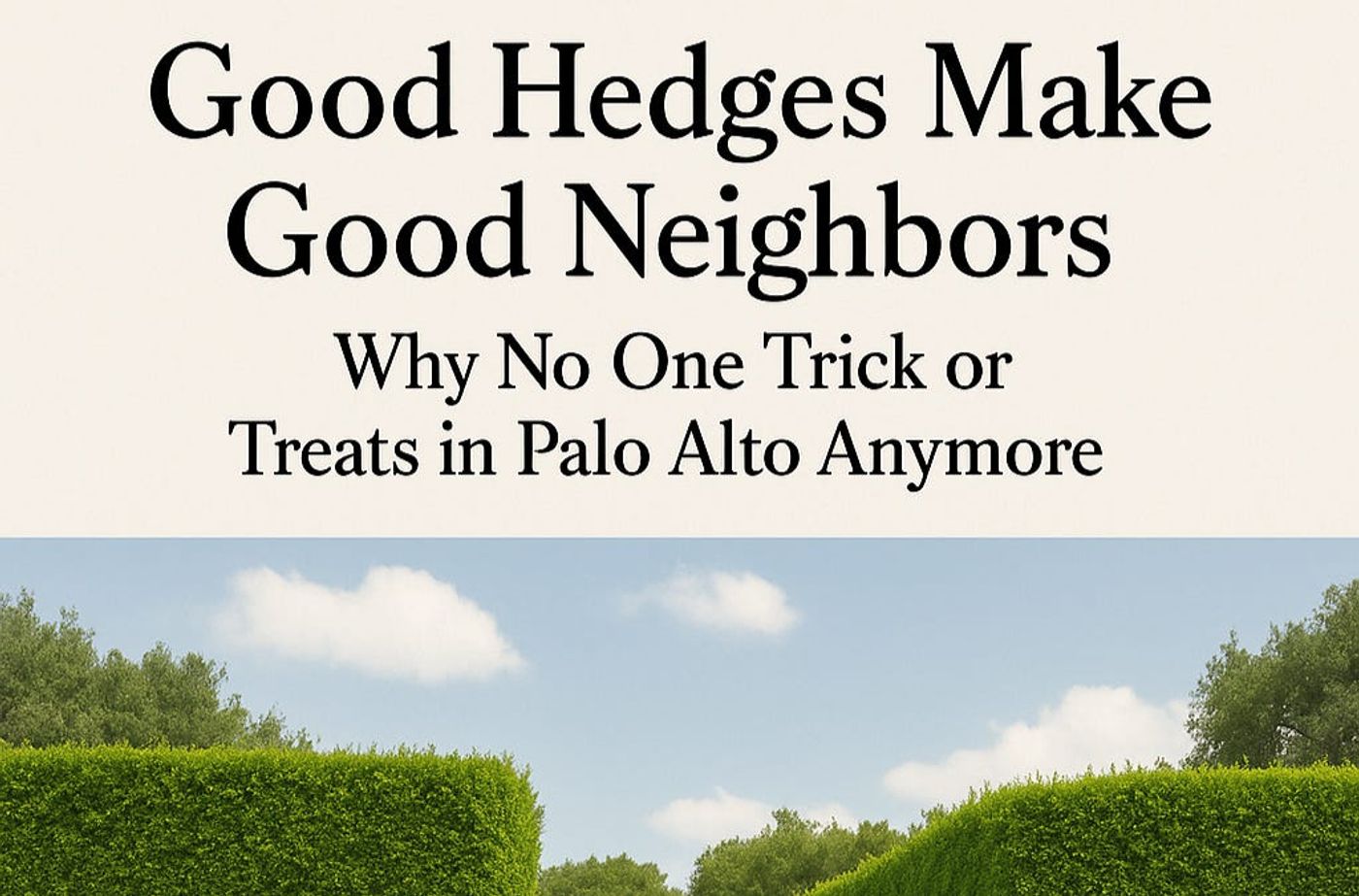
It starts with the hedges.
Not your run-of-the-mill suburban hedges, but chlorophyll-thick declarations of sovereignty — each one a living firewall telling you, in the language of manicured foliage, we don’t do casual encounters here. They guard the perimeter of Mark Zuckerberg’s Palo Alto compound like disciplined soldiers in a silent, leafy coup.
This isn’t just a home. It’s a statement, a mood board for late-stage capitalism in a year where the entire planet is high on what analysts politely call “intense global competitive mania” and less politely call “geopolitical cocaine.” 2025 is a year where nations can’t stop racing each other in AI, green energy, and space — burning cash, time, and goodwill like it’s a limited-edition NFT drop. It’s wasteful, it’s dangerous, it’s addictive… and it’s exactly the kind of fever that makes billionaires double down on their fortresses.
Pull up — not too close — and you hit the matte black gate, the sort of thing that suggests it can tell the difference between you and someone who belongs. The driveway curves like a feed you’re not supposed to scroll, ushering you toward a residence that’s not a residence so much as a 110-million-dollar mood: 11 properties, a subterranean “billionaire bat cave,” a pickleball court, and a pool with a movable hydrofloor, because normal water is for the unoptimized. Down the street, the neighbor who complained about all the construction racket is still wearing the noise-canceling headphones Marko gifted as an olive branch.
And while the gardeners edge the hedges with military precision, the world outside is casually edging into the Third Nuclear Age. Sleeker bombs. More fingers on more launch keys. Deterrence now comes in a multiplayer version: the U.S., Russia, China, the usual suspects, with North Korea and maybe Iran peeking in. Allies like Saudi Arabia and South Korea flirt with their own nukes, and everyone’s redefining “trust” as “trust, but build your own bomb anyway.”
Inside Zuckerberg’s walls, AI is the religion and Meta is the cathedral. The man is planning to spend $72 billion this year on AI infrastructure because he believes that in the near future, anyone without AI glasses will be walking around like a disembodied spirit. The compound’s gardens might be manicured, but the rest of the world is jagged: Russia and China plotting lunar nuclear reactors, the U.S. trying to slap one together before 2030, all while the South China Sea turns into a floating middle school fight and NATO plays venture capitalist to military-tech fledglings.
Here, on Walled Garden Drive, you can smell the irony. The guy who built his fortune convincing humanity to share every meal, meme, and meltdown is now building a private school for 14 kids in one of his homes — in violation of zoning laws, of course — and somehow, no one at city hall is in a hurry to shut it down. The neighbors call it “occupied.” His staff calls it “neighbor relations.”
Beyond the gates, green energy and AI are locked in the same arms race logic that once built bombers. China dominates hydrogen, sells EVs like candy, and fusion energy might actually arrive early enough to make its own punchline obsolete. Inside the gates, the koi pond does not care.
It’s not that the compound is indifferent to the world; it’s that it exists in a reality where the world is an optional tab. The nuclear saber-rattling, the fragile Gulf détente, the exhausted grind in Ukraine, the Trump-brokered peace deals, the military-industrial complex swapping spit with the green-energy-industrial complex — they’re all just background noise to the algorithm that’s deciding how much sunlight the hydrangeas need today.
In the end, Zuckerberg’s Palo Alto compound is the perfect avatar of 2025: the planet is in a high-speed demolition derby for AI, space, and energy supremacy, and here is a man who has already declared his keep-out zone — not on the moon, but right in the middle of Silicon Valley. The rest of us are out there playing techno-utopian poker with debt, war, and orbital junkyards; he’s in here adjusting the pool depth by remote control.
The world may be on fire, but the compound remains, sipping its artisanal air, secure in the knowledge that while the geopolitical cocaine wears off eventually, good hedges last forever.