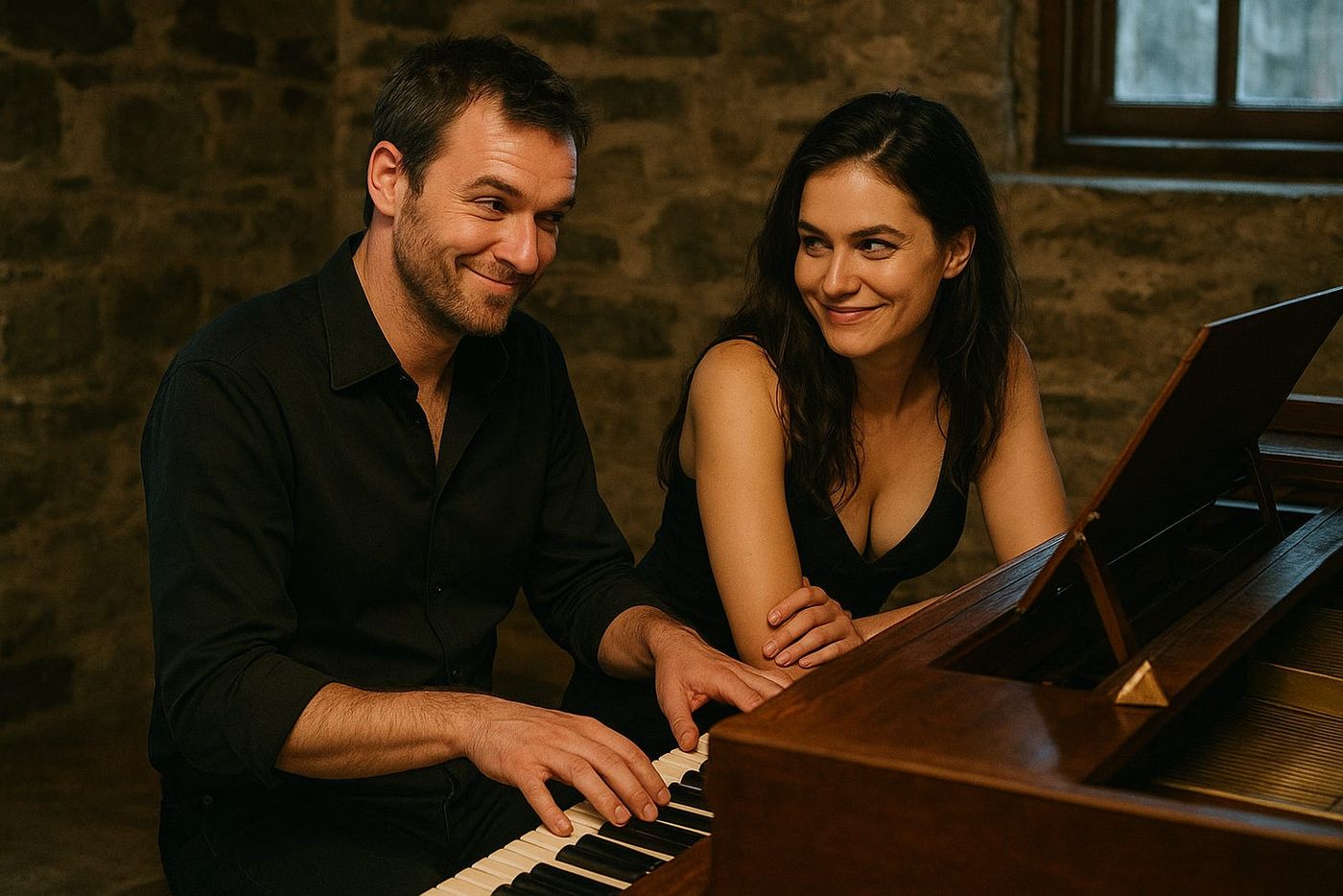
Dara’s heels clicked a syncopated code across the parquet, each step a jab at the metronome he’d never bothered to set. The Steinway—mahogany lungs, ivory teeth worn from three generations of frequently careless use—remembered better players. Third octave E was long gone, a casualty of cousin Glynn’s vodka-fueled Chopin bender in ’98. Still, the old beast held pitch the way a drunk holds a grudge. Crooked but lethal.
She paused mid-stride, arms still cocked like loaded catapults, eyes triangulating the lone Toblerone he’d left on the music rack. Bait. A single golden trapezoid winking under the banker’s lamp. He didn’t look up, just let the left hand walk a bass line that sounded suspiciously like “Heart and Soul” if it had been raised by wolves.
“Subtle,” she said, voice pitched somewhere between NPR and a switchblade. “You angling for a thank-you note or just testing if I still salivate on cue?”
He answered with a glissando that skipped the missing E like a stone over a pothole. The chord resolved into something almost tender, the musical equivalent of shrugging in cashmere.
Dara peeled the foil with the reverence usually reserved for papal bulls. The chocolate snapped cleanly. Deliberate, vaguely obscene. She let the first triangle melt on her tongue, eyes of delight, a storm front deciding whether to hail or just loom.
“Still warm,” she murmured through the cocoa haze, “like you rehearsed the placement. Temperature, angle, emotional blackmail—PhD in passive aggression?”
“Street credit,” he corrected, finally meeting her gaze. “Doctorate’s in applied guilt. Minor in leaving Swiss bait for Irish tempests.”
She laughed once, sharp enough to cut the night, and flicked the empty wrapper into the wastebasket. Two points. The piano lid accepted the applause with a dusty thud.
“Play it again, Sam,” she said, sliding onto the bench beside him, hip checking him half an inch left. “But skip the missing note. We’ll call it avant-garde.”
His fingers hovered, then dove. The melody returned, ragged but real, two mismatched hearts hammering out a duet on a keyboard with a hole where middle E used to live.
Dara was born in a taxi on the N7 outside Limerick, the driver swearing in three dialects while her mother—sixteen, feral, and already done with the world—pushed like she was evicting a tenant. The cabbie cut the meter, handed over a receipt that said “one girl, no charge,” and that was the only invoice Dara ever paid in full. With interest. In chaos.
Her childhood smelled of peat smoke and wet wool. Granny’s cottage had the Steinway no one played because the keys stuck like guilty consciences, but Dara learned to pry them loose with a butter knife and a curse. By eight she could pick out “Danny Boy” in a minor key that made the parish priest cross himself twice.
By twelve she’d traded the butter knife for a switchblade and the parish for the back room of a bookie’s where the real music was the clatter of dice and the hush when someone’s luck ran out.
Dublin swallowed her at seventeen. Art college on a scholarship she forged herself, with calligraphy so flawless the admissions board thought it was a Renaissance relic. She studied sculpture because clay didn’t talk back, but mostly she studied people: how a shoulder blade twitched when a lie was forming, how a laugh could be weaponized.
Her thesis was a life-size bronze of her mother mid-scream, mouth open wide enough to park a bicycle. The examiners gave her a First and a wide berth.
She paid rent by ghost-writing memoirs for politicians who couldn’t spell “contrition.” Learned that power tastes like cold tea and older men’s breath. Learned that lightning doesn’t strike from the sky; it’s generated in the hips of women who’ve been told to sit still one too many times.
At twenty-five she walked into a gallery opening wearing a dress made of shredded court transcripts—her own juvie record, redacted in gold leaf. A critic from the Times called it “feral elegance.”
That night she met a cellist who played Bach like he was picking a lock. They shacked up in a warehouse loft with a skylight that leaked on the bed and the cello in equal measure. He taught her that vibrato is just controlled shaking. She taught him that some notes are better left unplayed. They broke up when he tried to tune her.
Then came the years of controlled demolition. She tended bar in Temple Bar, smuggling rare manuscripts in hollowed-out Toblerone boxes (the irony delighted her), running an underground salon where poets read while pickpockets practiced sleight of hand on the audience.
She got a tattoo of a treble clef coiled around a lightning bolt on her left ribcage.
She learned three things that stuck:
- Every room has a frequency; find it and you own the air.
- Chocolate is a solvent for almost any silence.
- Never trust a man who apologizes with flowers. Trust the one who leaves a single perfect triangle of Swiss alchemy on a piano older than both your sins combined.
Now she moves like a rumor with hips, arms akimbo because the world keeps trying to fold her into something smaller. The storm in her hair isn’t static; it’s charged memory. She doesn’t enter rooms. She recalibrates them.
And the missing E on that Steinway? She took it. Years ago. Keeps it in a velvet pouch next to the switchblade. Some notes you don’t play—you weaponize.
Dara knows him the way a safecracker knows tumblers—by the click of childhood echoes in a grown-up ribcage. They met at fourteen in the back of a Garda van, both cuffed for separate flavors of petty larceny. He’d been lifting classical LPs from a charity shop (Beethoven for the adrenaline, he claimed); she’d filched a fountain pen from the mayor’s pocket during a school tour.
The sergeant parked them on a bench outside the station, told them to “contemplate consequences.” Instead they harmonized a filthy sea shanty in four-part counterpoint until the desk clerk paid them to shut up.
Later, he slipped her half a Kit-Kat through the bars; she taught him how to palm it so the CCTV saw communion, not contraband. First communion of many.
Years vectored them apart. Him to conservatories that smelled of rosin and regret. Her to the aforementioned warehouse lofts and forged scholarships. But the city’s a Klein bottle; every road loops. They re-collided at thirty-one in the basement of a failing jazz club on Capel Street. He was subbing dep on an upright that had more cigarette burns than ivories; she was evicting a handsy saxophonist with a pint glass and physics. Their eyes locked mid-mayhem. He recognized the switchblade scar on her thumb; she clocked the way he still tucked his left pinky when agitated, same as when he’d fumbled that first Kit-Kat. No names. Just a nod that said still alive, still awful, still us.
After that, gravity did the rest. He became the only fixed point in her orbital chaos: the guy who could splice a Bach fugue into a trap beat without breaking stride, who left Toblerone like breadcrumb trails because he knew sugar was her Kryptonite and his love language.
She became the variable that kept his equations from solving too neatly: the woman who’d kick in his door at 3 a.m. with a stolen Stradivarius case full of pilfered jazz tapes and a grin that could power the grid.
Tonight? She’s there because the velvet pouch with the missing E started quivering three days ago, like a tuning fork. She felt it in her sleep, a phantom vibration under the treble-clef tattoo.
Google Street View showed her the Steinway was still breathing in his flat above the shuttered butcher shop. She didn’t knock. Used the fire escape, the window he never latches because “burglars don’t test Bach.” The Toblerone was confirmation he felt it too. Some debts you don’t settle with words; you settle with chocolate and a chord that skips the note you both stole.
She’s not planning to stay. She never does. But for the length of one melted triangle and one fractured sonata, the room is exactly 440 Hz of home.
The bench creaks like a confession when she shifts, her thigh a live wire against his. He keeps the left hand rolling those wolf-raised arpeggios, right hand ghosting the melody so the missing E is a held breath neither of them takes. Cool is the currency she’s always cashed in; he’s the Federal Reserve of chill, minting frost since the Garda van days. But the air’s gone thick, humid with Toblerone ghosts and the ozone off her skin.
Dara leans in, slow enough for a UN resolution, lips brushing the shell of his ear. “Still playing monk, maestro?” His pedal foot twitches. Sustain pedal as panic button. The chord blooms, decays, blooms again.
He answers without looking, voice pitched to the back row of a half-empty concert hall: “Monk’s overrated. I’m more of a Coltrane man, long as it resolves in twelve bars.”
She laughs, low, a subharmonic that rattles the piano’s soundboard and his resolve in equal measure. Her hand finds his knee, thumb tracing the seam of his jeans like she’s reading Braille for “own this man.” He feels the switchblade scar on her thumb, remembers how that same blade once drew his blood in a friendly bet over who could lose a bishop in chess faster. Blood brothers, chocolate sisters. Dublin’s weird sacraments.
“Eyes on the keys, choirboy,” she murmurs, but her own gaze drops to the pulse hammering at his throat. She knows the topography, the exact latitude where cool fractures into carnal. Has mapped it with tongue, teeth, and once, memorably, the blunt end of a cello bow.
He risks a glance. Lightning in her hair, thunder in the way her pupils have swallowed the green. The room tilts; the Steinway lists like a drunk ship. His right hand abandons the melody, lands on her wrist. Piano fingers, pickpocket grip. Her quick turn toward him spills the little blue pouch; the ivory E tumbles out, clinks once on the parquet like a dropped coin in a confessional, comes to a stop against his bare ankle.
“Dara,” he says, half warning, half benediction, “we finish this, the key stays on the floor. Some holes you simply don’t fill.”
She grins, feral elegance in HD. “Good. I like my music with a funky story.”
Then she’s kissing him. Not soft, or sweet, but the way a storm kisses a lighthouse. Inevitable. Illuminating. Slightly destructive. The bench topples. Sheet music avalanches. Somewhere in the wreckage, the Toblerone wrapper glints like a spent cartridge.
He rips the dress of shredded court transcripts because of course it’s tonight’s outfit. Symbolism’s a bitch. She tears his shirt because buttons are for people with time. Skin on skin, the treble-clef tattoo sparks against his chest; the missing E buzzes like a trapped bee against the floorboards.
They sink into each other the way a minor seventh resolves—tense, gorgeous, temporarily. The piano watches, impartial, its third octave forever silent. Some notes you don’t play. You fuck to them instead.
The bench is on its side like a capsized confession booth; sheet music snowdrifts across the parquet in accidental origami. They’re tangled in the wreckage, limbs braided the way counterpoint braids voices, equal parts accident and architecture. The Steinway above them, lid half-open like a voyeur who’s seen too much and still wants an encore.
He’s first to move, fingers tracing the lightning bolt tattoo on her ribcage, now slick with sweat and the faint metallic tang of exertion. The treble clef looks smudged, as if the ink itself came. “Still humming?” he asks, voice hoarse from minor thirds and her name.
Dara exhales a laugh that’s half smoke, half psalm. “The E’s vibrating like a goddamn pager. Think we just tuned the room to 69 Hz.” She rolls onto her back, court-transcript dress in tatters around her hips, and stares at the ceiling crack that maps the exact route of their history: Garda van to jazz basement to this exact pile of splinters.
Silence settles. Not the awkward kind, but the kind that follows a standing ovation when the house lights stay down. He props himself on an elbow, studies her the way he studies a tricky modulation: reverent, wary, already hearing the resolution.
“I was cool,” he says finally. “For, like, four whole minutes. Personal best.”
“Bullshit,” she counters, but soft. “You were molten the second I unwrapped the bait. Cool’s just your drag, baby. I see the tempo under the tux.”
He snorts, plucks a stray Toblerone foil from her hair like it’s confetti. “And you? Ms. Recalibrate-the-Room? You walked in here with a storm in your stockings and dropped it in my lungs.”
She turns, meets his eyes, green on whatever that color is when his guard’s down. “I felt the vibration. Had to check if you were bleeding out or just finally ready to admit the hole’s ours, not the piano’s.”
His hand finds hers, thumb to scar, mayor’s pen, Kit-Kat, blood oath. “It’s ours. Always was. I just needed the chocolate to say so.”
Dara sits up, slow, gathers the velvet pouch from the floor. The missing E ivory glints inside like a tooth pulled in a bar fight. She presses it into his palm, closes his fingers around it. “Reconciliation’s a duet, not a solo. Glue it back if you want. Or don’t. But stop leaving Swiss rosary beads like I’m a saint who forgot her sins.”
He considers the key, then the piano, then her. “What if we leave it out? Make the silence part of the score. Call it Dara’s Divergence—avant-garde with benefits.”
She grins, the kind that could power a small city or start a riot. “Deal. But I get royalties in post-coital cocoa.”
They right the bench together, teamwork of grunts and laughter. He slides the E into his pocket. Some absences are load-bearing. She straightens what’s left of her dress, ties a knot in the transcripts like a promise ring made of red tape.
The Steinway waits, patient as an old priest. He sits, pats the bench. She joins him, hip to hip, no space for the Holy Ghost or second thoughts. Together they play, slow, deliberate, skipping the third octave like it’s a pothole on the road home. The melody’s new, less wolf, more hearth.
Still ragged, but now reconciled.
Outside, Dublin rain starts its nightly percussion on the skylight. Inside, two gutter hearts with a shared felony record lean into the same chord. It holds. It resolves. It doesn’t need the missing note to be whole.
The rain’s turned from percussion to white-noise lullaby, the kind that makes Dublin feel like a snow globe someone forgot to shake. On the bench, their shoulders touch. No daylight between, just the humid overlap of two storms deciding to share an umbrella. The new melody they’re nursing is lazy, almost bluesy, a 12-bar confession in 6/8 time.
He takes the lead; she harmonizes an octave up, voice husky from earlier athletics and the cigarette she bummed off his windowsil.
He breaks first, mid-phrase. “You know this tune’s got no name yet.”
“Call it Orgasm of Clarity in E-Flat Major,” she deadpans, then steals the bass line with her left hand, forcing him into the treble like a hostile takeover. “Minus that middle E, of course. Keeps the critics guessing.”
His laugh rumbles against her collarbone. “Critics. Right. The only review that matters is the one from the neighbors.”
She snorts, fingers dancing a trill that’s half flirt, half threat. “Old man Kelly? I bet he thinks we’re running a furniture fight club.”
The piece drifts into silence, intentional this time, a fermata stretched like taffy. Outside, a siren dopplers past, red-blue heartbeat under the rain. He pockets the moment the way he pockets the ivory E. Close to the body, no intention of return.
Dara leans her head on his shoulder, hair still crackling with static and sex. “You ever think we’re just two kleptos who graduated from LPs and fountain pens to stealing each other’s oxygen?”
“Every day,” he says.
She lifts her hand, studies the switchblade scar in the lamplight. “We should get matching ones. His and hers. Call it a late-bloomer blood oath.”
“Too suburban. We’ll tattoo the Toblerone triangle on our asses instead. Symmetry.”
“Speak for your own arse, maestro. Mine’s already a national treasure.”
He plays a soft chord—open fifth, no third, pure ambiguity. “Stay till the rain stops?”
She considers, eyes on the skylight where droplets race like gamblers on a fixed track. “Define stops. Dublin’s version is more of a lifestyle.”
“Till the kettle boils, then. I’ve got that fancy cocoa you pretend not to like.”
“The one with the chili?” She perks up, storm front clearing. “You’re evil.”
“PhD in applied guilt, remember?”
They rise together, slow, sore, synchronized like a pas de deux choreographed by gravity and passion. He rights the fallen music stand. She folds the court-transcript dress into a makeshift sarong, red tape fluttering like surrender flags.
The Steinway gets a pat on the lid, a good dog for not judging.
In the kitchenette—two burners, one sad bulb—he measures cocoa with the precision of a pharmacist cutting lines. She hops onto the counter, legs swinging, and watches him the way sculptors watch marble: already seeing the David in the defect.
“You know,” she says, “we could glue the E back tomorrow. Make it a ritual. Super Glue and swearing in three dialects, like my birth.”
“Or we melt it down,” he counters, stirring. “Cast a tiny lightning bolt. Hang it from the music rack. Dara’s Divergence: The Pendant.”
She hops down, pads over, slips arms around his waist from behind. Chin on his spine. “Or we keep it in your pocket till it wears a hole. Let absence be the feature, not the bug.”
The kettle whistles, shrill, impatient, Dublin’s national anthem at 2 a.m. He pours, hands her the first mug. Steam curls between them like incense in a chapel built for heathens.
“To holes,” he toasts.
“To the music they make,” she finishes.
They clink ceramic. The rain eases to a drizzle, then a hush. Old man Kelly bangs a broom on his ceiling. Three sharp knocks. They grin into their cocoa, two street-smart apostates who just turned sacrilege into sacrament.
The E stays pocketed. The night stays theirs. The Steinway sleeps, dreaming in five-octave color and one deliberate void.