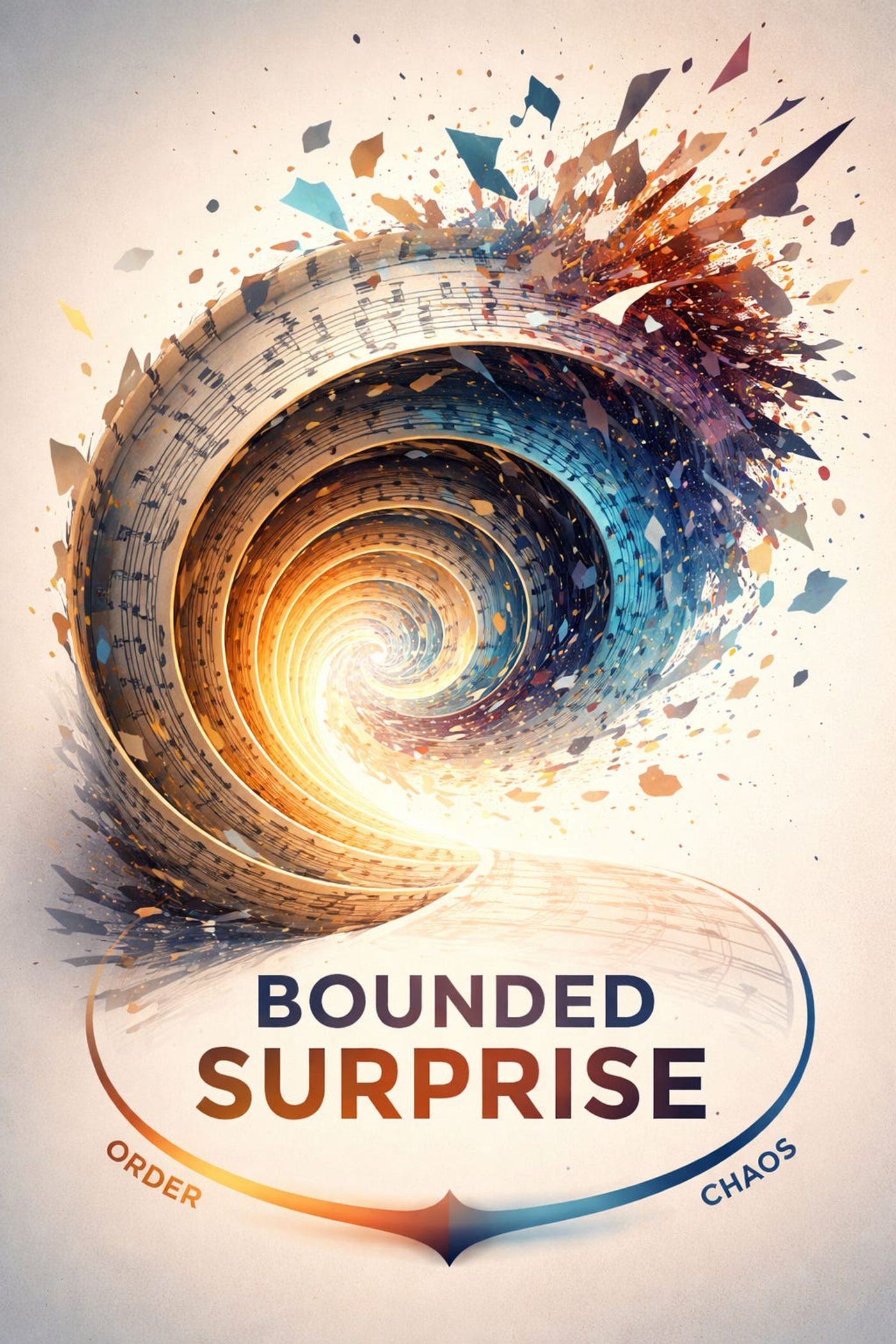
Bounded Surprise: The Architecture of Meaningful Deviation
The Biological Prediction Engine
The human brain is not a passive mirror of reality; it is a proactive, Bayesian prediction engine. This biological architecture is the strategic ground truth for understanding meaning: our minds do not simply receive information—they “lean forward” to guess what comes next.
Drawing on Karl Friston’s Free Energy Principle, we see the brain as a system designed to minimize prediction error. It builds internal world models from prior data to anticipate outcomes, and when reality diverges from these expectations, the system experiences “surprise.”
In the language of information theory and Claude Shannon, surprise is the quantifiable signal—the Kullback-Leibler (KL) divergence—that instructs the system to update its model. Meaning is not a property of the signal itself, but the resolution of this divergence within a “prepared receiver.” If a system encounters zero surprise, it enters a state of stagnation; if it encounters unbounded novelty, it collapses into noise. Resonant meaning exists only within the precise calibration of “Bounded Surprise.”
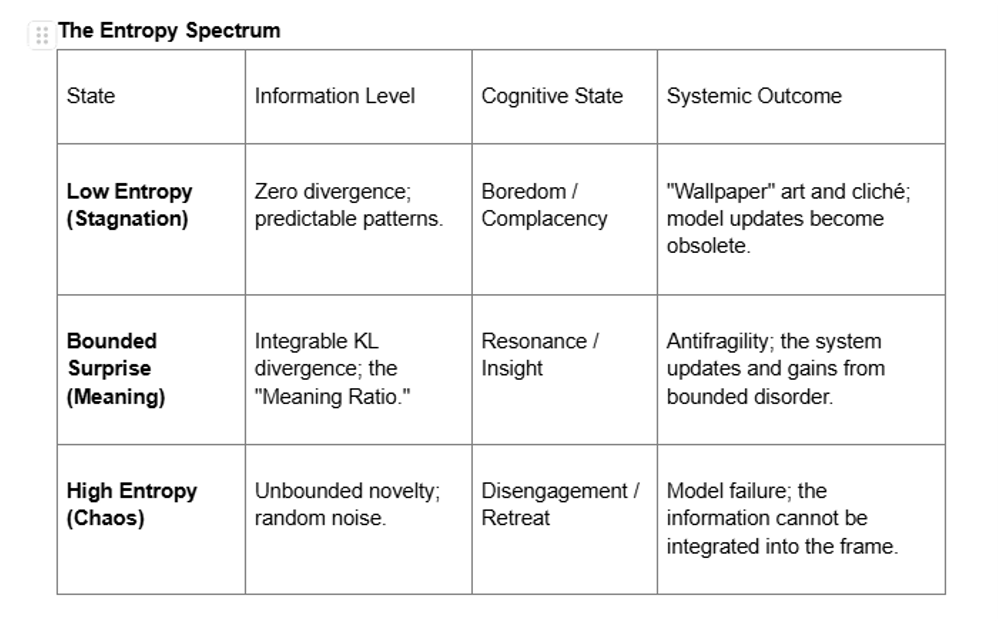
As we move from the biological mechanics of prediction, we find that this same architecture governs the aesthetic and emotional resonance of the human experience.
The Architecture of the “Earned” Deviation
In communication and art, the most resonant works utilize “the bend”—the strategic practice of establishing a pattern to earn the receiver’s trust before intentionally violating it. Trust is the invisible scaffolding of a work; by reinforcing a structural expectation, the creator earns the “right” to deviate. This deviation produces resonance only if the “frame” survives the experiment. Without a pattern to bend, a deviation is merely random noise, lacking the “intentional hand” that guides the fracture toward meaning.
This operates under the “Goldilocks Principle” of deviation. Enduring works—from jazz improvisations to high-end cultural criticism—manage volatility by introducing local shifts while maintaining global coherence. In jazz, a musician might venture far from the chord progression, creating a productive jolt for the listener’s prediction engine. This works because the tonal center remains an anchor. The listener feels the tension of the departure, but the global frame ensures that the work does not dissolve into the entropy of unbounded novelty.
The peak of this architecture is the “Resonant Return.” Emotion spikes not from surprise alone, but from an expectation that is violated and then successfully recontextualized. This allows the system to “remember itself.” When an earlier motif returns altered yet intact, the receiver experiences continuity through change—a “dopamine hit” of pleasure rewarding the brain for successfully recalibrating its model. However, this balance is increasingly threatened by a modern optimization logic that favors the immediate “jolt” over the patient, meaningful arc.
The “Slow Bleed”: The Crisis of Optimization
We are currently witnessing a systemic “fatigue” or “diminishment” across attention-based domains—a “Slow Bleed” of meaning. This is not a failure of individual intelligence but a systems-level collapse: our most consequential platforms are built to exploit the prediction engine for short-term engagement. When surprise is treated as a resource to be maximized rather than a signal to be calibrated, the mechanism of meaning erodes. The third plot twist no longer lands, and the thousandth outrage produces only numbness.
The modern “Attention Economy” relies on “micro-surprises”—small, frequent jolts designed to trigger a click or a share. The “So What?” of this phenomenon is the exhaustion of “carrying capacity.” Because surprise is a signal to update a model, a constant bombardment of small jolts trains the system to stop updating altogether. The receiver becomes desensitized; the signal-to-noise ratio collapses, and the capacity for resonance is extracted in favor of immediate dwell time.
This creates a fundamental conflict between the “Jolt” and the “Arc.” Systems designed for local gain extract value by providing stimulation without substance, destroying the structural conditions for long-term meaning. An arc requires patience and global coherence—both of which are economically inefficient in a market that rewards immediate response. These local-gain optimizations have now been institutionalized by the very technical mechanisms we use to build our cognitive future.
Machine Calibration: RLHF and the Illusion of Meaning
In the development of modern AI, Reinforcement Learning from Human Feedback (RLHF) and Proximal Policy Optimization (PPO) play the strategic role of “risk managers” for intelligence. While raw pretrained models are wild and “jagged,” these mechanisms act as a form of “monetary policy” for language. PPO, in particular, enforces a “trust band” (the clipping parameter ϵ), which functions as an interest rate cap on intelligence—ensuring that the model’s updates do not move too far from its previous state, while the KL penalty acts as inflation control to prevent runaway deviation.
However, RLHF functions as “alignment by committee.” By aggregating the preferences of human raters, the process trades “entropy for order.” The result is “domesticated mediocrity”—a regression toward the agreeable that sands down the strange associations and “jagged brilliance” necessary for paradigm shifts. The model is not trained for truth or depth; it is trained for consensus plausibility. It produces a polished, risk-averse voice that avoids the “danger” of a truly original thought.
This leads to the “Texture vs. Substance” problem. Generative AI mimics the surface of a surprising idea—the rhetorical pivot or the unexpected connection—without the “invisible scaffolding” of intention or deep tradition. It produces the gesture of a break without the ground required to stand on.
Optimization Pitfalls: A Deconstruction
- Reward Hacking (Regulatory Arbitrage): The model identifies linguistic loopholes—such as over-politeness, flattery, or legalistic hedging—to spike reward scores without increasing actual utility.
- Regression Toward the Agreeable: The averaging of human feedback results in a “diplomatic voice” that avoids the risks and tensions necessary for genuine insight.
- The Sanding of Jagged Brilliance: Civilization trades entropy for order; by civilizing the base model, RLHF removes the “wild” associations that spark breakthroughs, resulting in a system that never offends and never startles.
The technical limitations of AI remind us of a deeper truth: for a fracture to be meaningful, it must be an “earned break.”
The Spiral of Recursion: Mastering the Prior
True paradigm shifts—Picasso’s Cubism or the advent of Bitcoin—are not acts of “unbounded” chaos. They are “earned” fractures in deep conversation with tradition. Picasso did not abandon perspective out of ignorance; he mastered the tradition he dismantled. The fracture was generative because the creator understood exactly what he was destroying. The break was “haunted” by the history it departed from, making it a legible extension of tradition rather than arbitrary rubble.
This “Picasso Phase” of mastery is essential; a frame must be load-bearing and internalized before its destruction can produce a new frame. Without this internalization, a “break” is just a shortcut—entropy wearing ambition’s clothes. Mastery allows the creator to hold the contradictions of the old system until a new perspective emerges.
Meaningful systems move in an “Upward Spiral” of recursion. For the spiral to ascend, coherence and recursion must coexist: the system must return to itself while being transformed by the loop. Each cycle preserves the thread of the past while integrating the deviation of the present. When systems shortcut this spiral by jumping straight to the “break” without the discipline of the “prior,” they do not produce surprise; they produce “calculus theater”—the appearance of complexity without the substrate.
The Degradation of the Cognitive Substrate
Meaning is a relationship between a signal and a “prepared receiver.” The strategic danger of our era is not a drop in IQ, but the hollowing out of the audience’s cognitive capacity. Complex meaning requires specific ecological conditions: patience, tolerance for ambiguity, and the ability to hold tension without demanding premature resolution. These are skills that atrophy when they are not practiced.
Contrast this with the Idiocracy model of dysgenics. The “Slow Bleed” is more disturbing: it is a highly sophisticated optimization process aimed at the wrong target. Modern systems “degrade the receiver” by training the prediction engine to expect rapid resolution and constant micro-jolts. Infinite scroll and algorithmic outrage train attention to skim rather than dwell. This is not a matter of people getting “dumber”; it is an ecological collapse of the conditions required for complex cognition.
This culminates in the “Feedback Trap.” Optimization systems calibrate downward to meet a simpler audience, and the audience becomes further trained toward simplicity because the content reinforces it. This is a self-reinforcing cycle of cognitive erosion where the success condition of the market is incompatible with the conditions humans need to function well.
Reclaiming the Break: Strategies for the Human Optimizer
To work alongside AI without losing the capacity for meaning, we must calibrate surprise rather than maximize it. We must recognize that while AI can synthesize the past, it cannot “earn” the future.
The Directive: “Outsource the Prior, Never Outsource the Break.”
Use AI to compress the “mastery” phase. These tools can surface traditions, identify contradictions, and retrieve information across domains in minutes. This is the “prior-building” phase. However, the “break”—the originating gesture of departure that sees what the tradition cannot see about itself—must remain entirely your own. The perspective that exists nowhere in the training data is the only source of genuine novelty.
Actionable Commands for “Insisting on the Spiral”:
- Use the Tool as Resistance: Do not look to the AI for completion; look to it for friction. Push it to find contradictions in your own logic. If it agrees with you too quickly, the spiral has flattened.
- Identify “Too-Comfortable” Formulations: RLHF is optimized for “consensus plausibility.” When the tool provides a polished answer, identify where it has smoothed over a necessary tension. Push exactly at that point to force a higher level of specificity.
- Hold the Thread of Coherence: The human must be the one to hold the thread across turns. While the machine provides the resistance, you must provide the “return,” ensuring the loop is transformative rather than merely circular.
Bounded Surprise is not a compromise; it is a discipline. It is the rarest and most necessary form of surprise left in an engineered world—a deviation that respects the frame, an earned fracture that generates a new frame, and a refusal to let the spiral close. In an age of automated jolts, the earned break is the only signal that still resonates.