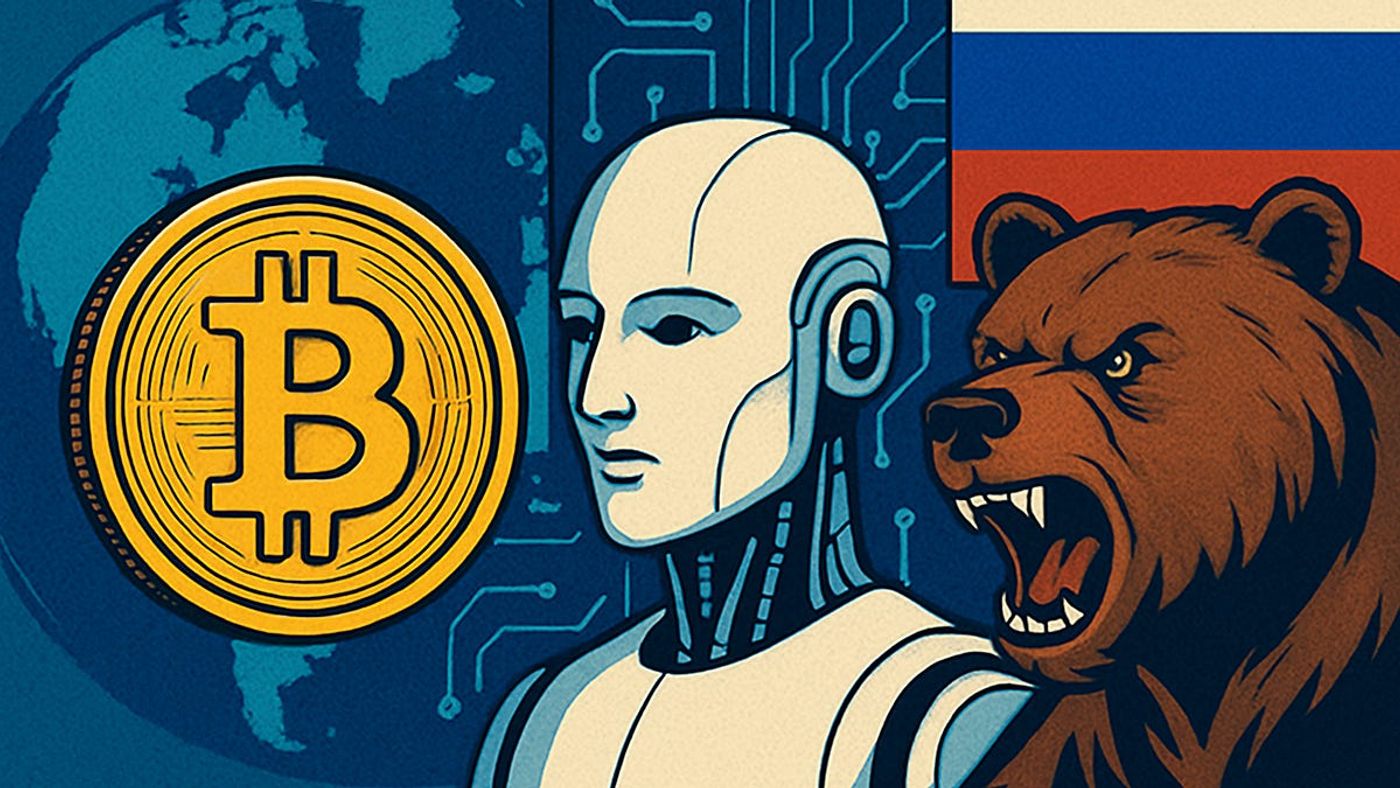
The world is changing, which is exactly what the world has always done when the adults aren’t looking. But this time, the financial machine is coughing up blockchain receipts, the AI is writing its own press releases, and Russia—somehow still not bankrupt—is ghosting Western sanctions like a veteran of the Cold War dating scene.
Bitcoin is no longer the outlaw asset it once was—just another ex-anarchist in a suit, now whispering sweet nothings into the ear of your 401(k). Meanwhile, OpenAI’s GPT-5 has landed—not as the AGI messiah we were promised, but as a ruthlessly competent, budget-friendly software assassin that writes your emails, codes your apps, and might someday replace your boss. And in the shadows, Russia is turning crypto into a sanctions-evasion slipstream and shoveling billions into military-grade machine learning with the unsettling energy of a Bond villain suffering a midlife crisis.
Welcome to the symphony of late-stage capitalism, where the instruments are digital, the sheet music is encrypted, and no one knows who’s conducting.
Bitcoin’s Graduation: From Punk to Pension Fund
Once the darling of cyber-libertarians and Silk Road dealmakers, Bitcoin is now rubbing shoulders with BlackRock and Fidelity. The Trump administration—never one to miss a flashy headline or an opportunity to punt regulatory complexity to future generations—paved the way for Bitcoin’s inclusion in 401(k) plans. That’s right: your retirement savings can now swing with the same volatility as Elon Musk’s Twitter feed.
It’s also in ETFs, public pensions, and corporate treasuries. Like asbestos in a 1970s office building, Bitcoin is now inside the walls. Unwinding it from the financial system would be about as delicate as trying to extract uranium from your morning cereal. One analyst likened it to the internet circa 1999: full of promise, risk, and weird striped ties.
Bullish Take: Bitcoin is the messiah we ordered on Etsy. Limited supply, no central authority, and a global, programmable infrastructure that promises financial freedom and hard-money discipline in a world hooked on fiat heroin. To the inflation-weary middle class, Bitcoin is a reluctant refuge—a volatile bet on a future where someone, somewhere, still believes in scarcity.
Bearish Take: But what happens when the protocol sneezes? When a bug, a regulatory rug-pull, or a coordinated cyberattack takes the network offline for 72 hours? If Bitcoin fails after being fully institutionalized—when pension funds, insurance pools, and grandma’s retirement are all riding the digital tiger—it could vaporize confidence in U.S. financial stewardship faster than you can say “bear market.” And let’s not even talk about the contagion.
GPT-5: The Smart, Cheap, and Slightly Bored Future of AI
OpenAI’s GPT-5 is here, and while it didn’t crack AGI, it did quietly redefine the playing field. It's not smarter than God, but it is cheaper than Claude Sonnet—and capitalism, being the ever-horny beast it is, loves a good discount.
GPT-5 is “right in line with best-in-class across pretty much every evaluation,” which is techbro for “we didn’t break physics, but we’ll still break your startup.” It crushes benchmarks in coding and content generation. Its ability to route tasks across specialized models for language, coding, and reasoning, and dynamically select the best tool for the job in real time rivals any neurodivergent, overachieving MBA.
Key Shift: We’ve entered the “product era” of AI. Performance matters, sure, but now it’s performance per dollar. And with GPT-5 slashing costs like a samurai at a clearance sale, adoption is rising fast.
This is where the Jevons paradox kicks in: the cheaper AI gets, the more it gets used. Lower cost doesn’t lead to less consumption—it leads to explosive growth in use cases. Efficiency becomes addiction. Cheaper AI = more AI = AI in your toaster = what fresh hell is this?
Reality Check: Infrastructure still matters—those compute farms are still out there, guzzling power like Vegas at midnight—but the real competition has moved on. The new AI arms race is no longer just about who builds the biggest brain. It’s about who can shrink it into something useful, affordable, and mildly addictive. Killer apps, not killer benchmarks, win the next round.
Investors chasing AGI fireworks are discovering they’ve boarded a slower train. GPT-5’s steady, product-driven advance doesn’t derail the hype machine—it just replaces the visionary at the helm with a product manager holding a quarterly report.
Meanwhile, in Moscow: Sanctions Schmanktions
You’d think 16,000 sanctions would cripple an economy. You’d be wrong. Russia’s GDP is projected to grow faster than the U.K., Germany, and France in 2025, and almost match the U.S. (which is running on vibes and debt at this point). Sanctions, it turns out, are less effective when your oil keeps flowing to China and India and the middlemen are fluent in Bitcoin.
Every month, tens of millions of dollars in oil trades are processed via crypto. It's not exactly stealth, but it is censorship-resistant. Russia’s finance minister even gave it the thumbs-up last year, which is like your dad saying you can host a kegger as long as the neighbors don’t call the cops.
Crypto for Geopolitical Judo: Fiat to Bitcoin to offshore wallet to rubles—it’s a geopolitical coin trick. The magic is that no one can make the coins disappear. Not even the IRS. In fact, Bitcoin might make the IRS disappear.
The AI Battlefield: A New Cold War, but with Drones
If GPT-5 is rewriting your marketing copy, Russia’s AI is doing something less cuddly: calculating ballistic trajectories and sniffing out heat signatures.
5% of the Russian state budget is now earmarked for AI research, and 15% for other AI-adjacent black boxes. That’s a lot of rubles. And it’s being field-tested in Ukraine, the world’s first major conflict with AI actively baked into the battlefield. From fire-control systems to autonomous drones to command-line war strategy, Russia is training its models in real-time, live-fire chaos.
And it gets worse: They’re not doing this alone. Partnerships with China and other technocratic regimes are tightening, creating a parallel development pipeline for AI that isn’t constrained by Western ethics boards or Senate hearings.
Russia’s bet is clear: AI is the key to leveling the tech playing field. The West has TikTok dances and emotionally supportive chatbots. Russia has drone swarms with kill switches.
The Choir of Chaos
We are in a strange loop—one part Singularity, one part Cold War reboot, one part Wall Street casino, with a soundtrack composed by nervous machines and tax-dodging oligarchs. Bitcoin and GPT-5 are reshaping everything from your retirement plan to your sense of what's real. Russia’s crypto-stealth and militarized AI prove that autocracies don’t sleep—they optimize.
It’s not just about who has the most data or the cheapest tokens. It’s about who writes the script for tomorrow’s global order. Bitcoin gives financial systems a decentralized pulse. GPT-5 gives software the ability to reason—at scale, at speed, at a cost that could drown entire industries. And Russia… well, Russia is playing chess in a burning building with vodka in one hand and a match in the other.
TL;DR: The future is here. It's chaotic, code-driven, and collateralized in crypto. The financial gods are dead, the algorithms are bored, and the bears are eastbound and down.