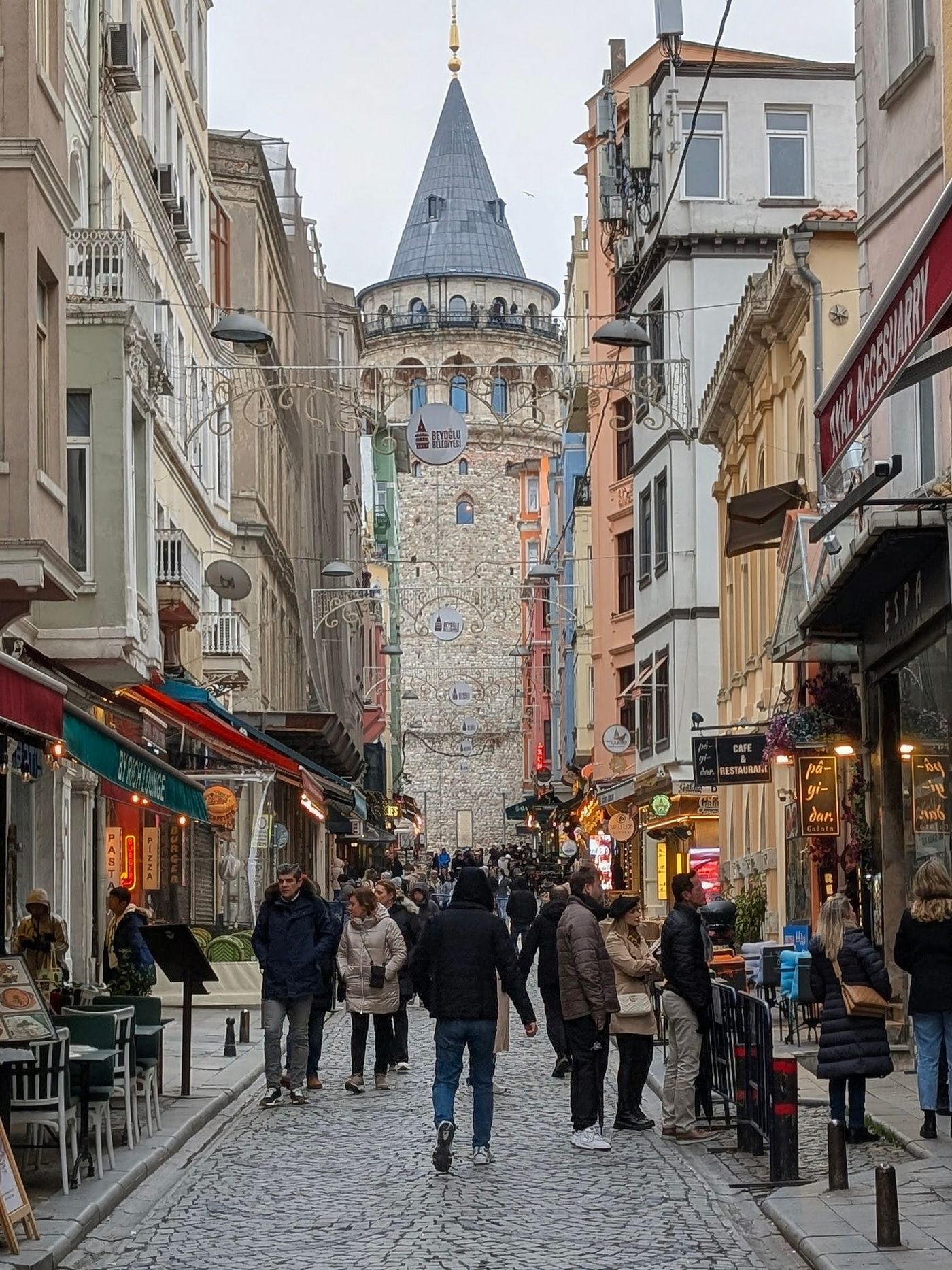
I’m in the fourth week of a one-month stay in Istanbul, living a short uphill slog from Galata Tower — that medieval exclamation point in the skyline, now supervising a daily parade of selfie sticks and espresso cups.
Galata is busy in a way that feels permanent. Not frantic. Just fully inhabited. Tourists orbit the tower like it\s a magnet. Locals on their scooters thread through them with the efficiency of people who have somewhere to be.
There are hundreds, maybe thousands, of three- and four-story buildings stacked around me, each leaning into the next like they’ve been sharing rumors for centuries. Every doorway holds a story. Some of those stories involve inherited property and long-settled accounts. Others involve roommates and late rent and a cousin looking for work.
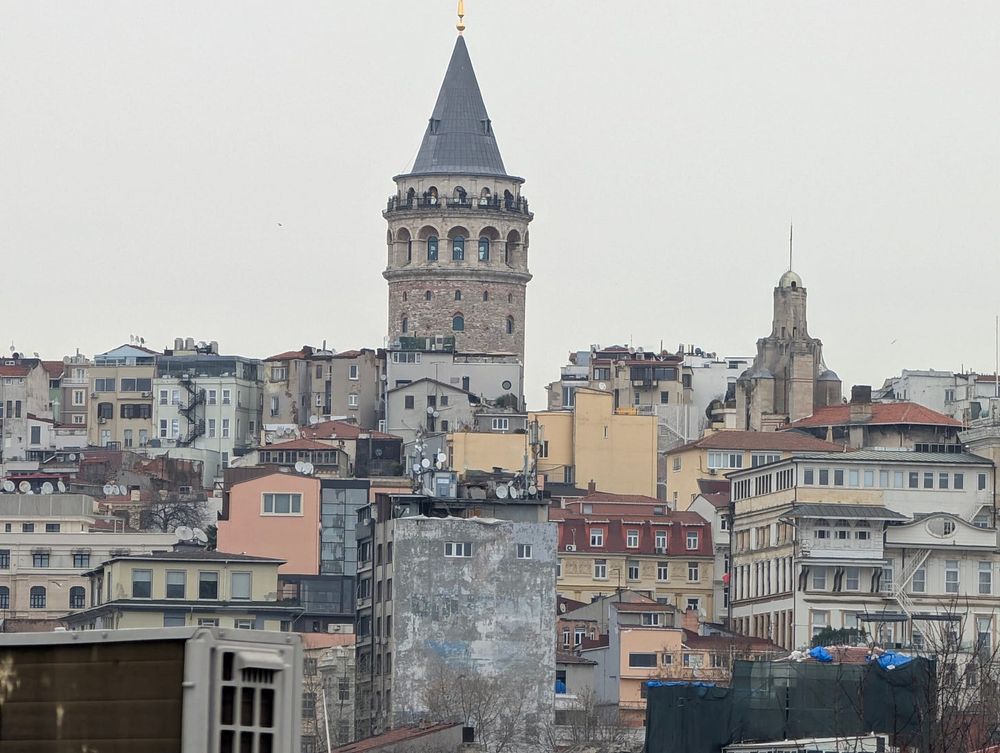
If you walk long enough, you’ll find water in every direction. Ferries cut across the Bosphorus with commuter indifference. Cargo ships idle beyond the shimmer. On one corner, accumulated wealth sits comfortably at a café table. On the next, a man hustles perfume that may or may not be perfume. The economic contrast is visible but not theatrical. It’s just there. Like weather.
My Turkish vocabulary is heroic in its brevity. I can greet you. I can thank you. I can order food if you’re patient. Beyond that, I am a mime with a credit card. Fortunately, many people here speak some English, fragmented but generous. Between gestures, shared nouns, translation apps, and mutual stubbornness, we manage surprisingly well. Communication turns out to be less about grammar and more about goodwill.
I’ve met a number of people in this neighborhood, but two men have quietly anchored my days.
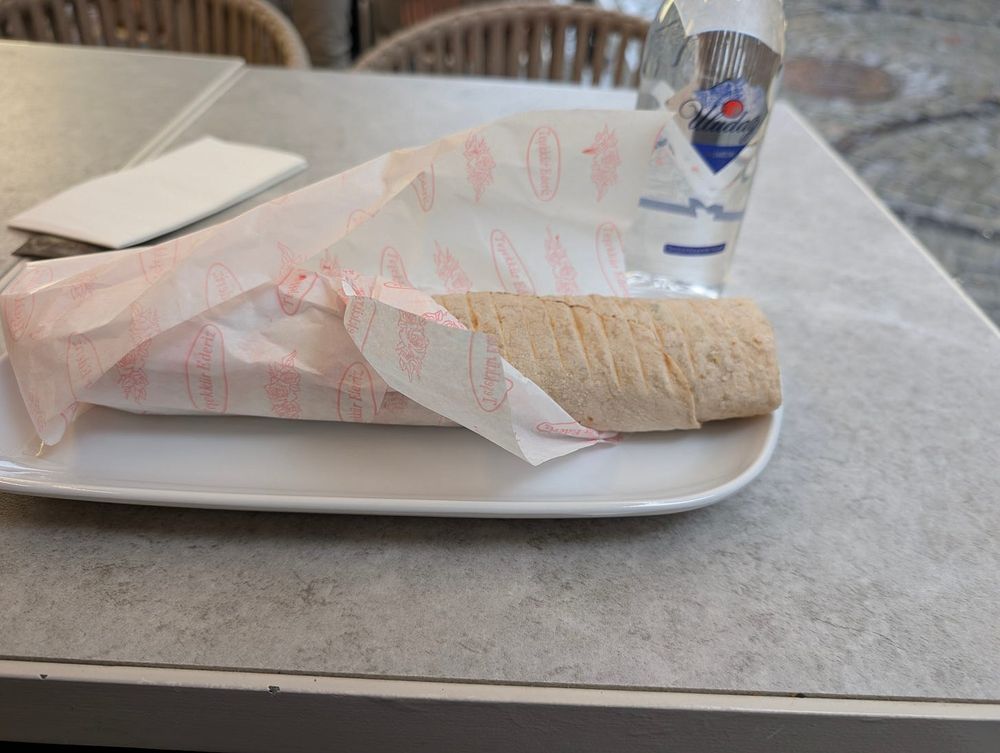
The first I’ll call “U.” He runs a kebap stand just around the corner. Mid-forties, compact, perpetually on the verge of laughter. Not the retail kind. The real thing. The first time I stepped into his shop, he clocked my linguistic incompetence immediately and took it upon himself to tutor me. What to say. How to say it. What to order here. What to order elsewhere. A public service.
When business slows, he pulls up a chair at my sidewalk table. We talk about America. We talk about Galata. We talk about soccer, women, and the ongoing mystery of both. The universal male curriculum.
He tells me he’s tired. He works constantly. The shop is small but relentless. Family depends on it. There’s no complaint in his voice. Just fact.
One afternoon while we’re talking, a delivery driver in a faded jacket steps up to the counter and orders lentil soup. He counts out coins slowly. Comes up short by a few lira. There’s a brief pause — the quiet arithmetic of thin margins. U waves it off, fills the bowl anyway, and hands it over without ceremony. No speech. No halo. Just soup.
Another afternoon his brother — also his business partner, because that seems to be how things are done here — stops by. They confer rapidly in Turkish. His brother disappears into the back and returns with three small glasses of cloudy white raki. We toast. We down it. It’s warm, licorice-heavy, and not interested in your approval. We embrace cheek to cheek, right then left. No awkward half-measures.
Then he turns without missing a beat to serve a perfectly grilled tavuk şiş to a Japanese tourist in an Aspen hoodie. Somewhere in that exchange — Turkish grill master, American deck shoes, Japanese outerwear, Colorado branding — you can see the entire global economy condensed into one sidewalk cafe.
The next day I walk past and he runs into the street shouting my name like I’ve just returned from a hero’s campaign. We sit. We dissect the previous night’s Champions League result with scholarly seriousness. He feeds me again. I try to pay. He refuses with theatrical offense. I leave his worker a strong tip instead. We hug. This has happened several times now. Same warmth. Same refusal to treat me like a transaction.
Today his shop is closed for Ramadan. He never introduced himself through religion. Never made a point of it. He simply closed the door and went home.
The call to prayer floats over the hill five times a day. Neither of these men stops mid-conversation when it sounds. It washes through the streets like weather — constant, present, but not interrupting the work at hand.
My second friend is “H,” the owner of the building where I’m staying. I’m on the fourth floor of a walkup. The stairs are not subtle. The view is worth the negotiation with gravity.
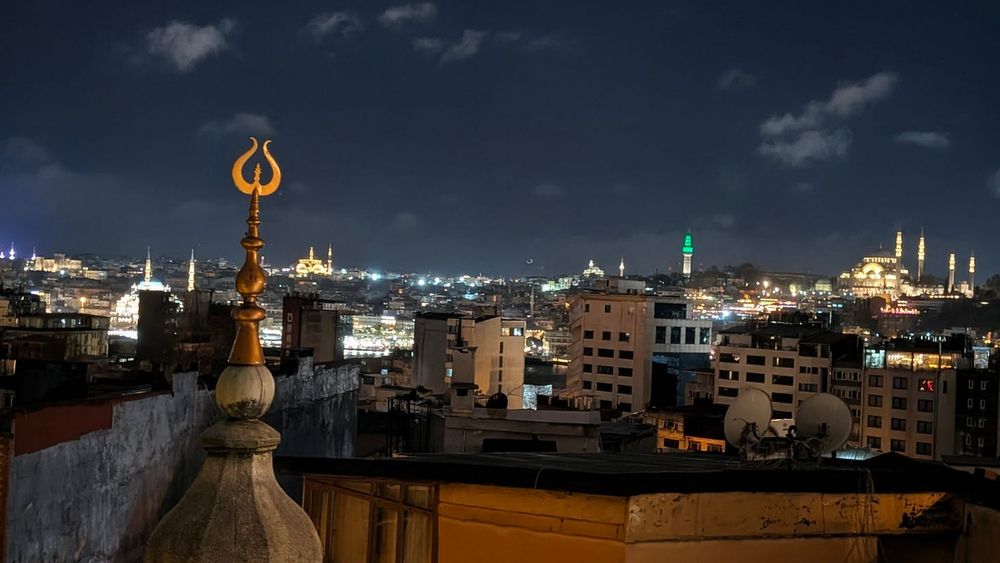
H offered me a lower floor with a sly grin — a gentle joke about age, I suspect. I declined. I’ll take the climb.
He and his brother inherited the building from their father. They run an LED lighting shop on the ground floor. It’s half storefront, half community center. Plastic chairs. Tea glasses in circulation. Customers drift in and out. Friends stop by and settle in for debate.
I’ve spent hours sitting with H and his wife, “D.” We drink Turkish coffee and tea. We share simit. H shifts easily between animated conversations in Turkish — politics with one visitor, soccer rivalries with another. I don’t grasp the specifics, but I understand tone. Volume rises. Laughter follows. We communicate through DeepL and Google.
He asks about my travels. He is genuinely unsettled that I travel alone. The idea violates something fundamental in his worldview. Movement, to him, is communal. Family-centered. The notion of voluntarily wandering the globe solo feels slightly tragic. Or slightly insane. Possibly both.
D asks for my Substack URL and reads while we talk. Every so often, she looks up at me with an expression I can’t decode — curiosity, mild suspicion, maybe literary critique. Fair enough.
H is a businessman. He wants to know about America. About supply chains. About China. About Trump. I answer plainly. He listens carefully. I ask him about Turkiye, Syria, Russia. He is well-informed, articulate. He makes it clear he is a practicing Muslim. Today his shop, too, is closed for Ramadan.
Both men call me “big brother.” Partly because I’m older than they are. Partly because I’m taller and thicker — a normal-sized American, which here translates to “retired defensive lineman.” In this culture, age carries weight in a way it no longer does back home. There’s a subtle deference that feels both flattering and foreign.
They clock my brighter hoodies and Margaritaville deck shoes immediately. I am not camouflaged. In a neighborhood of mostly neutral palettes, I look like a visiting cruise director who took a wrong turn. And yet the noticing here feels observational, not evaluative. I’m visible, but not judged. That’s a subtle kindness.
My oldest son stopped through for a brief visit. He met both men in passing. I watched H shift instantly into host mode — expansive, proud, welcoming. Family is infrastructure here. When my son walked in, I wasn’t a wandering foreigner anymore. I was a father. That translated cleanly.
U and H are different men. Different temperaments. Different economic positions. U works a grill on tight margins. H manages inherited property and a lighting business in a neighborhood where rents and tourists keep climbing. The disparities on this hill are real. You see them in overcoats, in shoes, in who owns and who rents. But neither man performs resentment. Neither performs superiority.
Whatever the sport, they and I love the action and the hometown team. We look at each other incredulously and ask why women behave the way they do, as if this mystery has only just been discovered. We want to understand the larger world, but we don’t want it poisoning our joy. We hold our beliefs close without swinging them like clubs.
Galata hums with collision — wealth beside hustle, tradition beside tourism, Ramadan beside rooftop cocktails. The tower watches. The ferries keep cutting across the water.
And in the middle of all that movement, two men still pull up a chair. They pour tea. They argue about soccer. They feed a foreigner who can’t pronounce half the menu. They call him “big brother” like it makes perfect sense.
It does make sense.
This is how the world keeps itself from splintering completely.