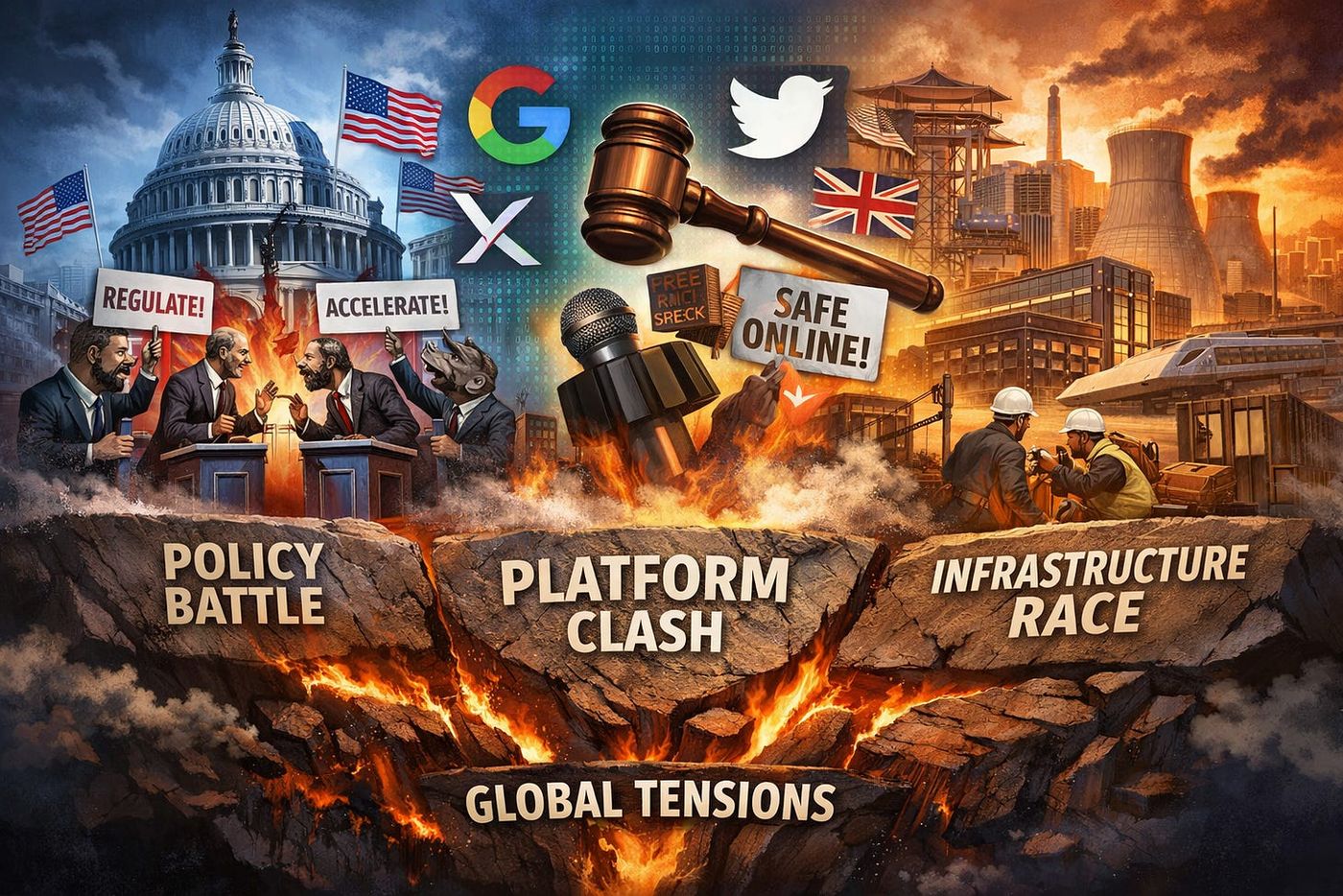
Artificial intelligence isn’t racing forward on a single track. It’s fighting a three-front war (at a minimum), and none of the fronts agree on the rules. Policy, platforms, and power infrastructure are pulling against each other like tectonic plates, and the friction is starting to throw off heat.
What looks like a regulatory debate is really a struggle over who gets to move fast, who gets to slow things down, and who quietly builds while the rest argue.
Front One: Washington Eats Its Own
In the U.S., the AI conversation has escaped the hearing room and gone feral on the campaign trail. Roughly $150 million is lining up to influence who writes the rules—or who makes sure there aren’t any.
On one side are the accelerationists, the “AI hawks.” Industry-backed, VC-fed, caffeine-rich. Their gospel is simple: one national framework, light touch, no state-level interference, no brakes. Fifty regulators is chaos; one regulator who listens is efficiency. Speed is safety. Delay is surrender—mostly to China, but also to fear.
They don’t deny risk. They just believe risk should be handled after deployment, preferably by the same people who shipped the product.
Across the aisle, and awkwardly across party lines, are the “AI doves.” Former lawmakers with longer memories and less imagination. Their pitch is equally blunt: unchecked AI burns trust, and burned trust invites backlash. They want guardrails—testing, transparency, accountability—and they’re not inclined to neuter states should Congress stall. National security isn’t a talking point here; it’s the point, they say. Advanced chips don’t belong everywhere. Pretending otherwise, handing potential enemies a rope, is how rivals leapfrog.
This is both a culture war and a timing issue. One side wants velocity. The other insists on a legitimacy they can’t define. Both ultimately want control of the hottest tech of the generation. Both insist they’re saving innovation. Both prey on the fears of the semi-informed public. It’s a Roman spectacle.
Front Two: Speech, Free and Dear
A quiet shock ran through the industry when Google began to publicly criticize the UK’s Online Safety Act—a law built to force platforms to police speech “harm” aggressively, under threat of fines large enough to sting even trillion-dollar beasts.
Google’s complaint isn’t subtle: broad rules plus massive penalties equal over-censorship. When survival depends on not being fined, nuance dies first. Speech, they argue, gets rounded down, innovation starts to whimper.
The irony, thick enough to spread on toast, is that Google has spent years being accused of exactly that behavior. But irony doesn’t stop market shifts. Something changed.
Part of it is competitive pressure. When Elon Musk turned X into a free-speech experiment, he forced every other platform to choose: double down on moderation—or risk looking like the hall monitor while users wander off.
Part of it is political. U.S. figures increasingly frame Europe—and especially the UK—as sliding toward speech control rather than speech safety. The argument isn’t academic anymore. It’s diplomatic. Trade deals now carry a free-expression subtext. Platforms are discovering that “global standards” fracture the moment sovereign governments remember they’re sovereign.
This platform fight mirrors the U.S. regulatory split perfectly. The precautionary model looks a lot like the doves. The laissez-faire model smells like the hawks. Same argument, different arena, louder microphones.
Front Three: Concrete Beats Commentary
While the West debates ethics and enforcement, Asia pours concrete.
The AI arms race ultimately runs on electricity, land, cooling, and fiber. Compute doesn’t care about op-eds. It cares about uptime.
That’s why places like Johor, Malaysia have become improbably central to the future. Data centers are sprouting fast enough to exhaust local engineers and blow overtime budgets. Industrial parks sprawl across hundreds of acres, financed by overseas capital that prefers boring certainty to ideological purity.
No accident. It’s regulatory arbitrage with a hard hat. Capital goes where friction is lowest, permits are fastest, and policy arguments happen elsewhere. Taiwan is opening a “sovereign” AI data center with a 15-megawatt facility hosting the Nvidia-powered “Nano 4” supercomputer, the state of modern computing art. Japan is considering a nuclear restart to attract chipmakers and data centers. Microsoft is looking to invest over $17 billion in India.
While Western democracies negotiate what AI should be, Asia focuses on what AI needs.
The Throughline Nobody Likes
These fronts aren’t separate stories. They’re a Mobius loop.
Loose regulation accelerates infrastructure elsewhere. Tight regulation inhibits and fractures the tech platforms. Platform fragmentation feeds national policy backlash. Policy paralysis sends capital offshore. Offshore build-outs reduce Western leverage. Repeat.
The uncomfortable truth is this: internal disagreement is becoming a strategic liability.
If the hawks win outright, infrastructure will explode—but so will foreign regulatory backlash and trust erosion. If the doves slow things down too hard, innovation won’t stop. It will relocate. Either way, the build continues. Just not always where the arguments are.
The AI war won’t be won by the loudest polemics. It will be won by whoever aligns law, legitimacy, and load-bearing steel before the feedback loops lock in.
Right now, the East is building.
The West is still deciding what to argue about.
Same as it ever was.