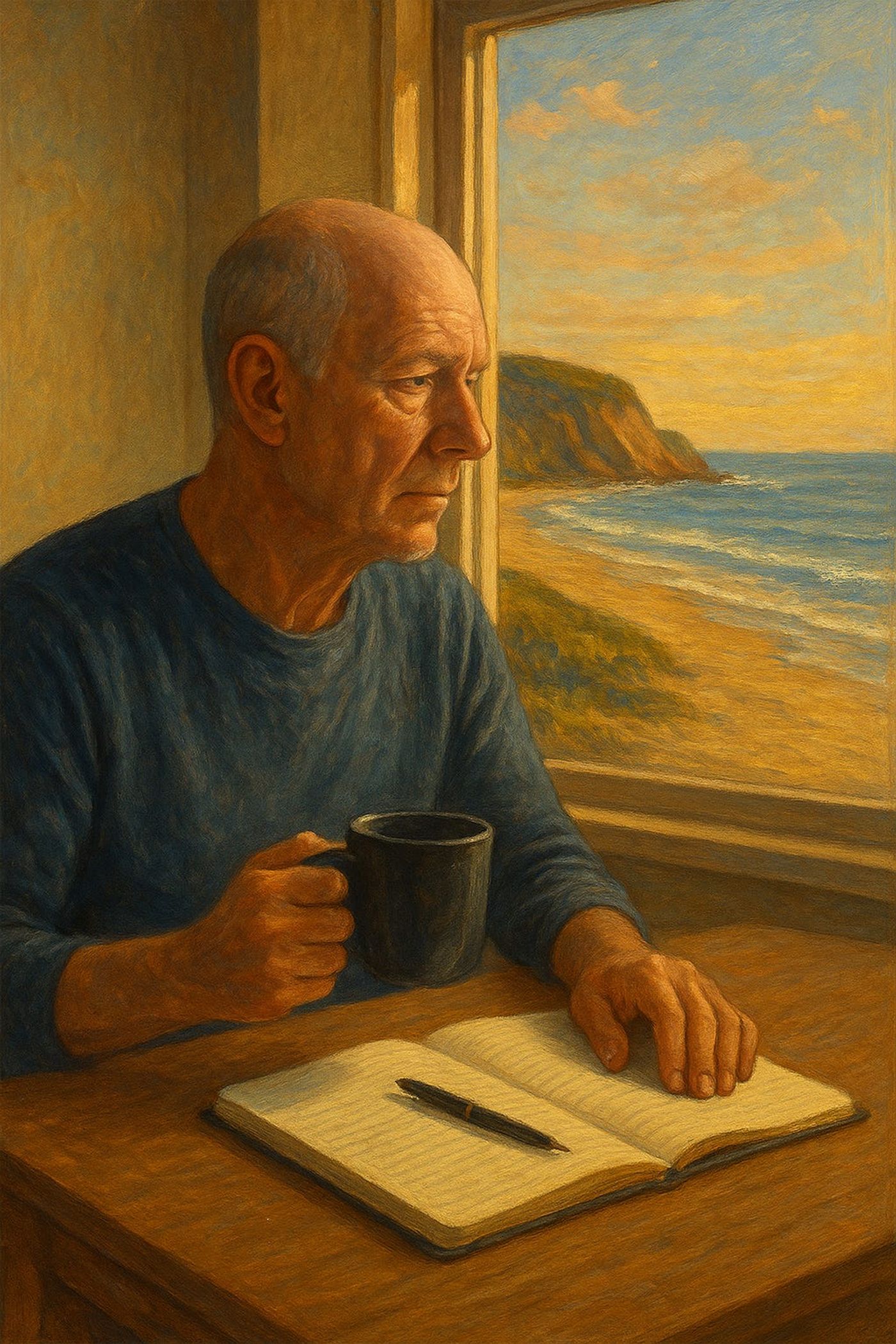
There is a trope that says good material can only come from a bloody heart. That the fire goes out when the bleeding stops.
I’m here to report, at sixty-nine, that the bleeding has stopped and the material is only now getting interesting.
This is not a victory lap, or a trauma memoir in a happier font. This piece is about me because it has to be, but it really isn’t about me at all.
This is a field note from the far side of the work nobody applauds, written by a man who spent a lifetime performing (onstage, offstage, in marriages, in boardrooms, in the lonely locker room of his own head) and who finally took the costume off and didn’t expire.
What follows is me wrestling with what a writer does when the old engine - pain, rage, the exquisite fuel of being wronged or wrong - finally cools and the new one starts turning so quietly you almost miss it.
There are no war stories here. The war is over. I’m describing the DMZ, the strange country where the shooting has stopped but the memory remains. Turns out you can write from there.
I don’t have any further trauma to work through at this point. I have done what Jung would call the shadow work, the long, ugly, necessary staring contest with every part of myself I used to shove in the cellar. It’s quiet down there now. The lights are on, the doors are open, nothing growls when I walk past. So what happens when that job is finished and you still want to write?
I’m sixty-nine. I’m not numb. I’m not medicated into serenity. I’ve been through the wars. The pain was real, when it was real. I’ve lived out loud for a long time.
On actual stages (lights hot enough to burn your retinas, greasepaint that tasted like ambition and fear). Actor, singer, playing guitar in bars where the tip jar was half cigarettes and half mercy. Game days as a kid when thought I could outrun gravity. Then other stages nobody buys tickets to: lecture halls, corner offices where I learned to speak in quarterly directives and half-truths, a delivery room where I became somebody’s father, then the sidelines as their coach. Divorces, bankruptcies, sedatives, chemical rocket fuel, the door to the sideways kingdom. Been there, done that, as the boomers say..
From Dollar Store ramen to Michelin stars. Signed the contracts, signed the divorce papers, performed the human repertoire. I did the performance nobody claps for, dragging every ugly, frightened, pompous, wounded piece of me onto the stage and making them take a bow too. Kept it there until the whole cast could stand there without a knife fight.
Now that show is closed. The house lights came up, the audience went home. I walked out the stage door at sixty-something with nothing left to prove, no critics to impress. My biggest issue now is whether my shoulder lasts longer than my knees.
Sold all the old costumes. Sold everything in fact, save a few boxes in a Georgia storage locker and what I can carry onto an airplane. My daily life is pretty boring from the outside these days. I write, walk the beach, cook, sit in the whirlpool, write some more, watch the sunset, walk the beach some more, cook. Take a shower, talk to the kids, write some more, walk the beach. And that’s pretty much my day. I would quite like to write about my day but I just don’t think there’s much to say.
I am a nomad, no fixed address or car title, no furry critters on the sofa. All by choice. But no trauma. The kids and I have a great relationship. I’ve settled accounts with the moms and the exes. My only true regret is that I don’t have anyone to share this space with, but that’s on me, because I’m a choosy little shit.
And I’m learning how to write from the place where the pain is no longer the engine. Where the engine is something quieter, slower, maybe even a little embarrassed to be happy.
The first morning I noticed the silence, I thought the ocean had gone mute. I stood on the balcony of a Portuguese condo, coffee in the Yeti mug that my kids gave me as a going-away, waiting for the old soundtrack. The low-grade emergency siren that used to score every sunrise. Nothing. Just gulls arguing over a dead crab and the soft mechanical slap of waves against the sandstone cliffs.
That was two years ago. I’m still waiting for the other shoe to drop, but apparently it got lost in the move.
People keep asking has the fire gone out. I tell them the opposite happened. The artist in me did a juice cleanse and discovered Pilates.
.
Pain was a terrific stage manager: loud, merciless, always knew where the spotlight should land. Peace is not so organized. It forgets to call places, leaves the curtains half-open, lets the actors mumble. But the audience (if there still is one) can hear every breath. That part is new.
Yesterday I spent forty minutes trying to describe the exact color of the foam when the tide pulls back over white sand. Kinda like the memory of cigarette smoke in a hotel room you checked out of in 1977. I wrote six drafts. All of them true, none of them useful.
The trick, I’m learning, is to treat contentment the way I once treated tragedy: with deep suspicion. Interrogate it. Ask it rude questions. Where were you when I needed you at 3 a.m. in that Plano motel with the broken ice machine? Why show up now, wearing flip-flops and a smug little smile?
Happiness doesn’t like being grilled; it gets shy and folds in on itself. You have to corner it in small spaces (the produce aisle, the laundromat, the minute after an orgasm before language comes back online).
I no longer wake up with a head full of unfinished arguments. Instead I wake up with grocery lists and half-remembered Portuguese verbs. The muse has apparently taken up birdwatching. She texts me photos of willets and says things like “Notice how the light hits the scapulars.” I want to shake her and scream WE USED TO SET CARS ON FIRE. She just shrugs in third person and hands me binoculars.
I used to think the work was excavation. Turns out it’s mostly just sweeping the floor.
Sixty-nine is a ridiculous age to be surprised by joy, but here we are. The heart keeps its own counsel. One morning it simply closes the wound the way an oyster closes around a painful grain, suddenly a desirable gem. You look down and the scar is silver, cool to the touch, and the blood that once signed every contract has turned into ordinary ink.
So I write about the ordinary now, which is much harder than telegrams from the front. Ordinary asks you to notice that the salt smells different at dawn than at dusk. That loneliness can be spacious instead of sharp. That a man can spend an entire paragraph on the sound a refrigerator makes when it’s the only other creature awake in the house and not feel sorry for himself.
The engine is still turning. It just runs on something less theatrical than hemorrhage. Call it curiosity, call it gratitude, call it the low spark of a life that finally fits in its own skin. It’s quiet enough that I can hear my own breath.
And for the first time in sixty years of making noise, I don’t feel the need to apologize. I do, however, think I would still be a better linebacker than that Falcons guy I watched yesterday.