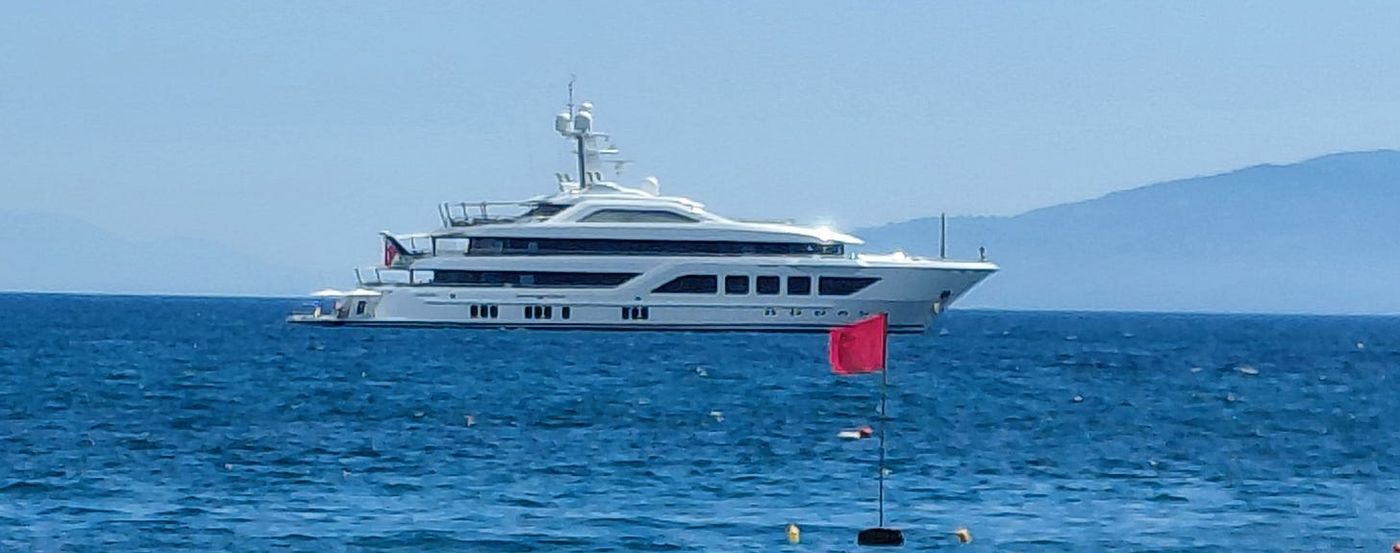
The trail went up for three hours and we all stopped pretending we were enjoying it somewhere around the second. Twenty of us, more or less — expats, a couple of long-term tourists like me, the loose federation of people who end up on a Saturday hike in a country none of them are from. By the top everyone had gone quiet in the good way, worn down to the version of themselves that doesn’t perform. The bay opened up below, the islands sitting in it like things placed. Even the people I didn’t know were beautiful for a minute, the way tired people are.
I spent most of the climb with Jo. Easy company — she carried half the conversation and didn’t need me to carry the other half well. Her friend Maren was up ahead somewhere, talking. You could hear Maren before you could place her: she talked about her dogs the way some people talk about God, and about sex the way other people talk about the weather, openly and often and to no one in particular. Gender studies degree, San Diego State. Family money, the soft kind that means you never have to say what you do. She called herself an influencer. As far as I could tell, the thing she influenced was her own itinerary.
I didn’t think about her much. I’m fairly sure she didn’t think about me at all.
There was a man named Rex on the climb, fifty-ish, who walked beside me for a stretch in the morning and talked about his knees and his divorce and a boat he used to own. Decent, dull, the kind of conversation you forget while you’re having it. I mention him only because the man who turned up that evening was someone else.
The day slid into dinner the way those days do. Nobody decides; you just look up and the light’s gone gold and you’re at a long table at a place above the water, and there’s wine, and everyone’s loose from the climb. The view did most of the talking. We were happy in the low, animal way of people who’ve earned their chairs.
Then somebody made the joke. A near-twisted ankle on the descent, somebody’s knee, and a man down the table said it was a good thing nobody actually got hurt, because the insurance company would’ve found a way to decline the claim. Everybody laughed. It was true and it was ours; nobody at that table loves an insurance company.
Rex picked it up. He leaned into it. The new version of him had been sharpening all day, and now it had somewhere to go. He took the joke and stretched it, slid it toward the shooting back in the States, the CEO, the kid they’d arrested for it. He watched Maren while he did it, not the rest of us. Testing distance. Seeing what would land.
Maren laughed once, then spoke into the space like she was filling it on purpose.
“It would be good for the world,” she halted for a split second, then decided to proceed, “if people finally declared war on the corporations. There should be more erasures.”
She said erasures like it was nothing. Like ordering another bottle. Like continuing a thought she’d already decided was correct.
Someone at the table made a small sound of agreement. Someone else didn’t.
Alexandra cut in immediately. “That’s not—” she started, then stopped herself, recalibrated. “This isn’t the place for that.”
Maren didn’t stop. She didn’t even look at her properly. “It is the place,” she said, still calm. “It’s always the place. That’s the problem.”
Rex laughed too quickly, trying to stay in the current of it. Nobody was looking at him now.
I set my glass down. “Sounds like you’ve got a plan,” I said. “Where would you start?”
That’s when she looked at me. Not earlier. Not during the climb. Not as background. Now.
“People like you,” she said, “can’t even see it.” A pause. A small smile that wasn’t warmth. “You’re an old white male running an old white male frame. That’s the whole problem. The frame’s expired. The sooner you are gone the better. That’s where we start.”
She didn’t know me from Adam’s housecat. We hadn’t traded forty words. Everything she’d just said about me she’d read off the outside of the box.
I didn’t answer. There’s a skill to not answering — I ran companies for a living, sat across from people who said worse with better grammar — and the skill is mostly letting your face do nothing while the rest of you decides she isn’t worth the heat.
The room didn’t move right away. That was the strange part. It didn’t explode. It just held. Jo did something small with her glass. Then she said, “Then when is the time, Alexandra? Where is the place?”
It wasn’t a question looking for an answer. It was a refusal to let the room pretend it had rules.
Alexandra stood in it for a second, then said quietly, “This is not how this works,” like she was speaking to her wine glass. Nobody responded to her.
“Ever kill anybody, Maren? Would you know what to do?” Maren, Jo, Alexandra, even Rex, glared at me.
For a minute there was only the sound of the table remembering itself. Then Laura, who I think only wanted the evening back, said some tentative something about a dog she used to have, and that was enough. The room took it. Gratefully. Like a handhold.
Maren turned with it immediately. “What kind of dog?” she asked. Her voice had changed back into something usable. The table followed. I didn’t.
I let a few minutes pass and took my wine out to the porch.
The bay was black now, the island lights low on the water. Alexandra came out after a bit. “I’m sorry,” she said. “She’s drunk. She’s not—she’s actually a good person, she just—”
“It’s fine,” I said. It wasn’t, but it was what you say when you’re done.
I walked home along the water. I wasn’t shaken. That would be a better story. I was just pissed. With her. With the whole clean, careless confidence of people who think the room will always absorb what they say. No matter how absurd.
Jo’s voice stayed longer than the rest of it.
Two days later I ran into Maren on the promenade. Quite by accident. She had the dog. Of course she had the dog. She lit up at it the way she had lit up at the table — real, immediate, uncomplicated. The rest of her rearranged around it.
We exchanged pleasantries. She asked if I’d recovered from the hike. I said I had. I asked the dog’s name. She told me. I forgot it as soon as she said it.
“Have a great afternoon, Maren.”
“Yeah, thanks, you too.”
The sea was a magnificent blue. The living noticed.