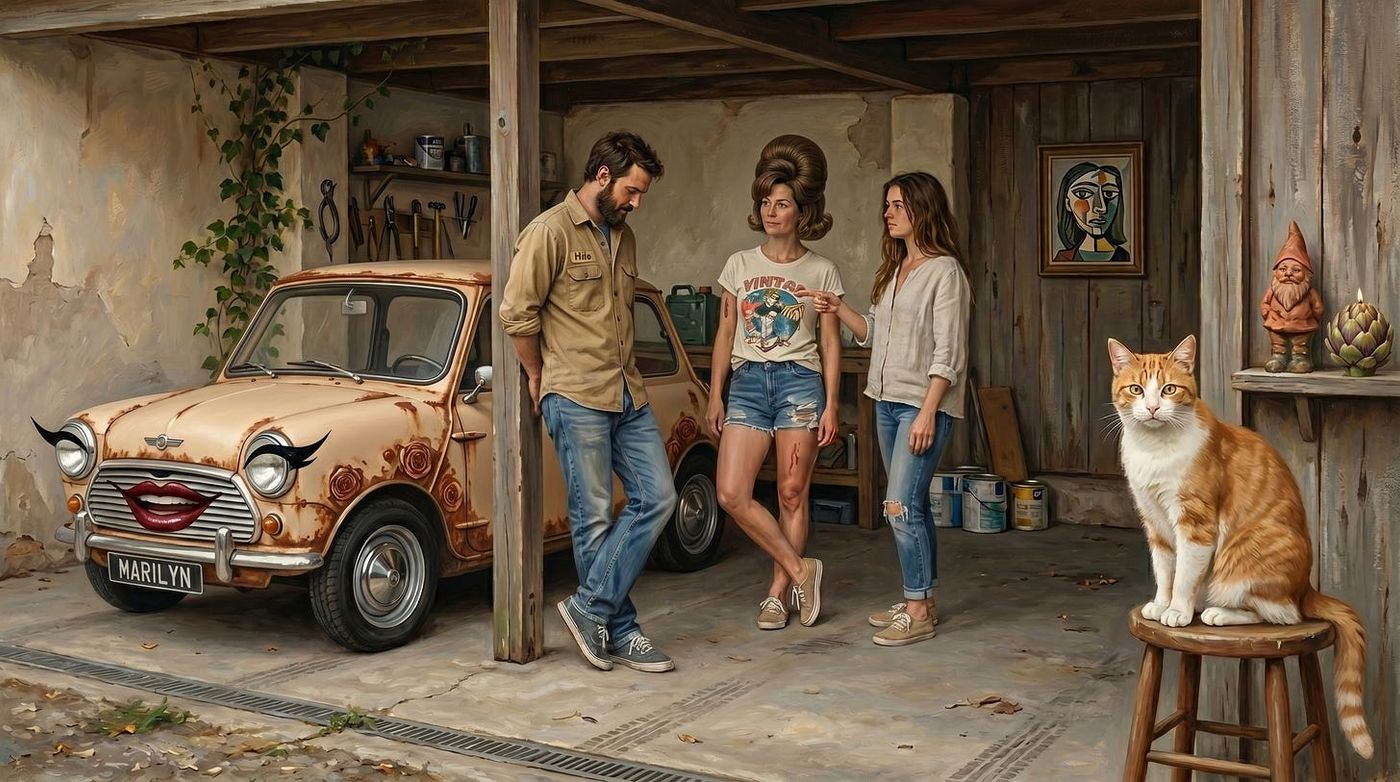
We shot each other in the leg twice a while back, and I guess you could say we bonded over it.
The first bullet was mutual stupidity, the kind that arrives wearing flip-flops and carrying a six-pack of IPAs. We were in the scrubby backyard behind the half-collapsed carriage house on Route 27, the one the county keeps meaning to condemn but never quite gets around to. Milo had found his grandfather’s old service revolver in a shoebox labeled “tax documents 1987–1994,” and I’d produced the little snub-nose .38 my ex left behind like a bad breakup souvenir. Two guns, two consenting idiots, one dare that started with “bet you won’t” and ended, predictably, with “holy shit you actually did.”
The first round each of us took was through the meat of the outer thigh—clean, almost polite, the way you might graze someone during a particularly passionate tango. We both screamed in that embarrassed, animal way people do when pain reveals how theatrical they’ve always been. Then we sat there on the cracked concrete, blood mixing with spilled beer, breathing like we’d just run up the down escalator at the mall.
Milo, ever the romantic, lit a cigarette with shaking hands and said, “Your turn.”
I looked at the little black hole in his jeans, already blooming like a rusty rose, and thought, ‘this is the most honest thing we’ve ever done’.
So I shot him again. Same leg, four inches lower. He shot me back—same deal, second verse, same thigh. The agreement was unspoken but ironclad: once more each, no higher, no arteries, just enough to make the story unusable in polite company.
Afterward, we didn’t go to the hospital right away. We sat there until the crickets decided we were background noise again. Milo kept saying “we’re even now,” like it was a receipt he could frame. I kept nodding because nodding is cheaper than crying.
When the pain finally got ambitious and started climbing our spines like ivy, we hobbled to the ER together, arms around each other’s waists like the world’s worst three-legged race team. The triage nurse looked at the matching bullet wounds, looked at our faces, and didn’t even bother asking. She just sighed the sigh of someone who’s seen every possible way humans can ask to be loved.
They dug the slugs out while we were both high on fentanyl and bad decisions. Milo’s came out in one piece; mine fragmented like the promises I make myself every January. The doctor held them up to the light like wine samples.
“Identical,” he said, deadpan. “Y’all shop at the self-service bad-idea store?”
We laughed until it hurt worse, then laughed some more because the hurting was already maximum occupancy.
Now the scars look like two sloppy parentheses on each thigh, facing each other. When we stand side by side in the mirror they almost kiss.
People ask how we met. We tell them the boring version: college, mutual friend, keg party, the usual. But late at night, when the streetlights turn the bedroom ceiling the color of weak tea, one of us will reach over and trace the little puckered moon on the other’s leg.
And in the dark, very quietly, we’ll whisper the truth to each other: We shot each other in the leg twice. And neither of us missed.
The scars had settled into quiet punctuation marks by the time spring 2022 rolled in like a late bus. We’d stopped mentioning them. Instead, we talked weather, the rent, the way the city now tasted faintly of burnt wiring and misplaced optimism. Milo Hamilton—full name, because he’d started insisting on formality after the fentanyl wore off—had moved into the carriage house proper and did some work. I moved in with him. Neither of us could explain it without sounding like a Nicholas Sparks novel ghostwritten by a depressed fisherman.
So the collecting started with the artichoke-scented candle.
Milo found it at a pop-up market in the old industrial district, the kind of place where artisanal everything costs more than therapy. The vendor claimed it was “beeswax-infused with the soul of the vegetable,” which Milo took as a personal challenge. Probably as a personal insult. He lit it the first night we tried sleeping in the same bed. The smell was not romantic. It was aggressively green, like someone had shoved a farmers’ market into a sauna and then whispered “self-care” through the steam.
We laughed until tears ran sideways. Then we kept it burning anyway. It became our truce flag: if the candle was lit, no old arguments were allowed to resurrect themselves. The room smelled like a vegetable had taken out a contract on perfume.
Then came the garden gnome.
We didn’t buy it. It arrived on the stoop one Tuesday, no note, just a ceramic little solo in a red hat, one eye winking like he’d seen our police reports and wasn’t much impressed. Milo named him Reginald. Reginald the Gnome. We put him in the tiny backyard patch where nothing was growing except anxiety and crabgrass. The first acid rain of the season - the kind that leaves faint etchings on car hoods and makes the news anchors high - Reginald sat there unbothered, grinning through the maelstrom.
The rain smelled like pennies and disappointment. Milo said it was the city crying for its childhood. I said it was the city crying because rent was due. We stood on the porch watching Reginald get baptized in chemical sorrow, arms around each other, the artichoke candle flickering behind us like a disapproving aunt.
Milo downloaded the sunset-rating app. “Golden Hour Oracle,” it was called. You point your phone at the sky, it assigns the sunset a score out of 10, then tries to sell you NFTs of the moment. Milo became obsessed. Every evening he’d drag me to the roof, phone aloft, narrating the algorithm’s opinion like a wine sommelier gone rogue.
“7.8. Solid but lacks emotional depth.”
“9.2! This one’s got notes of longing and industrial runoff.”
“4.1. The clouds are phoning it in.”
I pretended to hate it. I secretly loved it. The app became our new ritual, replacing the dare-you-to-shoot-me energy with something softer, stupider, safer.
Then the juice bar thing. It happened on a whim. There was this hole-in-the-wall on 4th that used to be a laundromat, now serving $14 smoothies with names like “Chakra Reboot” and “Forgive Your Parents.” We went after a fight about who left Reginald outside during the wood chipper incident. Milo ordered something green that tasted like lawn clippings and virtue. I got the beet one because I’m contrary. We sat at the counter under neon that buzzed like a trapped hornet, thighs touching under the table, scars brushing like shy lovers. That’s when he said it. I can tell you don’t believe me, but I swear every word is true.
And the Picasso.
We didn’t steal it. We inherited it. Milo’s aunt died, peacefully, in her sleep, clutching a rosary and a pencil she had named Dermot. Left Milo a storage unit full of things no one should own. Among the stuffed ferrets and boxes labeled “memories (do not open),” there was a small canvas, unmistakably Picasso, cubist, more or less female face staring out like it had been interrupted by a rude cannon. Probably worth more than both our livers combined. We hung it above the couch, right next to the smoke detector we’d disabled for the candle.
The painting watches us. Judges us. It approves. We’re pretty sure.
So now the evenings go like this: artichoke smoke curling toward the ceiling, Reginald chilling on the windowsill, the cubie chick frowning benevolently, Golden Hour Oracle chiming its verdicts, juice stains on our shirts, acid rain tapping friendly reminders on the tin roof.
We don’t shoot each other anymore.
We just sit here, two moon-faced paupers who accidentally built a life out of strange parts, listening to the world dissolve outside while the candle burns down to the heart and Reginald keeps the secrets. It’s not beautiful. It’s better.
Where are my manners? I’m Cyndy Lou, telling it slant, the way the light hits the holler at dusk when the mountains decide to keep their secrets a little longer.
Now we’re tucked into this little bungalow just outside Abingdon, Virginia, where the porch sags like it’s tired from holding up all our nonsense, and the roof tin sings when the wind remembers it’s Appalachian.
Milo Hamilton III, grandson of the great Milo Hamilton, voice of the Braves and the Astros - the man who could make a rain delay sound like poetry - is my co-conspirator in this quiet rebellion against the ordinary. His granddaddy called Hank Aaron’s home runs. We call time-out on the world, every morning, over coffee that tastes faintly of yesterday’s sins and tomorrow’s wait-and-see.
The scars? They’re our campaign posters now. Back in ’24, when the governor’s race got meaner than a copperhead in August, we rolled up our pant legs at a rally in Damascus. Two matching bullet holes, polite as parentheses, staring out at the crowd. “This,” Milo said into the microphone, voice steady as his grandfather’s play-by-play, “is what happens when two fools think they can out-dare each other.” I just stood there smiling, letting the thigh moons do the talking. We didn’t endorse so much as caution. The people listened. The governor won. He still sends us Christmas cards with pictures signed by his labradoodle.
We bicycle the New River Trail most Sundays, tires made entirely from recycled grocery bags and old flip-flops—green living with a side of irony. The path follows the river like a conversation with your grandma.
Reginald the gnome presides over our yard, a tiny exiled king. He’s weathered now, paint chipped, but still winking. There’s a feral tabby—orange and white, ribs like a xylophone—who won’t come within ten feet of us humans but curls up beside Reginald as if the gnome is the only thing in this world that doesn’t demand ablution. She watches us from the edge of the flowerbed, half-shadow, half-question.
A new artichoke candle burns in the kitchen window, defiant green scent curling out to meet the mountain air. We light it when the evenings turn thoughtful. A small stubborn flame in a world that prefers vanilla.
Then there’s the Mini. We found her in a field near Wytheville—an ancient Cooper, rust blooming like roses. Milo said, “She needs personality.” So we painted her: creamy skin tone, black eyeliner swoops around the headlights, red lips stretched across the grille in that famous half-smile. If Marilyn Monroe decided to become a car, she’d joyride through the Blue Ridge. We know this to be true.
One night last fall, Milo looked at me across the supper table—candlelight making shadows on his face—and said, real quiet, “Cyndy Lou, put your hair in a beehive for me?” No reason given, no occasion. Just a whim wearing his grandfather’s voice. So I did. Teased it high as vanity, sprayed it into submission. Walked out looking like 1963 had claimed me as a hostage.
We drove Mini Marilyn up to the overlook that night, top down, wind making my beehive tremble like it was trying to escape. Milo kept glancing over, grinning like a man who’d won at life, keep the change.
The Picasso still hangs inside, watching over the couch like a distracted lover. Reginald keeps his vigil. The cat keeps her distance. The scars keep their silence. And we keep pedaling the trail, two goobers who shot each other once and learned the hard way that love isn’t about the wounds. It’s about the stories you tell afterward, the ones that end with beehives and recycled tires and a governor’s labradoodle.
The world may not be our oyster but it ain’t a flaming pile of bear doo either. Gotta run. Milo says hi, by the way. Drive safe.