Why did Linda tase that dachshund? What did the mango say to you? We'll be taking your calls later.
The world inside my head is the one that actually makes sense. It always has been. Creating isn't expression. It's maintenance. When I stop creating, the big world moves in and starts rearranging the furniture.
The work doesn't ask you to suspend disbelief. It asks you to suspend the belief that belief is required. Come without your checklist of how things work. The critters run freely here.
Rick West was born into a body. primalbeet was born into a vibe.

The Current Stuff.
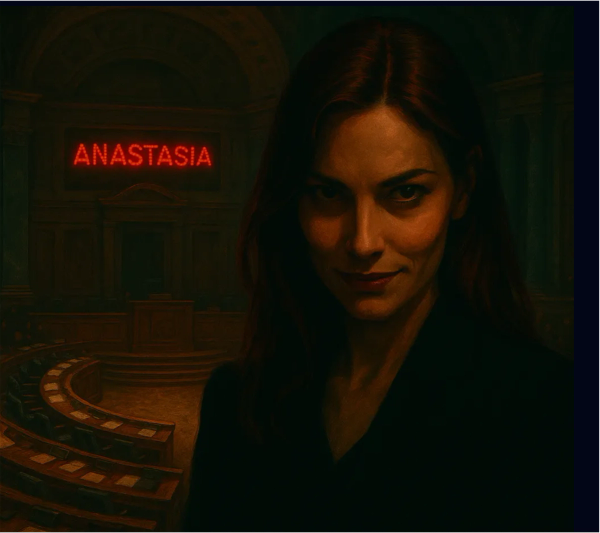 Fiction
Anastasia
I don't need to say a thing to dear Ms Counselor. You know what you did, you slutty little bad bad girl.
View in Fiction →
1. Ruth
1: Ruth
I signed up for the class on Tuesday, January 7th. Tom has woodworking at the high school on Tuesdays, and I didn’t want to sit home alone watching television shows about people renovating houses they’d never be able to afford. Been there, done that.
The class cost $240 for eight weeks. I wrote the check at the kitchen table while Tom made coffee. He asked what kind of class it was. I said art. He said what kind of art. I said painting, but that I wasn’t sure yet. The sign-up said simply “Creative Expression”, and showed a picture of an easel and some fruit.
I expected watercolors. He kissed the top of my head. “Have fun.” I had never taken a class just for myself. Nursing school doesn’t count. That was survival. This was something else.
The community college was fifteen minutes away. I arrived at 6:53 PM for a 7:00 PM class because I am the kind of person who arrives seven minutes early. Tom says it’s because I spent thirty years in hospitals where seven minutes could mean the difference between breathing and not breathing. He’s probably right.
The classroom was on the third floor of a building that still smelled like cigarettes, even though they were banned in 1998. Room 304. I checked the number twice. The space was large, cement floors, industrial lights, and tables covered in paint stains that looked like topographical maps of small, violent countries. The walls were covered in student work, some good, most of it trying too hard.
There were six others. I’d expected more. I’d also expected people my age, or at least people who remembered when MTV played music videos. The woman at the front—shaved head, jumpsuit splattered in paint that might have been intentional—was setting up a projector.
She looked up when I walked in. “Ah! A newbie. Welcome.”
“Yes. Thank you. I’m Ruth.”
“Ariel. Grab a spot. We start in five.”
I chose a table in the back, near the windows. Old habit. In nursing, you learned to position yourself near exits. Some habits don’t fade just because you’ve retired. I set out my supplies: watercolor set from the Blick art store on Murray Avenue, $34.99. Brushes, also from Blick, three sizes, $18.99 for the set. Pad of watercolor paper, 9x12, cold press, $15.99. All the prices still on my receipt in my purse because I might return them if this turned out to be a mistake.
The others filtered in:
A young person with an asymmetrical haircut and a t-shirt that said “eat the rich“ sat directly in front of me and immediately opened a laptop covered in stickers I didn’t understand.
A woman my daughter’s age, covered in tattoos—I recognized Frida Kahlo, Georgia O’Keeffe, and someone I thought might be Yoko Ono—set up an elaborate arrangement of materials that included a video camera, a roll of butcher paper, and what looked like a bird skeleton.
A man, early thirties, quiet, carrying a milk crate full of rusted metal pieces, took the table by the door. He didn’t look at anyone. Just started arranging his materials like he was preparing for surgery.
Two other students I didn’t get a good look at. They sat together, talking in low voices about someone named Shoji Yamasaki. I made a mental note to look that name up later.
At 7:00 PM exactly, Ariel turned off the projector and looked at us.
“Welcome to Experimental Mixed Media,” she said. “This is not a painting class. This is not a drawing class. This is a ‘what the fuck are you trying to say’ class, and we’re going to spend eight weeks figuring that out.”
She pointed at the student with the laptop. “Kai. What are you running from or toward?”
The student—Kai—didn’t hesitate. “Late-stage capitalism and my grandmother’s dementia. Both are eating everything I love.”
“Good,” Ariel said.
She pointed at the woman with the tattoos. “Morgan.”
“I’m demonstrating that beauty and rage are the same thing.”
“Better,” Ariel said.
She pointed at the quiet man with the metal. “Santiago.”
“My grandfather built this city. I’m trying to figure out what to do with the pieces.”
Ariel nodded. Then she turned to me.
“Ruth. In the back. What are you running from?”
I froze. My first instinct was to say: Nothing. I’m not running from anything. I’m a 64-year-old retired nurse taking a community college art class because my husband has woodworking on Tuesdays.
But that wasn’t true, was it? “I’m sorry?” I said, buying time.
“Nobody takes this class by accident,” Ariel said. “You could be taking watercolors downstairs with Barbara, who is lovely and will teach you to paint roses that look like roses. But you’re here. So what are you running from or toward?”
The room was quiet. Everyone was looking at me. I could feel my face getting hot. I hadn’t been put on the spot like this since nursing school, 22 years ago. “I used to paint,” I said finally. “Big paintings. A long time ago.”
“Why’d you stop?”
The question was so simple. The answer wasn’t.
“I had children. A job. A life.”
“And now?”
“Now they’re grown. The job’s done. And the life is... good. Quiet.”
Ariel tilted her head. “And you miss the noise.”
I felt something crack open. Something I’d sealed up so carefully when Hannah was born, then Luke, then the divorce, then the remarriage, then the decades of showing up for everyone else’s emergencies while my own dreams waited in the freezer next to the ice trays.
“Yes,” I said. It came out quieter than I meant it to. But everyone heard it.
Ariel smiled. Not a kind smile. A dangerous one.
“Good,” she said. “Now we can start.”
The class itself was unlike anything I’d ever experienced. Ariel projected images: Kara Walker’s silhouettes, Ana Mendieta’s earth-body works, Felix Gonzalez-Torres’s candy piles. She talked about art as ritual, art as exorcism, art as the thing you do when language fails.
She said: “Art school taught you to make beautiful objects. I’m going to teach you to make truths. It’s not the same thing.”
We didn’t paint. We didn’t draw. We did an exercise where we wrote down everything we’d ever given up and then folded the papers into boats and floated them in a bucket of water and watched the ink run.
My list included: painting, sleep, the idea that love alone could be enough, the belief that sacrifice meant something if the other person noticed. I didn’t show anyone my list. But when the ink ran and the words bled together, I felt something loosen in my chest.
Kai made a video of their grandmother forgetting their names. Morgan performed a piece where she stood still for eight minutes while reading statistics about women artists. Santiago arranged rusted I-beams into something that looked like a collapsed cathedral.
I sat there with my little plastic watercolor tray and three drugstore brushes and felt idiculous. Like I’d brought a lunchbox to an operating room.
At 9:01 PM, Ariel said, “See you next week. Bring something that terrifies you.”
I got to my car at 9:08. Tom would be home by now, probably making tea, probably wondering how the class went. I sat in the driver’s seat with the engine off. The parking lot was mostly empty. A streetlight flickered in that way that made you think about how everything eventually breaks down if you don’t maintain it.
I thought about Ariel’s question. What are you running from? I’d been running from noise for forty years. Toward quiet. Toward stability. Toward a life where nobody got hurt because I’d made sure all the sharp edges were covered.
Tom was quiet. Good quiet. The kind where you could hear yourself think. Where you could build a life that made sense.
Danny had been noise. All of it. The kind where you couldn’t hear anything except the chaos, and after a while the chaos became the only thing you knew how to dance to.
I’d chosen quiet. I’d chosen right.
But Ariel’s question—”And you miss the noise”—had landed like a diagnosis I didn’t want to hear. I started the car. Drove home. Fifteen minutes, three traffic lights, two left turns.
Tom was in the living room reading. He looked up when I came in.
“How was it?” he asked.
“Different,” I said.
“Good different or weird different?”
I thought about that. “Both.”
He smiled. “You going back?”
I set my purse on the counter. Hung up my coat. Walked to the kitchen and poured myself a glass of water even though I wasn’t thirsty.
“Yes,” I said.